

Can new Snapchat features help troubled teens?
- Written by: Matthew Fuller-Tyszkiewicz, Associate Professor, Psychology, Deakin University
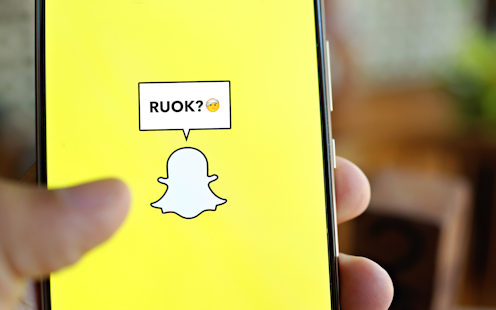
Snapchat has announced a new feature called “Here For You” that promises to “provide proactive in-app support to Snapchatters who may be experiencing a mental health or emotional crisis”.
The popular youth-oriented app is the latest to join a wave of social media platforms setting out to monitor and improve the well-being of their users.
Details are scarce, but it appears the Snapchat feature will monitor searches for key terms related to anxiety, depression, stress, grief, suicidal thoughts, and bullying. When these are detected, it will return links to helpful resources which Snapchat says will come from local experts.
This could mean, for example, that when a Snapchat user in Melbourne searches for “eating disorder” in the app, they are directed to credible content from Eating Disorders Victoria or the National Butterfly Foundation.
It’s a welcome move from Snapchat, because existing evidence suggests that conversations about mental health (including help seeking) are common online and that searching for such content is associated with lower well-being. Will it work? This likely depends on whether users actually click on the resources, and whether the resources are credible and lead people to seek treatment.
How have other social media platforms approached the issue?
On Twitter, Facebook, TikTok, and Instagram, users can block or report material, and Facebook also provides resources for users to engage directly with other users about their posts. These platforms, along with Pinterest, also deploy artificial intelligence to identify and ban content that may be viewed as harmful.
Facebook and Pinterest have also introduced more proactive measures, attempting to provide resources to users they view as being at risk for mental health concerns.
Read more: Twitter's plan to help young people not get too overwhelmed by bad news doesn't go far enough
Perhaps prompted by a number of suicides broadcast via the platform, Facebook has launched a suicide prevention initiative, which uses AI capabilities to flag users who may be at risk of self-harm or suicide. Pinterest prompts users to undertake mood altering in-app activities based on their searches.
Details are often hidden from sight
The exact details of these social media features are often hidden from view, with press releases speaking only in vague terms. The science that may (or may not) motivate the design of the features is seldom mentioned.
There is also an absence of peer-reviewed literature evaluating how successfully these features achieve their stated goals. Such information is essential to know whether these changes are having any effect, or whether further measures are needed to keep social media users safe and well.
Potential benefits of these initiatives should also be weighed against privacy concerns. Privacy experts are concerned that information on Facebook is not covered by traditional data protection and security laws. What’s more, Facebook has not shared details of privacy protection protocols that are in place for the initiative.
We need to know more about social media and mental health
Even if software gets better at monitoring and restricting harmful content, there are plenty of other ways in which social media platforms may lead to emotional crisis. While some of these issues are well known (such as unfavourably comparing oneself to others), some are newer and users need a certain level of online literacy to become less vulnerable to them.
New users need support to avoid falling prey to traps for the unwary, such as catfishing, false accounts and impersonation, or being misled by inaccurate or dangerous health recommendations.
We still don’t know much about what kind of interventions are more effective than others, and for whom. We know that simplistic solutions, such as putting warning labels on digitally manipulated images or temporarily banning users who post offensive content, have not been found to be effective.
Blunt instruments like these may not be sufficiently sophisticated to respond to different levels of need and may only provide a short-term fix to long-term issues. We clearly need a more nuanced, multi-targeted approach.
A holistic approach may be the answer
Media literacy, anti-bullying, and resilience-building programs can reduce exposure to harmful content and equip people with the right skills to help them better manage their social media environment. This more holistic approach to social media-enabled intervention forms the focus of our team’s WIRED project.
One important factor in steering users towards appropriate care is to increase awareness of the importance and availability of health-care services. However, mental illnesses are complex, and having information alone is no guarantee that someone will seek treatment.
Read more: Does social media make us more or less lonely? Depends on how you use it
A host of barriers, both individual and systemic, can also prevent people from seeking help. These include the cost of treatment, lack of local treatment options, and the stigma attached to mental illness.
These barriers and complexities make it imperative that Snapchat and other platforms recommend the right resources. The decisions about these resources must be undergirded by a rigorous base of scientific evidence.
Most of all, Snapchat and its social media siblings must be transparent and accountable. If we can’t see exactly what they’re doing, we have no way to tell if it’s working.
Authors: Matthew Fuller-Tyszkiewicz, Associate Professor, Psychology, Deakin University
Read more https://theconversation.com/can-new-snapchat-features-help-troubled-teens-131992


 Daily Bulletin


