

Gender diversity in science media still has a long way to go. Here's a 5-step plan to move it along
- Written by: Merryn McKinnon, Senior lecturer, Australian National University
Public representation of science in the media still struggles to reflect the true diversity of those who work in science, technology, engineering or mathematics (STEM). According to the Women in Leadership Australia’s 2019 Women for Media Report, women are quoted as sources in just 33% of science news stories.
However, this figure is based on 19 articles collected within a much broader study, of which science news was not a focus. To really understand the diversity of STEM representation in the media, we need a bigger sample.
Some masters students and I collected a representative sample of 655 articles published in Australia’s mainstream and science news media during 2018. In the case of international media companies with an Australian presence, we looked at articles posted on their Australian edition, some of which were produced locally and some republished from overseas.
Read more: Where are the women scientists, tech gurus and engineers in our films?
We tallied the genders of the journalist, sources quoted directly or indirectly, photographer and photo subject in these articles. If any gender was not explicitly stated using a readily gender-identifiable name (like Jane or Abdul) or an explicit personal pronoun, we categorised the gender as “unidentified”.
Our preliminary results show that in the 468 STEM-related news articles that used direct gender-identifiable quotes, both women and men were quoted as sources in 28% (133). Articles exclusively quoting men comprised 52% (241) of the articles we examined. Only 20% (94) of articles exclusively quoted women.
Of course, the devil is in the detail, and when you start to look at the number of individuals quoted in stories the difference is stark.
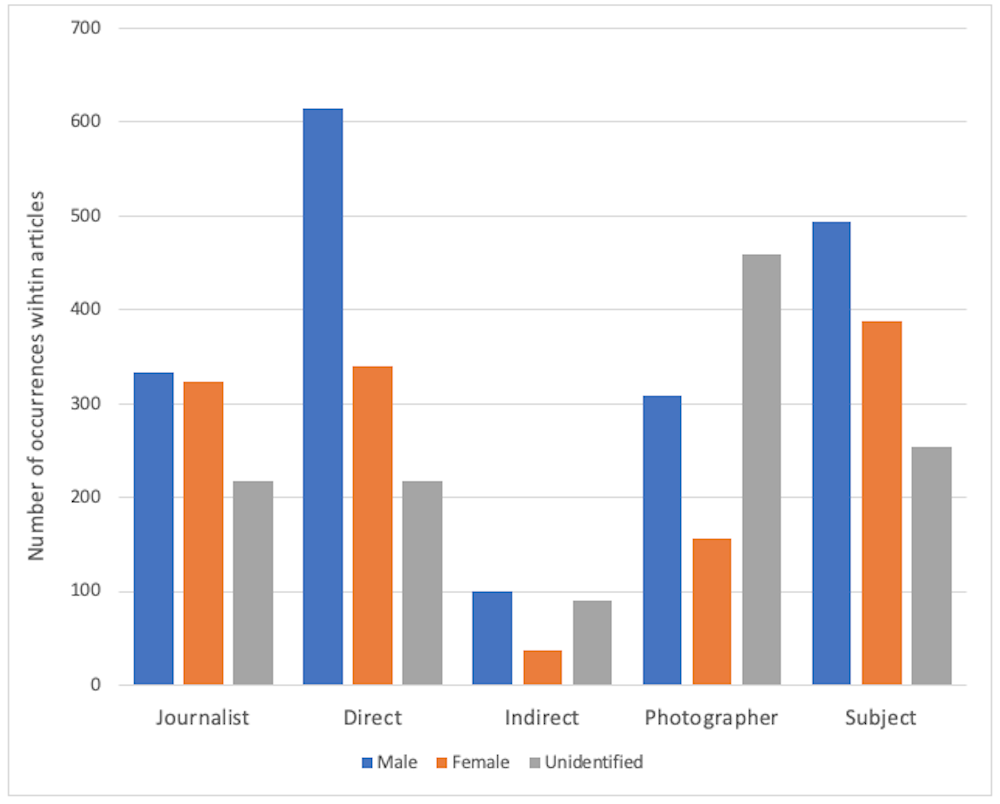 Gender of journalists, sources, photographers and photo subjects from a sample of 655 articles from 18 media outlets.
Merryn McKinnon, Author provided
Gender of journalists, sources, photographers and photo subjects from a sample of 655 articles from 18 media outlets.
Merryn McKinnon, Author provided
One egregious example was a “holiday reading list” from science magazine Cosmos, which featured nine books written or introduced by men, reviewed by five men.
If we look just at the top five STEM news providers in our sample, results are mixed. Our sampled suggested that The Conversation, the ABC and the Daily Mail have equal or greater numbers of women writing about STEM topics, compared with men. But although some of these outlets are also close to having gender parity in expert sources, the dominant voices are still generally male.
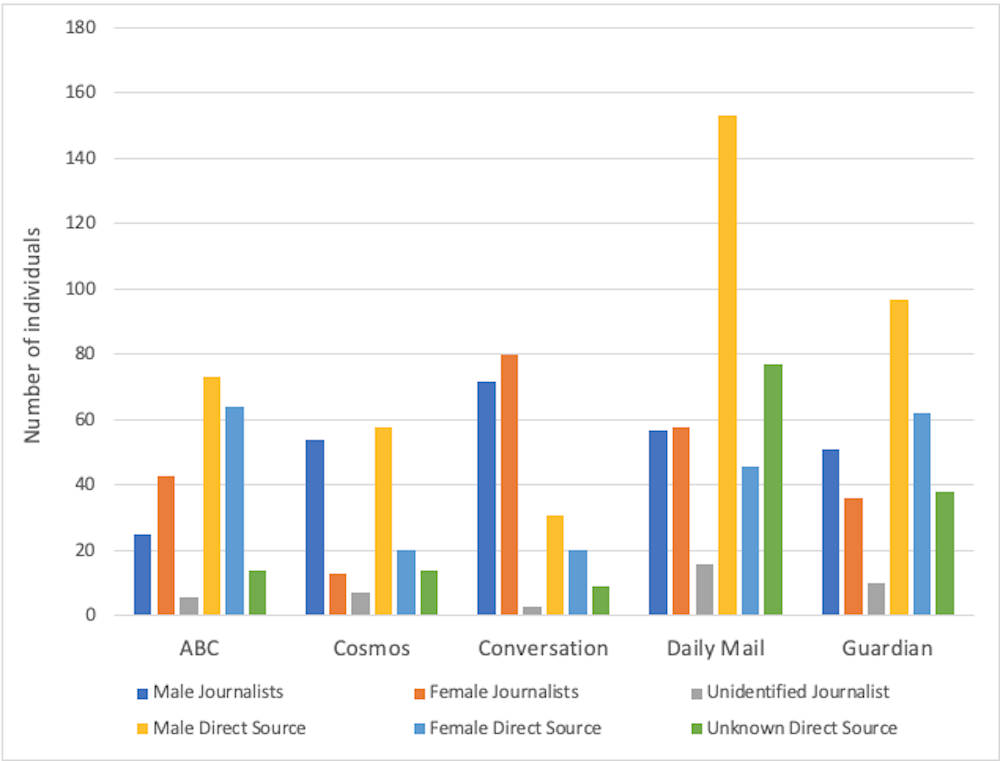 Comparison of the gender of science writers and directly quoted expert sources in the top five STEM news providers in our sample.
Merryn McKinnon
Comparison of the gender of science writers and directly quoted expert sources in the top five STEM news providers in our sample.
Merryn McKinnon
A man’s world?
If “we can’t be what we can’t see”, then it is vital that female scientists and science writers are prominent in the media landscape. But unfortunately, our results reveal that this landscape is still dominated by men.
There are many reasons for this. But let’s be clear: confronting this problem is not a job just for women, or just for the media. This is a systemic, structural and societal problem and everyone has a part to play in formulating the solution.
This was one of many discussions held at this month’s Catalysing Gender Equity conference, held in Adelaide by the Australian Academy of Science and featuring delegates from higher education, research, government, media and the private sector.
Building on the release last year of the Decadal Plan for Women in STEM, the conference aimed to develop tangible ways to work towards gender equity.
Of course, gender equity is just one part of the overall problem. There are many groups throughout society that similarly need equitable representation and inclusion. Nobody should be marginalised or disadvantaged because of their age, race, culture, religion, disability, sexual orientation or socio-economic status.
Read more: 'Death by a thousand cuts': women of colour in science face a subtly hostile work environment
So how do we improve STEM media diversity?
Based on many conversations with STEM professionals during communication workshops I have run over the years, I have developed a simple five-step process, with the mnemonic “START”. It is aimed at anyone in a STEM, or arguably any, organisation wishing to increase the diversity of their public representation.
Here’s how you START:
Support. Speaking publicly about your work should be seen as vital and valued from all levels in an organisation. Listen to concerns from those who may be intimidated by the prospect of talking to the media, and help alleviate those concerns. If you’re an experienced media contributor, invite a less experienced colleague to shadow you at an interview or studio. Online trolling can be intimidating, so be proactive in alerting outlets to inappropriate comments on articles or social media feeds. The standard you walk past is the standard you accept. Keep it classy.
Train. Few people are born with the ability to turn their complex, nuanced research findings into a pithy seven-second soundbite. But solid media training can give researchers the skills and understanding necessary to communicate effectively with the media. This includes learning how the media works, and realising that deadlines tend to be much shorter in a newsroom than a science lab!
Advocate. Most research disciplines have a handful of high-flyers who are usually tapped on the shoulder to do media interviews or public talks. But as long as the same shoulders are tapped, how do we discover new talent? One way is for those who already have a profile to use it elevate others too. Nominate a less experienced colleague – especially one from an under-represented group – to do the talk or interview instead, and then support them through it.
Reinforce. Media and public outreach can take time away from the “real job” of teaching, research and grant applications. But the resulting coverage benefits the organisation. Organisations should therefore see public engagement as an integral task, not a distraction, and include it in assessments of job performance and career development.
Track. Organisations should monitor their media coverage to understand who their “public faces” are. They should ask how diverse these faces are, and where resources might best be deployed to improve the picture.
Read more: Women in STEM need your support – and Australia needs women in STEM
In contrast to Mary Poppins’ advice, there is no need to START from the very beginning. Perhaps tracking or reinforcement is a sensible first step for your organisation. Or if you’re a researcher who already enjoys a significant media profile, you might start by thinking of some colleagues for whom you can advocate.
Irrespective of where we begin, equity - in all its forms - needs everyone to start somewhere.
Authors: Merryn McKinnon, Senior lecturer, Australian National University


 Daily Bulletin


