

When there's nowhere to escape, a bushfire-safe room could be your last resort
- Written by: Sahani Hendawitharana, PhD Scholar, Queensland University of Technology
Recent bushfires mercilessly destroyed almost one-third of Kangaroo Island, razing many homes to the ground.
Seeing this destruction on a recent visit to Kangaroo Island made us rethink how we could improve people’s safety. We spoke to people affected by the fires and learnt most preferred to stay and protect their properties, rather than evacuate. Here are some of their responses:
I’ll only leave my house if I see danger ahead.
When the fires started to come towards us, my husband wanted to evacuate early, but I wanted to spend the night in my home. The fires were far away and they didn’t reach us anyway.
He had $10,000 worth of hay he wanted to protect from the fires. But even with the help of fire services, we couldn’t save them.
People should always evacuate early to ensure their safety. But when they do decide to stay or they’re told it’s too late to leave, having a plan B is extremely important. Fire crews may struggle to reach you in time if anything goes wrong.
This is why having the option of a bushfire-safe room could be the last trump in your hand to save your life.
Read more: How to prepare your home for a bushfire – and when to leave
Safe rooms are a purpose-built, last-resort option to shelter from a bushfire attack. They should be built with fire-resistant material such as stone and bricks, be situated in or near a person’s home, and be resistant to toxic gas and smoke. This is a difficult task, so we’re researching how to make bushfire-safe rooms as safe as possible.
A growing number of people are turning to bushfire bunkers but are they lifesavers or deathtraps? Video: The ProjectWhy might you need a bushfire-safe room?
Imagine if:
you have no clue of the fire direction or the speed
your access road to escape is on fire
you wanted to escape before the fire comes, but can’t
you planned to stay and defend, but that seems impossible
emergency services cannot reach you in time.
On Kangaroo Island, for instance, long straight roads are the sole way in and out of some remote and rural settings. Often there’s no mobile coverage, some parts of the island have no beach for people to escape to and emergency services may take a long time to arrive.
When fire is approaching, it’s common for people to flee to nearby brick buildings, such as schools, to seek shelter.
Read more: Building standards give us false hope. There's no such thing as a fireproof house
But these buildings aren’t purpose-built for bushfire protection. And while they might be the safest option when there’s nowhere else to go, they are still risky. Smoke can penetrate, and burning embers can enter gaps in the building.
How safe are safe rooms?
Bushfire-safe rooms also have inherent risks. If they’re not constructed properly, they can be deadly.
Unlike other safe rooms used around the world (tornado shelters, war bunkers or bullet proof safe rooms), bushfire-safe rooms must be able to handle increased inside temperatures, carbon dioxide accumulation and smoke penetration, as well as withstand extremely high temperatures. They also need sufficient space for multiple people, and possibly space to store food supplies and valuables.
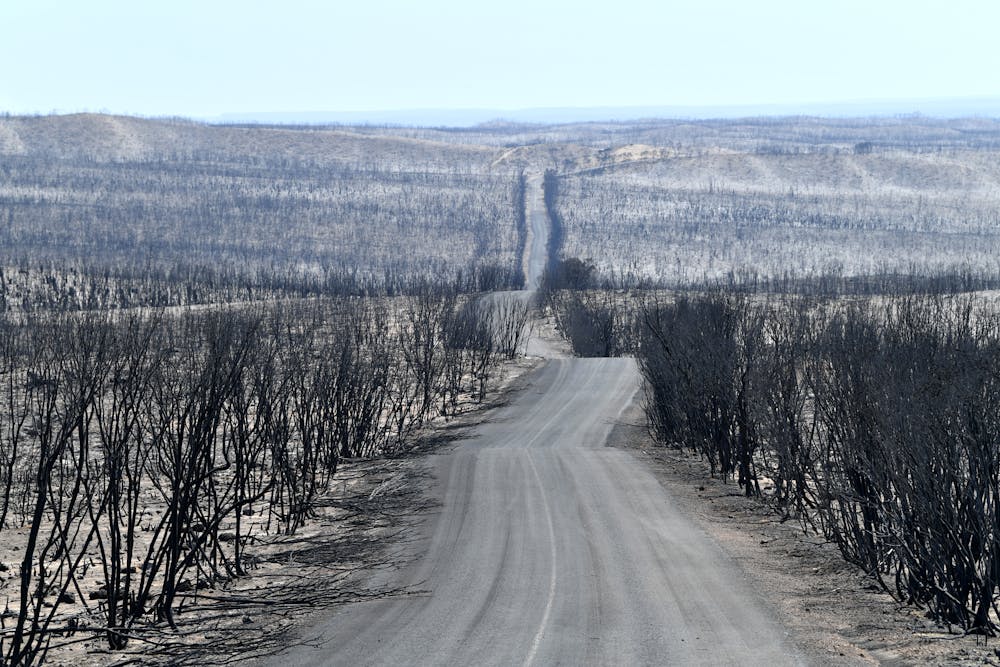 When the road to escape is surrounded by fire, where can you turn?
AAP Image/David Mariuz
When the road to escape is surrounded by fire, where can you turn?
AAP Image/David Mariuz
After Black Saturday, The Australian Building Codes Board released performance standards for the construction of private bushfire shelters. But these standards aren’t mandatory, and there’s room for improvement.
For example, the standards specify that an able-bodied person should stay in a private bushfire shelter for only one hour – the time it takes to withstand a fire front and any adjacent fires, and leaving a 10-minute safety margin before and after they hit.
But as bushfire severity and smoke conditions vary, people could, realistically, be stuck in there for a few hours.
This is why engineering safe rooms correctly and thoroughly is critical before the next bushfire disaster hits. This is where our research at Queensland University of Technology comes in.
Researching safety
We’re researching how to best construct bushfire-safe rooms from a structural engineering point of view, testing bushfire-resistant building materials, wall systems, and more. We’ll have results to share in six to eight months.
Interestingly, we’re also testing materials such as pumice (lightweight volcanic rock used in chimneys) and refractory blocks (ceramic material used to line kilns and furnaces), with promising results.
Safe rooms can be situated underground or above-ground at surface level, and we found both options have pros and cons. Above-ground structures would endure significant exposure to flames, while maintenance and accessibility for people with disabilities are problems for underground safe rooms.
Read more: Where to take refuge in your home during a bushfire
Still, Australia needs more scientific research beyond ours into the integrity of bushfire-safe rooms. We also need more behavioural studies to track how people respond to fires so we can better protect them with other survival options.
It’s high time people in bushfire-prone areas were given realistic ways to survive when evacuation is no longer an option.
Authors: Sahani Hendawitharana, PhD Scholar, Queensland University of Technology


 Daily Bulletin


