

behind the Reserve Bank's three point plan
- Written by: Peter Martin, Visiting Fellow, Crawford School of Public Policy, Australian National University
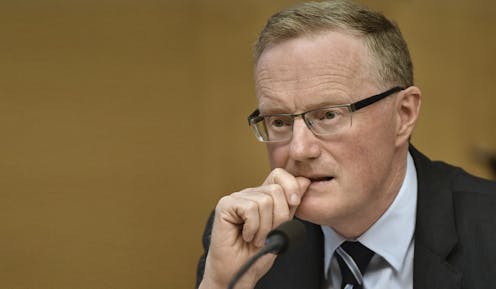
Today’s cut in the Reserve Bank’s cash rate to 0.25% brings it a new all-time low and the floor below which it plans to cut no more.
It means the rates set by the Reserve Bank of Australia, the United States Federal Reserve, the Bank of England and the Reserve Bank of New Zealand are all effectively 0.25%.
But it’s just the beginning.
Importantly, in his statement today Governor Philip Lowe said the Reserve Bank’s cash rate would stay at 0.25% for… well, for a very long time.
The board will not increase the cash rate target until progress is being made towards full employment and it is confident that inflation will be sustainably within the 2% to 3% target band.
Governor Lowe has previously described the bank’s estimates for full employment as being centred around 4.5%, meaning that, if interpreted literally, he is saying the cash rate will stay at its new all-time rock-bottom low until unemployment turns back down instead of climbing from its present 5.1% (as the coronavirus restrictions mean it is certain to do).
1. Rates at rock bottom for the duration
And he is saying he won’t lift the cash rate from that all-time rock-bottom low until until he is confident that inflation confident that inflation will be back sustainably within the 2% to 3% target band, somewhere it hasn’t been or seven years and shows no sign whatsoever of reaching.
His commitment amounts to a commitment to keep rates at effective zero (the bank believes 0.25% is effective zero, the effective lower bound) for at least three years, maybe even the best part of a decade, or as he put it late today, an “extended period of time”.
For anyone thinking of borrowing at the ultra-low rates , it provides something close to a guarantee of no upward surprises for as far as the eye can see. For homeowners, that’ll mean a mortgage rate below 3% for as far as the eye can see, and for businesses, a bank loan with a base rate of 5%.
2. Cheap money for banks
To make sure banks can get money at that rate, the Reserve Bank is going to hand it to them.
It will provide a three-year funding facility to authorised deposit-taking institutions (banks and financial institutions that are similar to banks) at a highly-concessional fixed rate of 0.25%.
At first, it’ll provide 3% of their existing loan book.
Then it’ll give them extra “additional funding” on one condition: that they increase lending to business this year, especially to small and medium-sized businesses.
The payoff to banks for increasing lending to small and medium sized businesses is generous indeed.
For every extra dollar lent to large business, lenders will have access to an additional dollar of funding from the Reserve Bank. For every extra dollar of loans to small and medium-sized businesses, they will have access to an additional five dollars.
The funds can be drawn on until the end of March next year. There is no extra borrowing allowance for additional housing loans.
It’ll cost the Reserve Bank north of A$90 billion.
Separately, the government – through the treasury and its Australian Office of Financial Management (AOFM) – will advance $15 billion of its own money to enable smaller lenders to continue to lend to consumers and small businesses, bringing the total cost to more than $100 billion.
Read more: 'Yield curve control': the Reserve Bank's plan for when cash rate cuts no longer work
It’s a departure for the AOFM. Usually, it borrows on behalf of the government. Now it’ll be lending on behalf of the government, something it has done before, including during the global financial crisis, but that isn’t its core business.
3. Forcing money into investors hands
And, as long-expected, from tomorrow it’ll begin so-called quantative easing, buying government bonds from investors to force cash into their hands (and force down a range of long-term rates as a by-product).
It’ll buy “government bonds and semi-government securities across the yield curve” meaning it won’t be picky. If it can buy Commonwealth 10-year bonds, it’ll do it. If it can buy NSW Treasury Corporation 5-year bonds, it’ll do it. If it can buy local government bonds, it’ll do it.
If a particular part of the market isn’t working well, the bank might choose to focus on it, Dr Lowe said late on Thursday.
It will announce what it intends to buy each morning at 11.15 am.
The aim will be to get money into the hands of the investors that owned them (it will only buy from investors, not from the government) and to get money into the economy.
Regularly updated targets
To give it guidance, it will have a target. That target will be force the yield on a 3-year Commonwealth government down to 0.25% from its present 0.50%.
As Zac Gross explained in The Conversation on Tuesday, it won’t be about the 3-year rate as such, but about using rate that to give it (and us) a guide as to whether it is doing not enough, or too much.
It is likely to regularly publish its 3-year bond yield target (and later, perhaps its 10-year bond yield target) so we can see what it is doing, in much the same way as it has published its cash rate target up until now.
Its cash rate target is likely to remain 0.25% for years to come. From now on we will be focusing on other targets for other rates, and that’s what its monthly announcements will concentrate on.
Authors: Peter Martin, Visiting Fellow, Crawford School of Public Policy, Australian National University
Read more https://theconversation.com/more-than-a-rate-cut-behind-the-reserve-banks-three-point-plan-134140


 Daily Bulletin


