

why should we stay 1.5 metres away from each other?
- Written by: Philip Russo, Associate Professor, Director Cabrini Monash University Department of Nursing Research, Monash University
The Australian government is recommending we stay 1.5 metres away from each other, one of several social distancing moves designed to limit spread of the coronavirus.
Why 1.5 metres? Is this our best, practical estimate? Or is there any solid scientific evidence to back it?
Read more: Social distancing: What it is and why it's the best tool we have to fight the coronavirus
The coronavirus is spread from person to person when someone with the virus coughs or sneezes. So people in close contact are at high risk.
Respiratory droplets can land in your mouth or nose. Alternatively, droplets could land on your face, and the next time you touch your face, and then rub your eye, you could infect yourself.
We know the influenza virus is spread in a similar way. One study shows when healthcare workers are within 1.8 metres of patients with influenza, their risk of being infected is increased.
Read more: Health Check: why do I have a cough and what can I do about it?
A quick search online will find lots of videos showing droplet expulsion from a sneeze. But there is a lack of good evidence to know for sure how far infectious droplets travel, and what is a “safe” distance.
Research is often laboratory based and doesn’t automatically translate to real-life situations. Then there are the variables about the number of infectious particles; their airborne survival; the humidity; and the speed of expulsion of the turbulent buoyant clouds“ (tornadoes of germs).
The US Centers for Disease Control and Prevention advises flu can spread up to 6 feet (1.8 metres). The key message is, the closer you are, the bigger the spray.
Similar research is yet to be done on the coronavirus. But the similarity with the way influenza is spread means we can apply what we know about influenza to the coronavirus.
What do others recommend?
The recommendation of 1.5 metres is not only based on our knowledge of influenza, it is also a practical distance that allows us to go about our daily lives.
Obviously it’s not a precise measurement, nor is it absolutely guaranteed to prevent spread. But that approximate distance is better than no distance.
The lack of scientific rigour behind these recommendations is borne out in the varied advice from around the world.
The UK’s National Health Service recommends people with symptoms stay at least 2 metres away from others.
The US Centers for Disease Control and Prevention recommends everybody should "put distance between yourself and other people”.
Finally, the World Health Organisation advises to keep at least 1 metre between you and anyone coughing and sneezing.
So you get the general idea. Don’t get close.
What does this mean in practical terms?
So, how do we keep 1.5 metres apart, short of carrying around a tape measure?
It’s about two arms lengths, but don’t stress about it. A little bit less is OK, a little bit more is good.
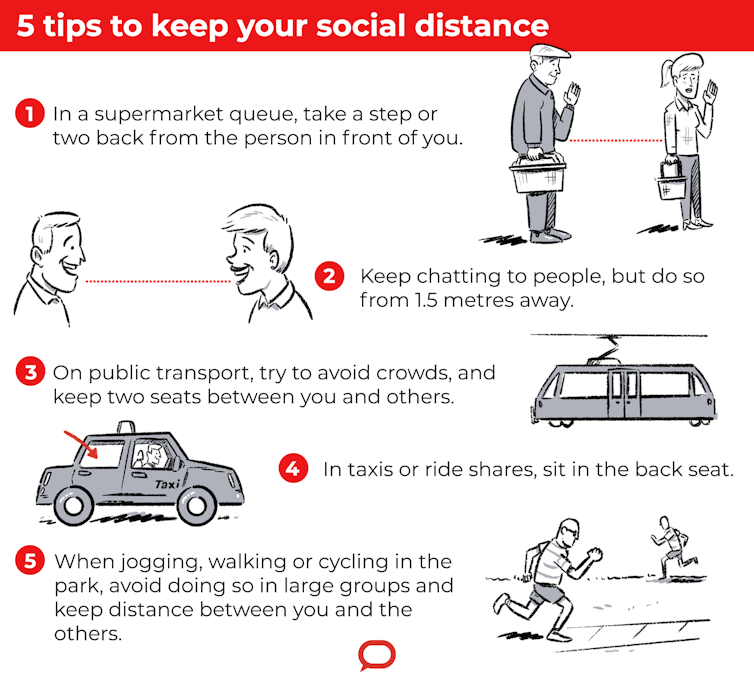 Wes Mountain/The Conversation, CC BY-ND
In a nutshell
Right now, avoiding close contact with others is important, and keeping 1.5 metres away from each other is not an exact science. It’s about keeping some sensible and practical distance between you and others.
It is just one of the strategies we can easily use to help slow down the spread of this virus. And please, wash your hands, and if you have symptoms, stay at home and seek medical advice.
Read more:
Coronavirus: why are we cancelling large gatherings? And what other 'social distancing' options are left?
Wes Mountain/The Conversation, CC BY-ND
In a nutshell
Right now, avoiding close contact with others is important, and keeping 1.5 metres away from each other is not an exact science. It’s about keeping some sensible and practical distance between you and others.
It is just one of the strategies we can easily use to help slow down the spread of this virus. And please, wash your hands, and if you have symptoms, stay at home and seek medical advice.
Read more:
Coronavirus: why are we cancelling large gatherings? And what other 'social distancing' options are left?
Authors: Philip Russo, Associate Professor, Director Cabrini Monash University Department of Nursing Research, Monash University
Read more https://theconversation.com/coronavirus-why-should-we-stay-1-5-metres-away-from-each-other-134029


 Daily Bulletin


