

how long does it take to get sick? How infectious is it? Will you always have a fever? COVID-19 basics explained
- Written by: Sanjaya Senanayake, Associate Professor of Medicine, Infectious Diseases Physician, Australian National University
You’re probably inundated with news and messages about coronavirus at the moment. But how do you know if you’re consuming evidence-based information or just speculation and myth?
There’s still a lot we don’t know but here’s what the evidence tells us so far about the coronavirus, called SARS-CoV-2, and the disease it causes, COVID-19.
How does it spread?
COVID-19 is transmitted through droplets generated via coughing and sneezing.
This means it can spread during close contact between an infected and uninfected person, when it’s inhaled, or enters the body via the eyes, mouth or nose.
Infection can also occur when an uninfected person touches a contaminated surface.
What are the symptoms?
COVID-19 causes similar symptoms to the flu. Fever is the most common symptom, occurring in almost 88% of cases, while a dry cough is the next most common, affecting almost 68% of those with the virus.
Data from 55,000 cases in China also show other symptoms can include:
- fatigue, in 38% of cases
- producing sputum or phlegm, 33%
- shortness of breath, 19%
- sore throat, 14%
- headache, 14%.
Unlike other coronaviruses that cause the common cold, COVID-19 is hardly ever associated with a stuffy nose. This is seen in just 5% of cases.
Diarrhoea is also uncommon, affecting only 4% with the virus.
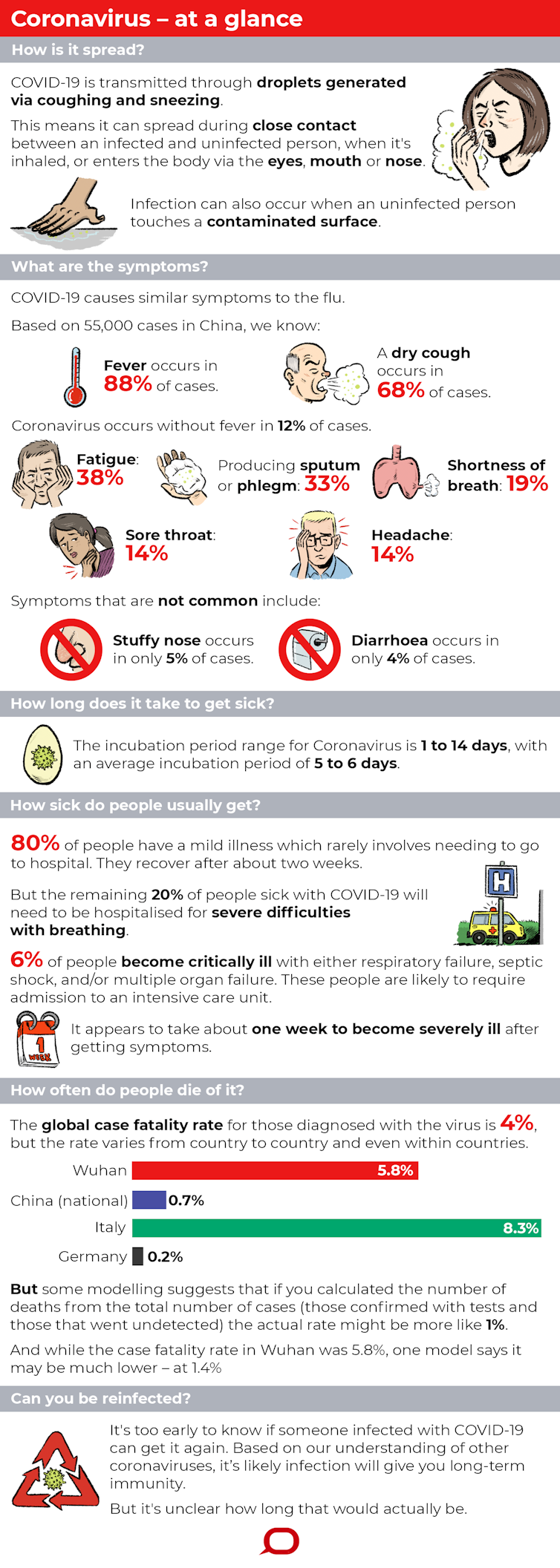 The Conversation, CC BY-ND
Can I be infected if I don’t have a fever?
Yes, you can still have coronavirus if you don’t have a fever. This occurs in about 12% of cases.
How long does it take to get sick?
The incubation is the period from when you’re infected to when you become sick. For COVID-19, the range is 1-14 days, with an average incubation period of 5-6 days.
How sick do people usually get?
Most people who get sick (80%) have a mild illness which rarely involves needing to go to hospital. They recover after about two weeks.
But just over 20% of people sick with COVID-19 will need to be hospitalised for severe difficulties with breathing.
Of the 20% who need to be hospitalised, 6% become critically ill with either respiratory failure (where you can’t get enough oxygen from your lungs into your blood), septic shock, and/or multiple organ failure. These people are likely to require admission to an intensive care unit.
It appears to take about one week to become severely ill after getting symptoms.
How often do people die of it?
The case fatality rate refers to the number of deaths among those who have tested positive for coronavirus. Globally, the case fatality rate today stands at 4%.
But this rate varies country to country and even within countries. These variations may partially be explained by whether hospitals has been overwhelmed or not.
The case fatality rate in Wuhan was 5.8% (although one model says it may be lower at 1.4%). In the rest of China, it was at 0.7%.
Similarly in Europe, Italy’s case fatality rate is (8.3%), greatly surpassing that of Germany (0.2%).
However the case fatality rate only includes people who are tested and confirmed as having the virus.
Some modelling estimates suggest that if you calculated the number of deaths from the total number of cases (those confirmed with tests and those that went undetected) the proportion of people who die from coronavirus might be more like 1%.
Read more:
The coronavirus looks less deadly than first reported, but it's definitely not 'just a flu'
Who is most at risk of dying?
People aged over 60 years with underlying health problems are at highest risk of severe disease and death.
For people aged 60-69, 3.6% of those who are infected will die from COVID-19. This rises to 8% for for 70-79 year olds and 14.8% for those over 80.
Among people under 50 years, just 0.2-0.4% will die from the disease and this rises to 1.3% for 50-59 year olds.
How infectious is it, and how does that compare with the flu?
COVID-19 and influenza are probably fairly similarly infections.
A single ill person with COVID-19 can infect more people than a single ill person with influenza. COVID-19 has a higher “reproduction number” of 2.0-2.5. This means one person will infect, on average, 2 to 2.5 people.
Seasonal influenza has a reproduction number of about 1.28, meaning one person will infect, on average, between one and two people.
But this is balanced by influenza’s ability to infect more quickly. It takes, on average, 3 days to become sick with the flu, but you can still transmit it before symptoms emerge.
It takes 5-6 days to become sick with COVID-19. We still don’t know if you can be infectious before getting coronavirus symptoms, but it doesn’t seem to be a major driver of transmission.
So influenza can spread faster than COVID-19.
The case fatality rate of COVID-19 is higher than that of seasonal influenza (4% versus 0.1%), although as noted above, the true fatality of COVID-19 is still not clear.
Can you be reinfected?
It’s too early to know if someone infected with COVID-19 can get it again.
On the basis of what we understand about other coronaviruses, it is likely that infection will give you long-term immunity. But it’s unclear whether that will mean one year, two years or lifelong immunity.
The Conversation, CC BY-ND
Can I be infected if I don’t have a fever?
Yes, you can still have coronavirus if you don’t have a fever. This occurs in about 12% of cases.
How long does it take to get sick?
The incubation is the period from when you’re infected to when you become sick. For COVID-19, the range is 1-14 days, with an average incubation period of 5-6 days.
How sick do people usually get?
Most people who get sick (80%) have a mild illness which rarely involves needing to go to hospital. They recover after about two weeks.
But just over 20% of people sick with COVID-19 will need to be hospitalised for severe difficulties with breathing.
Of the 20% who need to be hospitalised, 6% become critically ill with either respiratory failure (where you can’t get enough oxygen from your lungs into your blood), septic shock, and/or multiple organ failure. These people are likely to require admission to an intensive care unit.
It appears to take about one week to become severely ill after getting symptoms.
How often do people die of it?
The case fatality rate refers to the number of deaths among those who have tested positive for coronavirus. Globally, the case fatality rate today stands at 4%.
But this rate varies country to country and even within countries. These variations may partially be explained by whether hospitals has been overwhelmed or not.
The case fatality rate in Wuhan was 5.8% (although one model says it may be lower at 1.4%). In the rest of China, it was at 0.7%.
Similarly in Europe, Italy’s case fatality rate is (8.3%), greatly surpassing that of Germany (0.2%).
However the case fatality rate only includes people who are tested and confirmed as having the virus.
Some modelling estimates suggest that if you calculated the number of deaths from the total number of cases (those confirmed with tests and those that went undetected) the proportion of people who die from coronavirus might be more like 1%.
Read more:
The coronavirus looks less deadly than first reported, but it's definitely not 'just a flu'
Who is most at risk of dying?
People aged over 60 years with underlying health problems are at highest risk of severe disease and death.
For people aged 60-69, 3.6% of those who are infected will die from COVID-19. This rises to 8% for for 70-79 year olds and 14.8% for those over 80.
Among people under 50 years, just 0.2-0.4% will die from the disease and this rises to 1.3% for 50-59 year olds.
How infectious is it, and how does that compare with the flu?
COVID-19 and influenza are probably fairly similarly infections.
A single ill person with COVID-19 can infect more people than a single ill person with influenza. COVID-19 has a higher “reproduction number” of 2.0-2.5. This means one person will infect, on average, 2 to 2.5 people.
Seasonal influenza has a reproduction number of about 1.28, meaning one person will infect, on average, between one and two people.
But this is balanced by influenza’s ability to infect more quickly. It takes, on average, 3 days to become sick with the flu, but you can still transmit it before symptoms emerge.
It takes 5-6 days to become sick with COVID-19. We still don’t know if you can be infectious before getting coronavirus symptoms, but it doesn’t seem to be a major driver of transmission.
So influenza can spread faster than COVID-19.
The case fatality rate of COVID-19 is higher than that of seasonal influenza (4% versus 0.1%), although as noted above, the true fatality of COVID-19 is still not clear.
Can you be reinfected?
It’s too early to know if someone infected with COVID-19 can get it again.
On the basis of what we understand about other coronaviruses, it is likely that infection will give you long-term immunity. But it’s unclear whether that will mean one year, two years or lifelong immunity.
Authors: Sanjaya Senanayake, Associate Professor of Medicine, Infectious Diseases Physician, Australian National University


 Daily Bulletin


