

The community-led movement creating hope in the time of coronavirus
- Written by: Sango Mahanty, Associate professor, Australian National University
The global COVID-19 pandemic has disrupted the social networks we rely on. Workplaces, pubs, restaurants and gyms have closed and many people are now housebound.
COVID-19 represents a major rupture in the status quo and calls for new forms of response. Perhaps this is why thousands of new “mutual aid” groups have sprung up internationally. Many of these groups have swelled to several thousand members within a few days.
Such community-driven groups use diverse communication platforms such as Facebook, Whatsapp and letterbox leafleting, to provide safe and inclusive ways for people to network during illness and self-isolation. At a neighbourhood or street level they help each other, particularly vulnerable people, with grocery collection, walking pets, emotional support and more.
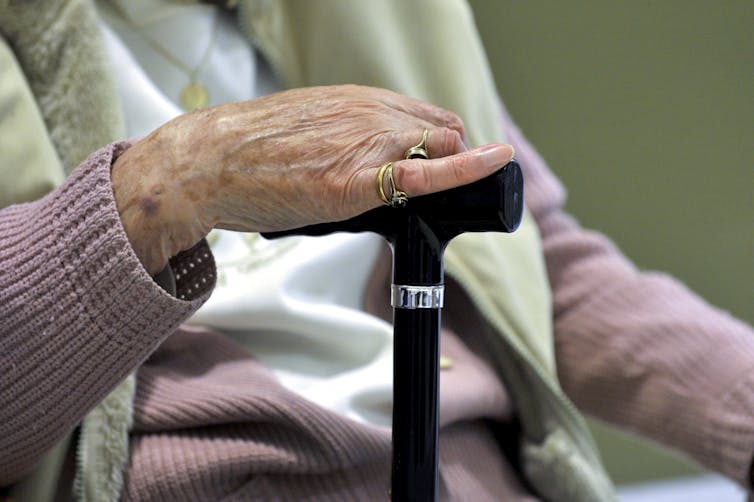 Elderly people are particularly vulnerable during this pandemic.
AAP
Elderly people are particularly vulnerable during this pandemic.
AAP
But the rapid growth of this movement creates a steep learning curve for group organisers. Just as in wider society, mutual aid groups must grapple with political differences and structural inequality. Groups in Australia can look to those overseas to learn how to overcome these challenges.
What do mutual aid groups do?
Co-author of this article, Nisha Phillipps, co-founded the Haringey COVID-19 Mutual Aid group. It is one of many such groups in Britain and has a membership of more than 3,300.
The Facebook group links its members to neighbourhood groups that coordinate volunteers. It also shares topical information, such as detail on London’s lockdown measures, online mental health services and help for tenants facing eviction.
One of the largest similar groups to emerge in Australia is Love Your Neighbour Melbourne which, at the time of writing had more than 9,285 members.
A Canberra mutual aid group is helping do grocery runs, and reportedly even received offers from plumbers to fit bidets for people who couldn’t buy toilet paper.
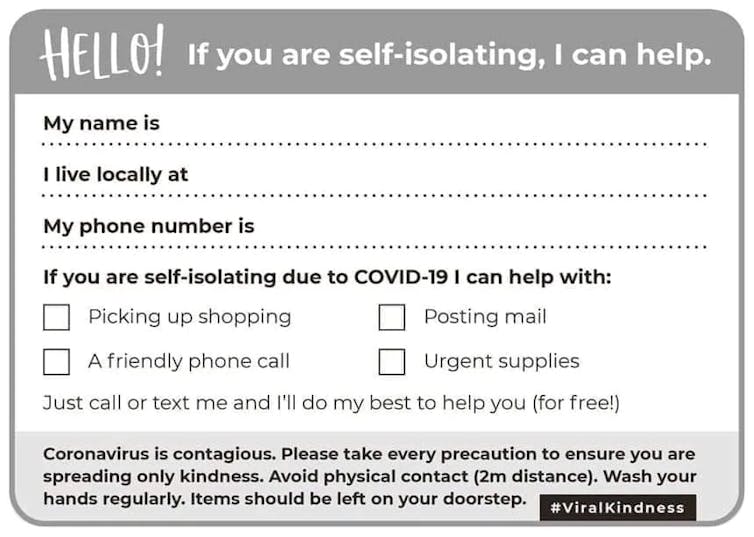 A leaflet distributed by a group offering support during the coronavirus emergency.
Author provided
A leaflet distributed by a group offering support during the coronavirus emergency.
Author provided
Lessons to be learnt
In the fast-moving context of the coronavirus, these groups can learn from each other by sharing approaches to their challenges.
Mutual aid – in the sense of voluntary cooperation for a common purpose – has deep historical roots and can mean different things to different people.
In medicine and social work, mutual support groups are set up by professionals to help those living with particular health and social risks. But mutual aid groups initiated by grassroots activists focus on addressing gaps or harm caused by state services through community-building.
Read more: Why are we calling it 'social distancing'? Right now, we need social connections more than ever
This means members of a new mutual aid group may arrive with differing expectations of the group’s goals and approach, so clarifying this is important.
The Haringey group’s Facebook page states its goal as “supporting members of the community who are immuno-compromised or self-isolating” through an approach that “coordinates but does not dictate” how groups organise themselves at the street and neighbourhood level.
Their decentralised approach allows groups to use diverse communication systems, such as Zoom, WhatsApp, Slack, email or SMS, depending on what best suits a specific neighbourhood or street.
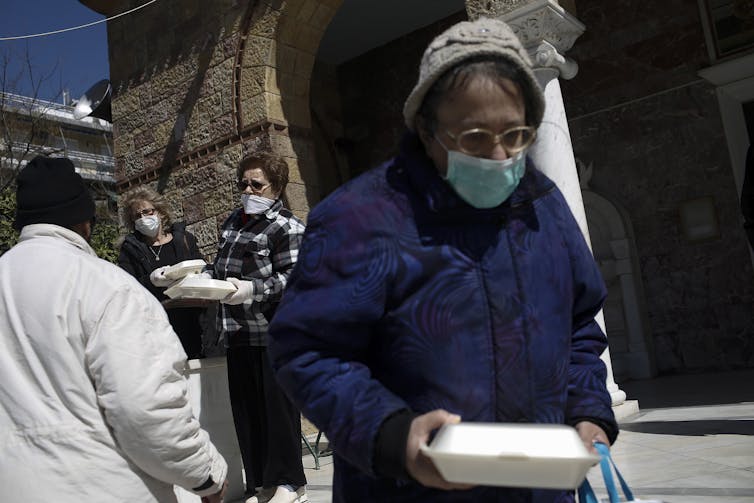 Women deliver meals to needy people in Athens, Greece.
KOSTAS TSIRONIS/EPA
Women deliver meals to needy people in Athens, Greece.
KOSTAS TSIRONIS/EPA
Dealing with difference
Cooperation and community-building are a welcome salve to the individualistic waves of panic-buying and “shopping rage” we’ve seen of late.
But communities are complex, and reflect the diversity and structural inequalities of wider society. Factors such as ethnicity, disability, socio-economic status, gender or access to technology means some people’s voices are excluded, or they are denied opportunities.
Haringey draws on accountability guidelines from the community organisation Incite. These affirm the principles of respect, care and solidarity and lay out how to address discriminatory conduct. This follows a “transformative justice” approach. A facilitator talks to the people involved, to address the harm caused.
Read more: Why housing evictions must be suspended to defend us against coronavirus
The large and decentralised communities that comprise most COVID-19 mutual aid groups encompass diverse political leanings, from which differences of opinion emerge.
In one Canberra group for example, heated online debate broke out over a post proposing a “rent strike” to deal with job and income losses from COVID-19 lock-downs. This rift largely took place along socio-economic lines, between renters and homeowners/landlords.
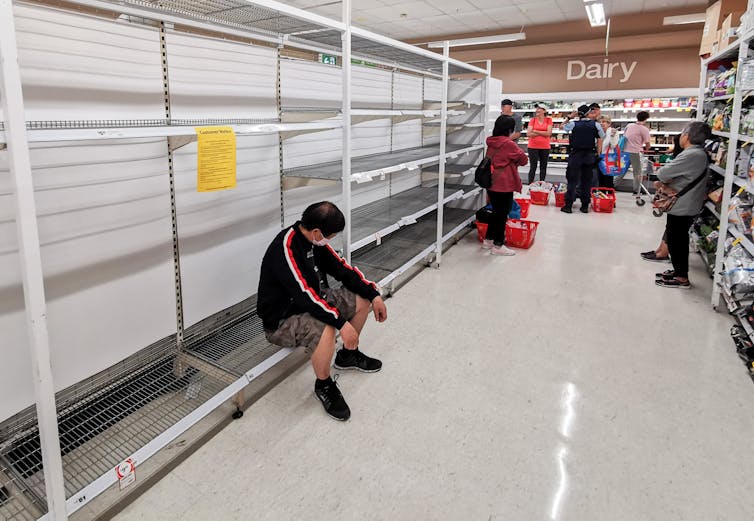 People waiting in the toilet paper aisle for a delivery at a Coles supermarket in Sydney.
JAMES GOURLEY/AAP
People waiting in the toilet paper aisle for a delivery at a Coles supermarket in Sydney.
JAMES GOURLEY/AAP
Many groups, like Haringey, have an explicit community-centred stance, independent of government. For example, Haringey Council asked for volunteer lists but group administrators did not provide them, as they do not maintain a centralised list and preferred to continue a community-centred approach. Many members do not want direct engagement with police and neighbourhood watch groups, as this might disenfranchise homeless people or undocumented residents.
Where there are differences of opinion on these matters, they are discussed openly. Principles of community-building, solidarity and independence are important reference points in these discussions.
In a pandemic, the safety of volunteers and those receiving help is crucial. In Haringey, the organisers limit posts that suggest do-it-yourself actions to manage or treat COVID-19 that could heighten risks to the community, such as homemade masks. Volunteers draw on hygiene protocols from trusted websites run by health services and community groups such as QueerCare, a transfeminist autonomous care organisation.
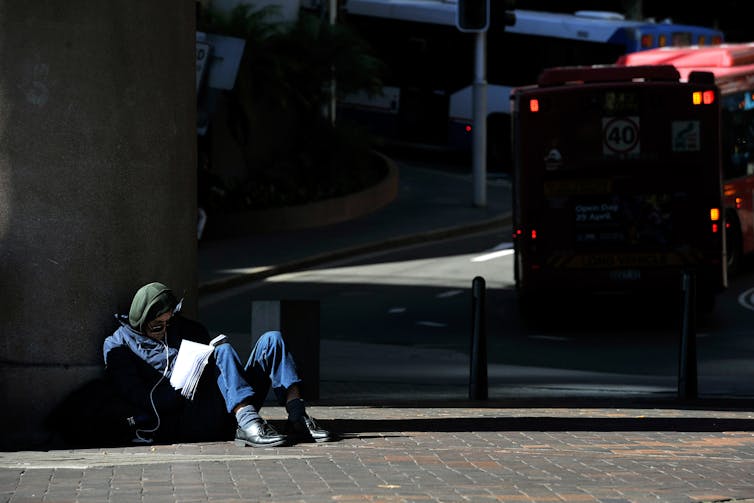 Involving police or neighbourhood watch groups might alienate some members of the community.
AAP
Involving police or neighbourhood watch groups might alienate some members of the community.
AAP
Building community while we’re apart
As we move further into the COVID-19 lock-downs in Australia and elsewhere, mutual aid will be relied on more than ever.
Issues such as inclusion, accountability and political frictions can challenge community-driven initiatives of all kinds. Reflecting on what we do, and sharing lessons, will help nurture mutual aid in ways that address these challenges.
Authors: Sango Mahanty, Associate professor, Australian National University


 Daily Bulletin


