

Why coronavirus may forever change the way we care within families
- Written by: Leah Ruppanner, Associate Professor in Sociology and Co-Director of The Policy Lab, University of Melbourne
The global spread of COVID-19 has illuminated the “care crisis” that has been building for decades.
Women, through their unpaid housework, childcare and elder care, have kept families functioning. However, COVID-19 is putting a strain on women’s abilities to keep the cogs of daily life turning. We are now starting to see the impact of what happens when women are unable to do it all.
What is the care crisis?
For decades, scholars have warned that the bulk of the unpaid domestic work carried by women is unsustainable. The ageing of populations across Western nations will add to the burden even more as women care for elderly parents, spouses, friends and family. This will in turn significantly reduce the employment pool and add strain on those providing the care.
Mothers do almost twice as much housework as fathers, even when they are earning most of the family income. Greater time in housework is at the expense of their time in employment, leisure and sleep.
Without free childcare or flexible work, families are patching together a tenuous web of caregivers and family members to smooth before- and after-school transitions and to tend to sick children. COVID-19 exposes our care system as being held together by a thread, based on the unpaid and perpetual labour of women.
For decades, researchers have shown women are stressed, pressed and emotionally unwell from the constant struggle to manage these competing demands. The data are clear – women’s larger share of the care is making them sick.
Once COVID-19 started to spread, the world changed dramatically. Now, the invisible unpaid work started to become visible. And someone has to do it.
Worried about childcare? What our searches can teach us
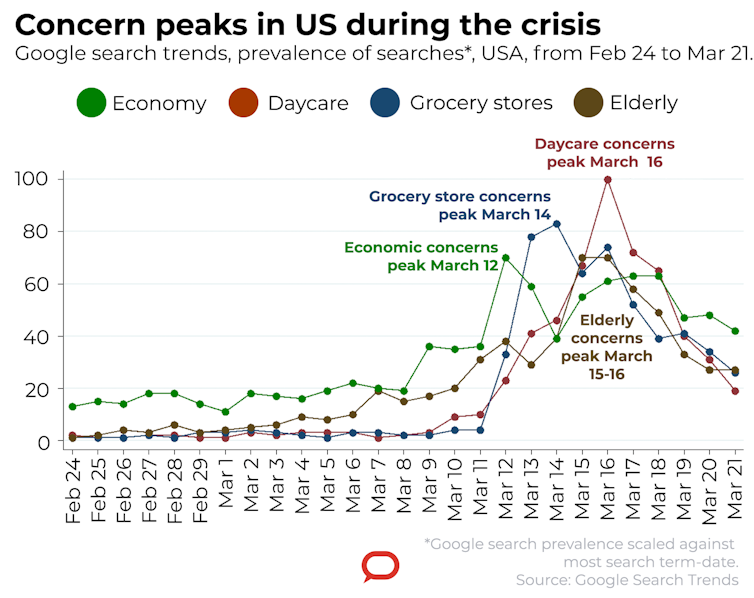
To better understand how childcare during coronavirus is worrying Australian parents, we draw data from Google searches over the past 30 days from the United States and Australia. The US is further along in the coronavirus journey, so can offer some insights into how worry about the virus changes over time.
At first, Americans were more concerned about the economy. But as schools, workplaces and non-essential services start to shut down, the threat of the care crisis has emerged – the concentration of Google searches for coronavirus that include “daycare” and “elderly” intensifies. The work is coming home. Who is now going to do it?
 Author provided/The Conversation, CC BY-ND
Australia is now preparing more aggressive social-isolation measures to slow the spread of COVID-19, with school and non-essential service closures reported only this week and only in some states.
However, Australia, too, has been slow to respond and the federal government has resisted school closures in part because 30% of healthcare workers in Australia are women. What will happen to this group of workers if they have to look after their children and those affected by COVID-19?
Do all states exhibit the same worry?
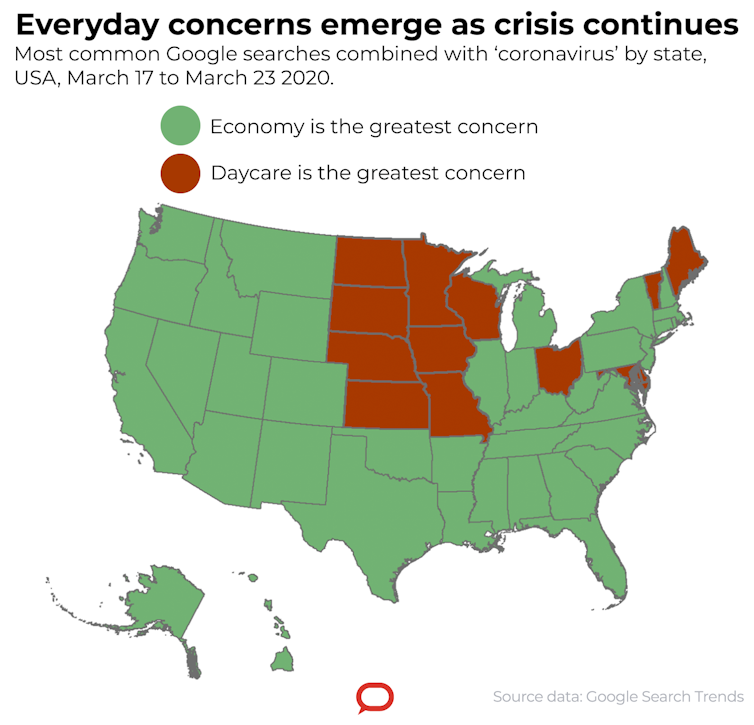
Across the US, trends in search terms vary dramatically across states. In the past week, searches in most states have been concentrated on how coronavirus will impact the economy.
But something interesting is happening to the states in the middle of the country – Nebraska, Kansas, Iowa and Minnesota. In these states, searches for daycare and coronavirus are more common than searches related to coronavirus and the economy, grocery stores and the elderly.
Author provided/The Conversation, CC BY-ND
Australia is now preparing more aggressive social-isolation measures to slow the spread of COVID-19, with school and non-essential service closures reported only this week and only in some states.
However, Australia, too, has been slow to respond and the federal government has resisted school closures in part because 30% of healthcare workers in Australia are women. What will happen to this group of workers if they have to look after their children and those affected by COVID-19?
Do all states exhibit the same worry?
Across the US, trends in search terms vary dramatically across states. In the past week, searches in most states have been concentrated on how coronavirus will impact the economy.
But something interesting is happening to the states in the middle of the country – Nebraska, Kansas, Iowa and Minnesota. In these states, searches for daycare and coronavirus are more common than searches related to coronavirus and the economy, grocery stores and the elderly.
 Author provided/The Conversation, CC BY-ND
Our research shows mothers in these states have access to better childcare resources – more affordable childcare, longer school days and more expansive after-school care. A forthcoming book, Motherlands, shows mothers in these states are more likely to work full-time, including right before and right after childbirth. These states are exemplars, offering parents the best childcare resources.
Read more:
Sharing the parenting duties could be key to marital bliss: study
But what happens for families in these states when everything shuts down?
When we dig a little deeper, we see searches for daycare centres being open during coronavirus soared by 100%. Questions about whether those centres will charge fees even while closed increased by 400%. Nebraskans are also worried about their financial futures, but theirs are more tightly linked to daycare.
Author provided/The Conversation, CC BY-ND
Our research shows mothers in these states have access to better childcare resources – more affordable childcare, longer school days and more expansive after-school care. A forthcoming book, Motherlands, shows mothers in these states are more likely to work full-time, including right before and right after childbirth. These states are exemplars, offering parents the best childcare resources.
Read more:
Sharing the parenting duties could be key to marital bliss: study
But what happens for families in these states when everything shuts down?
When we dig a little deeper, we see searches for daycare centres being open during coronavirus soared by 100%. Questions about whether those centres will charge fees even while closed increased by 400%. Nebraskans are also worried about their financial futures, but theirs are more tightly linked to daycare.
 Author provided/The Conversation, CC BY-ND
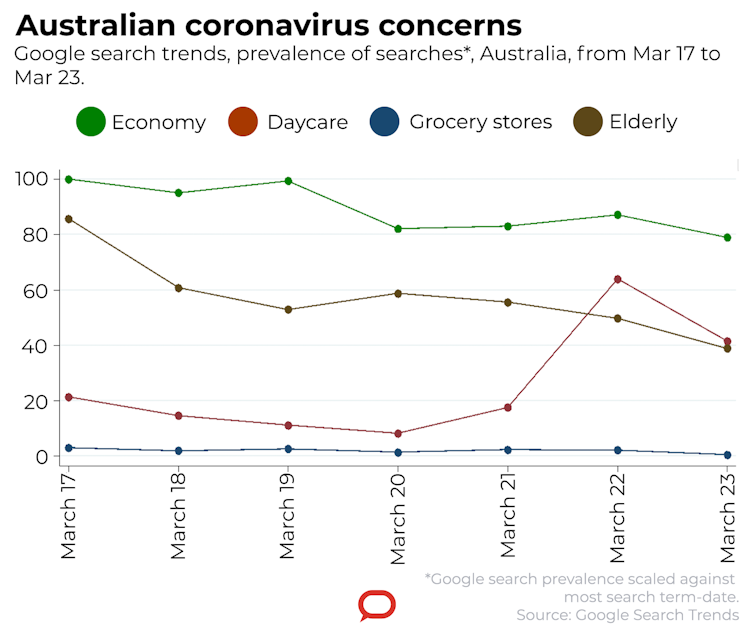
Over the past week, Australians are increasing their searches of daycare, with some regional variation. People in Australian Capital Territory, New South Wales and Victoria are most likely to ask Google about daycare. Families in these states average 31 hours of weekly childcare, or equivalent to another full-time job – time that families will have to fill.
What is the future of care?
COVID-19 will be devastating in its effect on our health, families and economy. But, as we face this new brave world together, it is important to understand the role of caregiving and the importance of carers in this crisis.
To date, women have done this work freely for families. But now the burden is too big and we need to see this work for what it is – important, essential and of great economic value. Individuals can use this as an opportunity to try something new, but also take stock of what we value as a society.
It is an opportunity to realise that the unpaid labour of grandparents and women is not enough – we need real solutions for a problem that, until now, has remained invisible.
Author provided/The Conversation, CC BY-ND
Over the past week, Australians are increasing their searches of daycare, with some regional variation. People in Australian Capital Territory, New South Wales and Victoria are most likely to ask Google about daycare. Families in these states average 31 hours of weekly childcare, or equivalent to another full-time job – time that families will have to fill.
What is the future of care?
COVID-19 will be devastating in its effect on our health, families and economy. But, as we face this new brave world together, it is important to understand the role of caregiving and the importance of carers in this crisis.
To date, women have done this work freely for families. But now the burden is too big and we need to see this work for what it is – important, essential and of great economic value. Individuals can use this as an opportunity to try something new, but also take stock of what we value as a society.
It is an opportunity to realise that the unpaid labour of grandparents and women is not enough – we need real solutions for a problem that, until now, has remained invisible.
Authors: Leah Ruppanner, Associate Professor in Sociology and Co-Director of The Policy Lab, University of Melbourne


 Daily Bulletin


