Emoticons and symbols aren't ruining language – they're revolutionizing it
- Written by: The Conversation
 Does this represent the degeneration of language? Not quite.from www.shutterstock.com
txt msgs r running language
*ruining
^lol, jk!! :)
In many casual discussions of language and the internet, it’s not uncommon to hear about how such “textspeak ruins language” – how technology has made everybody lazy with their speech and writing. Major media outlets such as the LA Times, the BBC and The Daily Mail have all bemoaned the ways in which people communicate through technology.
Of course, language does change when it’s used to text or write messages on the internet. It’s even become the focus of the field of linguistics known as Computer-Mediated Communication (CMC). Although it specifies computers in its name, CMC refers to the study of interaction facilitated by technology like computers, mobile phones and tablets.
And contrary to the idea that these innovations are corrupting language, they actually demonstrate a creative repurposing of symbols and marks to a new age of technology. These evolutions of language are swift, clever and context-specific, illustrating the flexibility of the language to communicate nonverbal meaning in a nuanced, efficient manner.
Change doesn’t mean decay
It turns out that people have been complaining about language being “ruined” for as long as they’ve been writing and speaking.
In a TED Talk, linguist John McWhorter shared stories of people complaining about language change through the ages. For example, in 63 AD a Roman scholar groused that students of Latin were writing in an “artificial language” – a language that would become French!
And a 1871 quote from Charles Eliot, the President of Harvard University, might sound familiar:
Bad spelling, incorrectness, as well as inelegance of expression in writing, ignorance of the simplest rules of punctuation… are far from rare among young men otherwise well prepared for college studies.
 Former Harvard president Charles Eliot spouted a ‘kids these days…’ refrain that’s been repeated throughout history.Wikimedia Commons
Young Theodore Roosevelt – a student at Harvard in the 1870s – was possibly among those young men being described. As historian Kathleen Dalton observed in her biography of Roosevelt, the future president would eventually support the revision of American English spelling rules, many of which we still use today, like changing -re endings to -er in words like center and changing -our to -or in words like color.
The emoticon: more than a face
Today, people are able to communicate rapidly through a range of mediums – and perhaps no linguistic development better indicates changes in the ways we communicate than the ubiquitous emoticon.
The emoticon :) – a colon followed by a parenthesis – is a visual representation of a smiley face turned sideways. Although an emoticon may look like a smile, a frown or any number of facial expressions, it doesn’t represent a face, as many internet users assume. It’s actually intended to convey a feeling (“I’m happy,” or “just joking”).
This meaning is evident even in the first emoticon, credited to Scott Fahlman at Carnegie Mellon University. In a 1982 e-mail, Fahlman suggested :-) as a “joke marker” to indicate wisecracks or sarcasm in text communication. In this legendary e-mail, he also used the first instance of the frown emoticon :-(.
Words that represent these feelings are what linguists call discourse particles, or little pieces of language that convey information about the tone of the statement. Folklorist Lee-Ellen Marvin called them the “paralanguage of the internet, the winks which signal the playfulness of a statement over the seriousness it might denote.”
In a study of instant messaging, scholar Shao-Kang Lo describes emoticons as “quasi-nonverbal cues” – something that looks like a word, but performs the functions of a nonverbal cue, like a hand gesture or nod.
In fact, the variations in how you construct this emoticon can imply something about your identity, just like whether you use a soda, pop or Coke can suggest what part of the United States you come from. For example, as linguist and data scientist Tyler Schnoebelen pointed out in a 2012 study, people who put a “nose” in their emoticons tend to be older than non-nose emoticon users.
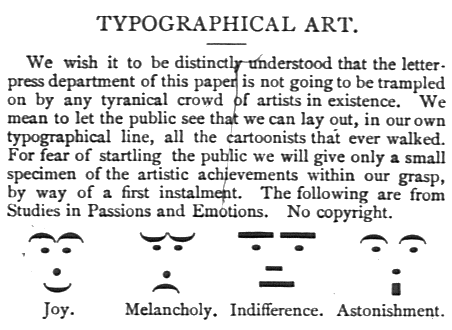
Though emoticons have been the subject of numerousstudies, individual symbols – which serve a different purpose than emoticons – can add meaning to a message or express meaning all on their own.
 In a precursor to the modern emoticon, 19th century typographers took a stab at conveying emotion through symbols,Wikimedia Commons
Fluid conversation and clarified meaning
Have you ever seen someone fix a typo in a message with an asteriks? (*asterisk)
The asterisk signals a repair of an error in language. Conversational repair, or the act of correcting ourselves or others in spoken language, has been discussed for decades by conversation analysts in spoken language. Saying “sorry, I meant to say” or “er, I mean” can be awkward and interrupt the dynamics of a spoken conversation.
This conversational move has made its way into online written language, where that awkwardness is reduced to a single symbol. Instead of saying “oops, I mispelled ‘asterisk’ in my previous sentence,” people can avoid a conversational detour by simply typing an asterisk before the word: *asterisk.
That’s not the only use of the asterisk. A pair of them around a word or phrase can indicate emphasis. This style has gradually given way to words in all caps and repeated letters to show intensity and emphasis, as linguist Deborah Tannen and communication scholar Erika Darics havenoted. Tannen provides an example of a text message that uses multiple styles to convey an intensely apologetic, sincere tone:
JACKIE I AM SO SO SO SORRY! I thought you were behind us in the cab and then I saw you weren’t!!!!! I feel soooooooo bad! Catch another cab and ill pay for it for youuuuu
Meanwhile, punctuation marks like hyphens and periods suggest a change in voice and tempo. One example is the ubiquitous ellipses. Traditionally, this mark has been used in text to denote deleted text. Now, it can also indicate a tone of voice that’s trailing off or hesitating, such as the following example from a conversation in the popular online role playing game World of Warcraft:
So… since we live in the same city, do you wanna like… meet up sometime…?
This use of the ellipses adds that extra meaning to the text and it can also do the work of denoting someone else’s turn in the conversation.
It’s even been incorporated into user interfaces. In instant messaging and chat programs like Skype, an ellipsis is used to show that the other party is typing.
 Ellipses are used by the iPhone text messaging interface to show that someone is typing.Elite Daily
A single symbol conveys a complex message
A single symbol can also be an entire message on its own. In her contribution to the book Discourse 2.0: Language and New Media, Susan Herring describes how a single question mark can be an entire message that indicates that the user is “confused or does not know what to say.”
In other words, a question mark does the job of asking for clarification in a single keystroke. Similarly, a single exclamation point as a message can illustrate surprise and excitement. You can repeat either of these symbols for as a superlative to show a greater level of surprise. Consider this exchange in which B uses nothing but symbols to express reactions to A’s statements:
A: So I have some good news.
B: ?
A: I got a raise today
B: !
A: And it came with a promotion
B: !!!
These two aren’t the only punctuation that can stand on their own as a message. In my 2012 study of World of Warcraft players, I found that in this community, and others, the carat (^) can stand alone as an entire message that indicates agreement with another person. Meanwhile, an arrow-shaped symbol (<–) signaled volunteering for a task, like raising a hand in the classroom.
Here’s a hypothetical interaction:
A: I am so ready for vacation.
B: ^
A: Who wants to go to Florida with me?
B: <–
Far from crippling language, these examples indicate how people can now communicate complex feelings in a streamlined manner – perfect for our modern, fast-paced world.
Lauren Collister is a member of the Linguistics Society of America.
Authors: The Conversation


 Daily Bulletin