

THE SKINS GAME – K-LEATHER
- Written by: Cienwen Hickey, Australian Advocate for Wildlife
“Kangaroos are quintessential Aussies; they evolved with the environment, in synergy with Australia’s nature. We exploit kangaroos; destroy the grasslands and woodlands where they live, shoot them and destroy their families because they’re in our way. Kangaroos are only found in Australia; if we don’t change our ways, they won’t be found anywhere.”
Dr. Nadine Richings, Biologist
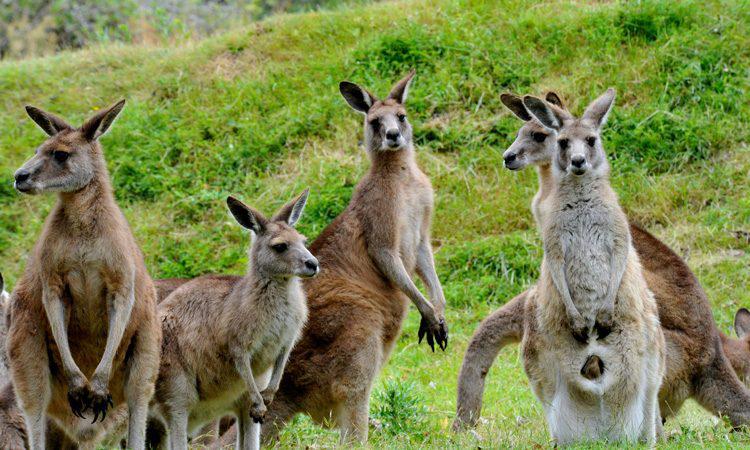
You are probably asking, “So what’s K-Leather?” Simply put, it is leather made from the skins of Kangaroos. Many buyers of football boots, sports shoes, bikers’ leathers, handbags, fashion garments or other items don’t realize their “k-leather” labelled purchase is made of kangaroo skin.
THE INDUSTRY AND THE GOVERNMENT The commercial slaughtering of kangaroos in Australia is sanctioned and financially supported by the Australian government. All Australian wildlife is, by law, ‘protected,’ but not from the government.
Killing kangaroos for profit is the largest land-based slaughter of wildlife on our planet, not something the Australian Government or Australian citizens can be proud of. The average Australian knows very little about the killing of kangaroos for commercial purposes, so effective is the facade erected by the government to hide the truth.
Today the main driver for the slaughter of millions of kangaroos has changed from purging the countryside of a perceived pest to landholders to utilizing this “protected” native animal as a managed and profitable renewable resource.
The Kangaroo Industries Association of Australia, or KIAA, was formed in 1970 and self-governed. Its original purpose was to take over the shooting of kangaroos from farmers to spare landholders the time this required, and the cost of guns and bullets. Today the KIAA orchestrates the commercial killing of kangaroos for profit. In addition, through a permit system in every State and Territory, anyone can apply for a permit to kill wildlife. By far the greatest number of animals killed under the permit system are kangaroos. Kangaroos are now being slaughtered on two fronts, the commercial industry and the permit system.
The KIAA kills well over two million kangaroos and joeys each year, with more than an additional million killed under the permit system. The in-pouch or at-foot joeys that are killed in accordance with the recommendations in the ‘National Code of Practice for the Humane Shooting of Kangaroos and Wallabies’ are not counted, as they are considered collateral damage. When a female kangaroo is killed and she has an at-foot Joey and an in-pouch joey, three kangaroo families are lost.
The rationale for KIAA taking over the shooting of perceived pests from farmers was the idea that it would provide experienced shooters, and carcasses would be used rather than left where they fell. Like a lot of good ideas, this one morphed into a full-blown industry, intent on gaining as much trade as possible for kangaroo skins and meat. KIAA found markets in Australia and many overseas countries for meat and skins, with skins being the main commodity. Only half of kangaroo meat is fit for human consumption. The rest is sent to pet food manufacturers.
Our Federal Government views kangaroos as a ‘commodity’ and fully supports their killing. For every kangaroo killed, the processor pays a levy to the Federal Government. The money is used for research projects that benefit the commercial industry.
Our taxes are used to support the commercial industry dedicated to killing our national icon. See here and here and here
THE CODES OF PRACTICE
Two National Codes of Practice, one for commercial killing and another, almost identical, for Non-commercial killing. These Codes of practice are held up as bibles of confirmation that everything possible is being done to make the slaughter more humane. However, the killings take place in isolated locations far from scrutiny and there is virtually no enforcement. Section 2.3 on Shooting procedures reads:
Where an individual kangaroo or wallaby is injured, no further animals can be shot until all reasonable efforts have been made to locate and kill the injured animal.
Unless the shooter is a very humane person this doesn’t happen. Time is of the essence to a shooter and looking for an injured animal is time wasted. That section continues: If a female kangaroo or wallaby is shot then any dependent young at foot must be shot as soon as possible
Again, time is money. If an in-pouch joey is found the Code requires he or she be killed “Where euthanasia is carried out using a blow to the head, the blow must be delivered with force sufficient to crush the skull and destroy the brain. The blow should be delivered with a suitably hard and heavy blunt instrument.” Is this humane? There is no scientific proof the joey dies immediately. Is pain felt? Of course, it is. The most common form of euthanising an in-pouch joey is to either swing the animal in the air and bash the head on the bull bar of the shooter’s ute or for the shooter to crush the head with the heel of his boot.
Another Section of the Code on Competence requires that kangaroos be killed by a shot to the head, but nobody, no matter how good a shot they are, can hit the small head of a kangaroo 100% of the time. There are missed shots blowing off the jaw of a kangaroo, or shooting a kangaroo in the neck or body.
3) Nowhere in the Codes of Practice does it mention monitoring the shooters' compliance with the Code. Shooters are not obliged to let authorities know where or when they are shooting. In the unlikely event an inspection should be carried out, the authorities would need to ask the shooters where and at what time they would be at a particular location, which would mean of course everything would be ship-shape.
The Code of Practice is not worth the paper it is written on, it is not ‘enforcable’ but our Federal Government and KIAA continually tout it as the basis for ethical sustainability of kangaroo slaughter. Mark Pearson MP has made public comments on the shortcomings of the Code.
PLAYING WITH NUMBERS
The number of kangaroos in Australia is the lynchpin for keeping the Commercial Industry viable. Australia has internalised a widely-repeated belief about the extravagant overabundance of kangaroos as they eternally bound through the Aussie landscape as shown in advertisements or government publications.
Government statistics allow people to be relaxed and comfortable about whatever is meted out to kangaroos (Maria Taylor). The method for counting kangaroos is very similar in each State. A plane or helicopter flies over sections of the zones designated for commercial killing. Spotters on the aircraft mark down the number of kangaroos they have seen. A “correction factor” is then used to adjust the count for kangaroos too small to see, lying under trees, inhabiting the areas not flown over by the spotters (and probably those on the Qantas planes also.)
This correction factor is used by State Governments to manipulate the kangaroo population figure, by up to 14 times more than counted. However, analyses of the data highlight egregious errors, confirming that authorities are hiding an alarming drop in the number of kangaroos so the slaughter can continue.
For example, in 2010 the official total population of kangaroos in Australia was 25,158,02. One year later, in 2011, the total rocketed up to 34,303,677, a massive jump of 9,145,651. It is a biological impossibility for kangaroos to increase their numbers to this extent.
Kangaroos are slow breeding animals. The greatest possible increase is 10% a year, and this is during ‘good times.’ The juvenile mortality rate is around 75% but can reach 100% during drought. It takes 18 months to bring a joey to the point of weaning. During drought, kangaroos can control their breeding and it is very limited. This link gives a lot of valuable information and is a must to see.
https://www.facebook.com/bathurstkangarooproject/photos/a.1406573629491156/1823069114508270/?type=3&theater all credits go to Ray Mjwesch, Conservation Biologist/Ecologist. WWW.kangaroosatrisk.net
Landholders are very fond of saying “kangaroos are in plague proportions” but interestingly there is never any evidence to verify these claims. On the contrary, kangaroos have been wiped out in many regions and have become ‘locally extinct’. The population is less than half what it was in 2001 and collapsed by nearly 2 million between 2009 and 2010. The numbers game is a controlling manipulation of population figures for the monetary benefit of the government. No consideration is given to the permanence of the kangaroos.
SKINS
Using kangaroo skins for leather is not a new revelation. Articles appeared in newspapers singing its praises as early as 1806, with skins and leather exported as early as 1826. Today’s exports of skins and leather are measured by the kilogram, not by number, another ploy by the government to avoid transparency.
Tourism plays a significant part in Australia’s economy, contributing to both GDP and employment. In 2018–19, GDP from tourism was $60.8 billion, making the economic value of the kangaroo industry minuscule. The third most popular ‘must-see’ for tourists is the kangaroo. It makes much more sense to use this ‘natural resource’ to attract tourists than to continue to decimate kangaroo populations for commercial trade.
See the campaign https://kangaroosarenotshoes.org/
THE SLAUGHTER OF OUR KANGAROOS MUST STOP BEFORE WE LOSE THEM. THEY ARE WORTH MORE ALIVE THAN DEAD


 Daily Bulletin


