

Election campaign lesson #1: don't mess with Medicare
- Written by: Jim Gillespie, Deputy Director, Menzies Centre for Health Policy & Associate Professor in Health Policy, University of Sydney
Labor’s 2016 “Mediscare” has entered political memory as a campaign tactic that almost changed the game in that election. Using robocalls and text messages purporting to come from Medicare, government proposals to outsource management of back-office business became inflated into an all-out “privatisation” of Medicare.
The hyperbole cut through because of a long history of Coalition hostility to Medicare as a universal health scheme. The then Turnbull government didn’t lose the election, but it became accepted wisdom that the Mediscare campaign contributed to the loss of some seats.
Health has taken centre stage once again this election, with both sides trying to use “Mediscare” tactics to drive fear about cuts or shortfalls in the health system.
Coalition hostility
Both the Whitlam government’s Medibank and Hawke’s Medicare faced withering hostility from Australian conservatives.
Australia became one of the only nations to introduce universal health coverage in 1975. This aimed to ensure all Australians had access to a wide range of health services at little or no cost, no matter where you lived or how much money you earned.
But the Fraser Coalition government abolished the system in 1981.
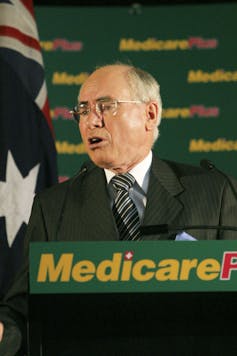 Howard changed his tune on Medicare.
Shaney Balcombe/AAP
Howard changed his tune on Medicare.
Shaney Balcombe/AAP
After three years of debate about the role of private health insurance, and indivuals’ responsibility to pay for their own health care, universal health care was re-established in 1984 by the Hawke Labor government, under the new name: Medicare.
In 1987, then opposition leader John Howard promised to return to a user-pays system based on private health insurance. He wanted to “take a scalpel, without punning too much, to Medicare”.
But rather than backing Howard’s plan, voters delivered a string of Coalition electoral losses. In 1990, the Liberal shadow minister for health confessed to the press, just before resigning:
I want to say with all the frankness I can muster, the Liberal and National Parties do not have a particularly good track record in health, and you don’t need me to remind you of our last period in government.
Read more: Labor's 'Mediscare' campaign capitalised on Coalition history of hostility towards Medicare
Howard’s 1996 electoral success relied on defusing the Medicare issue. He assured voters that “Medicare will remain totally in place under a Coalition government”.
However, he retained some of his ambivalence. Howard supported Medicare’s role as a “safety net” to support people with few financial resources. But the Coalition believed those who could afford it should pay their own way, through private health insurance.
The Abbott government’s 2014 Commission of Audit report restated this call for a two-tier health system:
Higher-income earners should be required to insure for basic health services in place of Medicare.
The incoming Turnbull government rejected this advice. But the debate reinforced an image of a reluctant and half-hearted convert.
When the Coalition extended the Medicare benefit freeze, which was originally introduced by Gillard’s Labor government, the extension hurt the Coalition far more than it had Labor.
Read more: What is the Medicare rebate freeze and what does it mean for you?
Embracing Medicare or avoiding a Mediscare?
The Coalition has been determined to avoid this trap again. The Turnbull and Morrison governments have underlined support for Medicare. The 2019-20 Budget documents are punctuated with statements about “guaranteeing” and “strengthening” Medicare. It also declares: “The government’s commitment to Medicare is rock solid.”
The Medicare Guarantee Fund was established in 2017 to emphasise this commitment. Tax dollars generated by the Medicare levy (minus the portion set aside for the National Disability Insurance Scheme), go into the fund. These are topped up with enough personal income tax receipts to meet the combined cost of the Medicare Benefits Schedule (MBS) and Pharmaceutical Benefits Scheme (PBS).
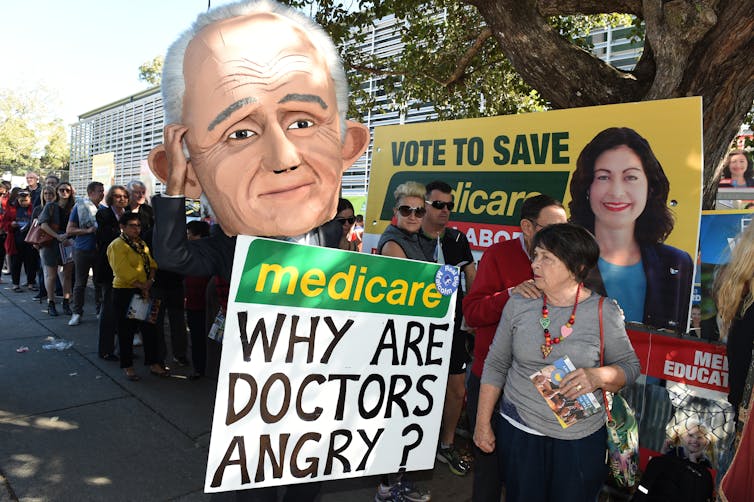 The 2016 Mediscare campaign caused more than a headache for the Coalition.
Dan Peled/AAP
The 2016 Mediscare campaign caused more than a headache for the Coalition.
Dan Peled/AAP
But the fund has been criticised as mere rebadging and an “accounting trick”. It offered no new funding or new policies; it simply changed the name of existing policies, and extended the definition of “Medicare” from payments of medical benefits to include pharmaceuticals.
But the “Medicare guarantee” wasn’t extended to guarantee adequate federal funding for public hospitals, which remains a problem.
Read more: Don't be fooled, the Medicare Guarantee Fund provides no real guarantee
When it comes to embracing Medicare and health funding, Labor has been called out for some of its own lapses.
In 2011 the Gillard government, during its struggles for control of spending, delayed implementation of some expensive pharmaceuticals, causing outrage among health provider and patient groups.
Labor has had to add its own guarantee this election campaign that all PBS drugs approved by the nation’s expert advisory panel will be approved immediately.
Mediscare 2.0
Labor’s new attempt at scare tactics over Medicare uses well established themes. It will test how far the Coalition has been able to inoculate itself.
The attack has again focused on the out-of-pocket costs from declining bulk-billing levels, especially in cancer treatment.
Despite the Gillard government’s Medicare rebate freeze, Labor has held the high ground in this cost debate. Its cancer package focuses on extending bulk billing to minimise out-of-pocket payments.
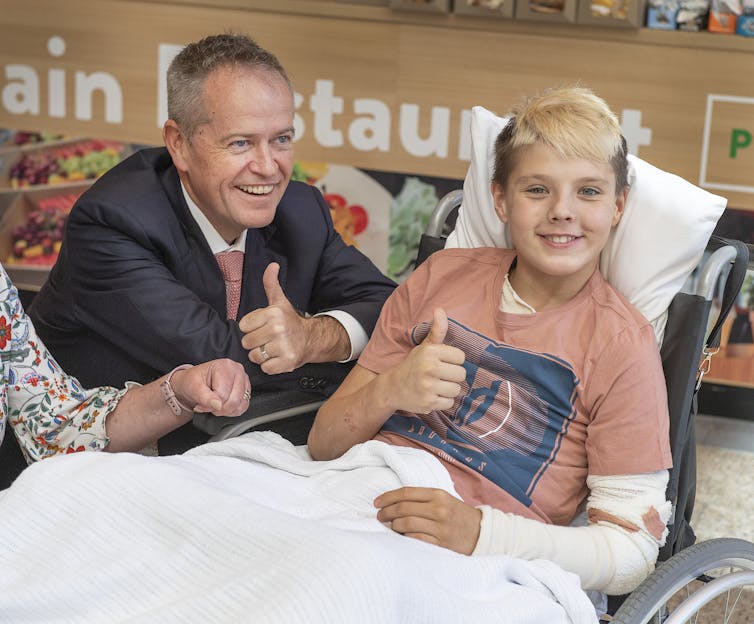 Labor has focused on spruiking its cancer package.
Ellen Smith/AAP
Labor has focused on spruiking its cancer package.
Ellen Smith/AAP
In the field of hospital funding, Labor’s “Mediscare 2.0” focuses on a A$2.8 billion “cut” in funding to the states to pay for public hospitals.
In 2011, the Rudd/Gillard government pledged to share the cost of public hospital funding growth with the states with a 50-50 split to end the “blame game”. The Abbott government abandoned this policy in the 2014 budget.
Read more: Budget takes hospital funding arrangement back to the future
The Coalition, under Turnbull, offered to return to funding 45% of the cost of public hospitals. The Labor-held states rejected this, and Shorten has now promised to restore this to 50%. Labor has made traction with these attacks, though much of the detail has been lost or confused in media soundbites.
Election campaigning in health has forced the Coalition to accept how much Australians value Medicare and the principle of universal health coverage. As the common ground between Labor and the Coalition expands, we may be able to have a more rational debate over Medicare’s virtues and deficiencies. But not in the partisan heat of an election.
Authors: Jim Gillespie, Deputy Director, Menzies Centre for Health Policy & Associate Professor in Health Policy, University of Sydney
Read more http://theconversation.com/election-campaign-lesson-1-dont-mess-with-medicare-114292


 Daily Bulletin


