

Explainer: what is inquiry-based learning and how does it help prepare children for the real world?
- Written by: Gillian Kidman, Associate Professor, Science Education, Monash University
Inquiry-based learning emphasises a student’s role in the learning process and asks them to engage with an idea or topic in an active way, rather than by sitting and listening to a teacher. The overall goal of an inquiry-based approach is for students to make meaning of what they are learning about and to understand how a concept works in a real-world context.
The inquiry approach is sometimes known as project-based or experiential learning. To learn about a topic, students explore resources, ask questions and share ideas. The teacher helps students apply new concepts to different contexts, which allows them to discover knowledge for themselves by exploring, experiencing and discussing as they go.
Learning through inquiry can be done differently depending on the subject area and the age of the student. Inquiry-based teaching and learning practices feature in many classrooms across the world. Teachers are conducting lessons with an inquiry-based approach, or aspects of it, without realising it.
How does it actually work?
If you’ve read the Harry Potter books, or watched the movies, you may remember that, in “The Order of the Phoenix”, Harry’s class gets an unpopular Defence Against The Dark Arts teacher, Dolores Umbridge. Her teaching method is based on learning through textbooks and discipline.
Harry questions whether this type of learning will help young wizards and witches if they ever come across the dark lord, Voldemort. So Harry sets up his own classroom in secret, where the class practise spells and learn from each other. This is a good example of inquiry-based learning.
Harry Potter’s version of the inquiry-based approach to learning defence against the dark arts.US philosopher and liberal education reformer John Dewey advocated learning through inquiry. His work to change pedagogical methods and curricula in 1916 was developed into classroom experiences in the 1930s. Although initially influencing schools in the United States, Dewey’s influence spread worldwide.
A key characteristic of inquiry is that it is externally and internally motivated, by the student. External motivation includes members in the team, the nature of the project and feedback from teachers. Intrinsic motivations include an eagerness to learn.
Although the inquiry is motivated by the student, it is guided by the teacher. A skilled inquiry teacher will vary their role along a continuum – from explicit instruction (where the teacher has clear goals as to what he or she will present to the students) to an inquiry approach that helps students control their learning.
Read more: Explainer: what is explicit instruction and how does it help children learn?
From primary to secondary
The primary school classroom offers rich inquiry opportunities as there is usually one teacher per class and s/he can use inquiry to link ideas and activities between learning areas. I observed a Year 1 classroom where the teacher and students were exploring nursery rhymes while developing early reading skills.
During the reading of Jack and Jill, a six-year-old boy asked: “What is the hill made out of?” The teacher built on this question to create an inquiry experience spanning five weeks. The children learnt concepts in science (forces, pushes, pulls, friction, soil types, rock types) and mathematics (slopes, fractions, time).
In doing so, children’s reading, writing and spelling (push, pull, trip, fall, tumble, slope etc) were enhanced. The class explored the geography of hills and mountains. Literacy, mathematics, science and humanities lessons revolved around learning about hills and answering the original question.
The class concluded that Jack slipped on wet clay and Jill tripped on a rock embedded in the clay. The class also discussed pushing and shoving each other, with one child asking if Jill could have been pushed by the same person who pushed Humpty Dumpty off the wall.
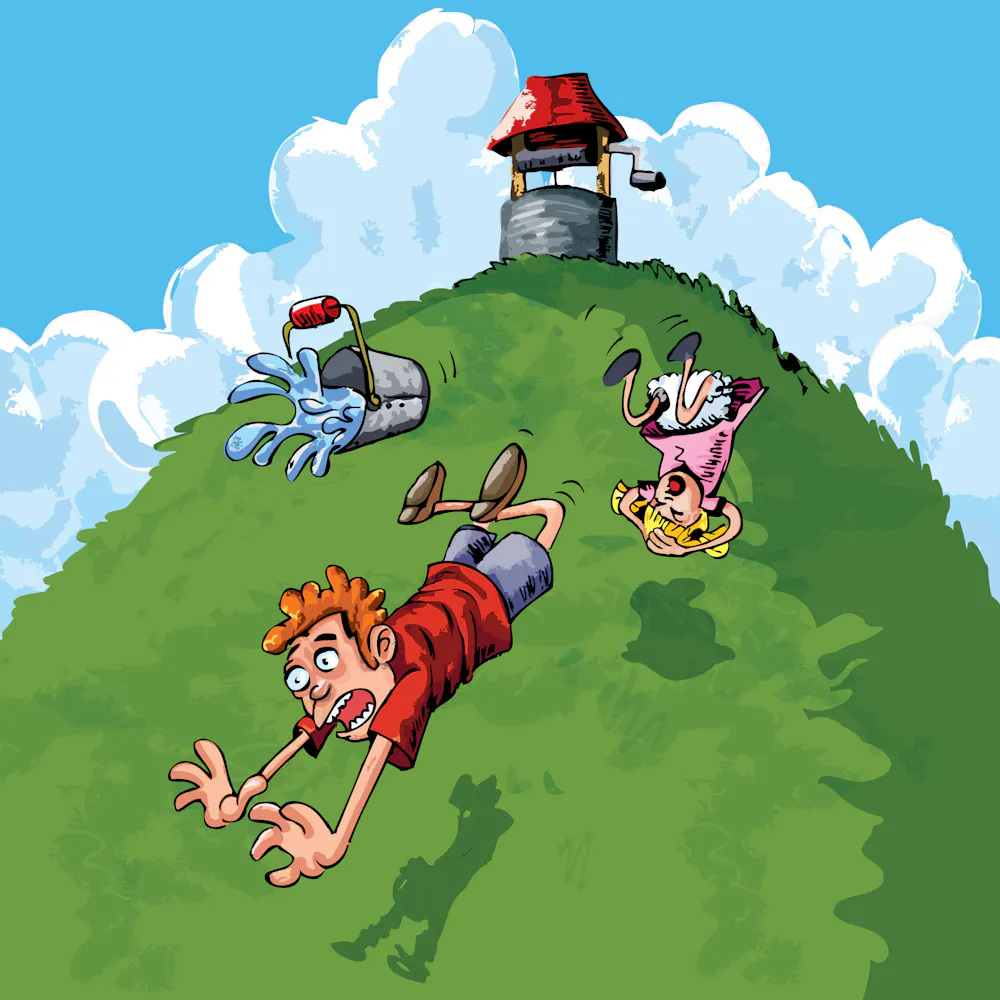 One lateral query about a nursery rhyme led to five weeks of inquiry-based learning.
from shutterstock.com
One lateral query about a nursery rhyme led to five weeks of inquiry-based learning.
from shutterstock.com
In secondary schools there are multiple teachers and classes, and therefore reduced opportunity for integrated inquiry. So the inquiry is generally within disciplines.
Different disciplines have different models for inquiry. In history, for instance, Telstar prompts inquiry by checking questions for guiding student progress. And in science, there are the 5 Es where literacy is emphasised in five consecutive phases – engage, explore, explain, elaborate and evaluate.
Teachers usually start with these generic models to accompany information contained in curriculum documents.
Challenges and misconceptions
The main challenge with an inquiry approach is assessment. Standardised testing monopolises educational assessment, which puts a value on core literacies: reading, writing, computation, and the accumulation of facts and figures. Educators are only beginning to identify parameters through which they can assess students’ discovery of knowledge and making meaning.
Read more: Why your child will benefit from inquiry-based learning
Global culture has become one of innovation, discovery and interdisciplinary thinking, which means solely relying on a standardised way of learning and testing is at odds with the outside world. Educators promoting an inquiry-based learning system believe it is only a matter of time until inquiry skills take precedence over learning content.
Misconceptions about using inquiry-based learning in the classroom include inquiry being too difficult for most students (that it is for the older gifted child) and that during inquiry the teacher does little and the class is in chaos.
But inquiry-based learning, guided by a teacher who models the process to various students, is valuable for the whole class. Classroom chaos is rarely seen in situations where the teacher is an active learner alongside their students.
Inquiry is part of human nature, but one can benefit from learning how to be a good inquirer. This includes learning skills such as how to ask and answer questions, solve problems and conduct investigations and research. To be an inquirer is liberating, exciting and transformative. It involves taking risks and is intellectually demanding. And, above all, it helps us learn.
Authors: Gillian Kidman, Associate Professor, Science Education, Monash University


 Daily Bulletin


