

Focus on managing social housing waiting lists is failing low-income households
- Written by: Abigail Powell, Associate Professor at the Centre for Social Impact, UNSW
A need to manage waiting lists, rather than ensuring positive outcomes for tenant households, strongly influences social housing policy, newly published research finds. This situation is not only a result of operational policies, but also a shortage of social housing stock that is suitable for tenants and a lack of viable alternatives – namely affordable, safe and secure private housing. Eligible applicants who don’t have a “priority need” can wait up to ten years to be housed. They face strict eligibility checks just to remain on the waiting list.
Since the large-scale post-war expansion to house working-class families, the social housing sector has shrunk relative to the rest of the housing system. More than 140,000 people are on public housing waiting lists.
Importantly, this figure does not capture unmet demand such as people sleeping rough and very low-income households in housing stress who are not on waiting lists.
Read more: Homelessness: Australia's shameful story of policy complacency and failure continues
Waiting lists also don’t include hidden demand such as people suspended from waiting lists or excluded by their visa status.
The supply of social housing stock simply does not match the growing numbers of households experiencing housing affordability problems. Between 2011 and 2016, government spending on social housing fell by 7% from A$1.42 billion to A$1.32 billion. Today, social housing is provided to over 800,000 tenants in more than 400,000 households – 76% in public housing, 20% in community housing and 4% in Indigenous housing.
The expansion of public housing (delivered by state and territory housing authorities) to community housing and Indigenous housing (delivered by non-profit community organisations and Indigenous organisations) has transformed social housing. Community housing has increased by 121% between 2008-09 and 2017-18. This growth includes tenanted stock transfers from public housing.
Read more: Australia's social housing policy needs stronger leadership and an investment overhaul
Against this background, policymakers are increasingly seeking to promote housing “pathways”. Operational housing policies are intended to improve tenant housing and social outcomes (such as well-being and economic participation), but also to manage long waiting lists and make the system more efficient.
These policies shape housing pathways, determining how tenants and households move into, within and out of social housing. But these pathways are also influenced by household relationships and a household’s changing needs. What a tenant or family need from their housing changes when, for example, relationships break down, new relationships begin, children are born or children leave home.
Our research sought to better understand the policy context behind housing pathways and their impacts on tenants’ experience.
Getting in
Pathways into social housing begin with application, which is a centralised process in most states and territories (apart from the Northern Territory). Prospective tenants apply once through a single portal, with information shared between government housing departments and community housing providers.
The success of an application depends on a range of eligibility criteria (see Table 1), starting with income and assets. Even if a prospective tenant meets the income criteria, priority is given to people and households with specific or complex needs. What constitutes “specific or complex needs” varies, but generally includes disability, poor physical or mental health, experience of family violence, exiting institutions, or being homeless or at risk of homelessness (the most common pathway into social housing).
Other criteria include citizenship and residence status (including restrictions based on permanent residency/citizen status), age and tenancy history.
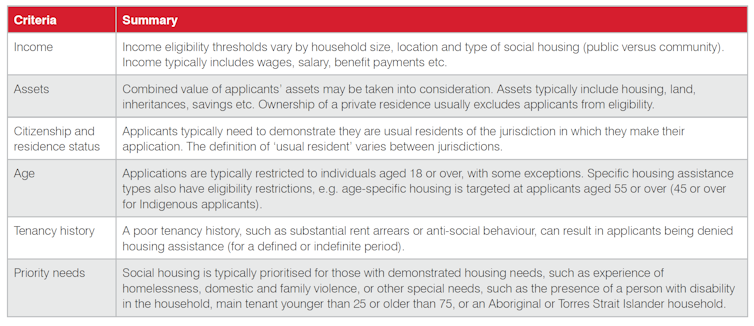 Table 1: Summary of common eligibility criteria.
Source: Powell et al 2019, Author provided
Table 1: Summary of common eligibility criteria.
Source: Powell et al 2019, Author provided
An applicant’s place on the waiting list is continually checked. If an applicant is found to be ineligible, or simply does not respond, they may be suspended or removed from the list.
Staying in
Most states and territories have policies on the eligibility of tenants to continue in public housing. Criteria include income levels, use of the premises, and household change. What criteria are reviewed, and how often, varies widely.
Eligibility reviews mean tenants fear any extra income might result in an end to their tenure or having to make higher rent contributions. This potentially undermines their preparedness to undertake education and training, or take up work opportunities that might lead to greater independence.
Moving within
Policies allow tenants to apply for a transfer if household circumstances have changed. A dwelling might no longer be suitable – for example, as a result of overcrowding or family violence.
In practice, however, supply constraints make this challenging. Policies that transfer public housing properties to community housing providers result in tenants becoming less mobile as moving between public and community housing is not possible.
Landlord-initiated transfers can also occur. For example, property or housing estate renewal might require tenant relocation. A transfer might also be a result of tenant conduct or changes in eligibility status.
Moving out
Exits from social housing may occur when a tenant chooses to move to private housing or is evicted. Eviction may result from issues such as neighbourhood disputes, anti-social behaviour, rental arrears, a lease coming to an end, or changes to eligibility.
Tenants who are no longer eligible for social housing based on their income may also be evicted. These tenants often still have limited capacity to take on and manage a private rental tenancy.
Policy levers to help with moves out of social housing include: selling dwellings to tenants; providing private rent subsidies; rental transition programs; financial planning; and client-based needs planning. Some policies also target private landlords with a goal of increasing housing affordability and therefore pathways out of social housing.
By far the biggest obstacle to moving out of social housing, however, is the lack of affordable housing alternatives.
Read more: Can the private rental sector provide a secure, affordable housing solution?
What this means
While operational policy establishes formal pathways (by setting eligibility criteria and so on), what happens in practice may be different, as service providers can interpret and implement policies in different ways, with different effects for tenants.
Further, what is known about the housing pathways of tenants moving in, within and out of social housing is based on partial evidence. It comes from social housing providers themselves (missing information about events prior to and following occupancy), or from survey research seeking to fill some of the data gaps. Many blind spots exist in the housing pathways evidence base.
Optimal policy development requires clear, up-to-date evidence on how we might understand social housing pathways within a changed housing policy and housing assistance context. We also need to consider what advances in administrative and longitudinal data can tell us about how policy innovation might improve social housing pathways.
Read more: Is social housing essential infrastructure? How we think about it does matter
Authors: Abigail Powell, Associate Professor at the Centre for Social Impact, UNSW


 Daily Bulletin


