

Making our cities more accessible for people with disability is easier than we think
- Written by: David Kelly, Human Geographer, Deakin University
You would think a city that each year hosts Australia’s largest conference for people with disability would be the most accessible for all people.
Not according to our research which highlights 119 issues that need fixing if Geelong, Victoria, wants to be a model “city for all”.
Clearly there’s a shortfall between aspiration and reality, which is surprising given that in the last Census count, about 6% of Geelong’s population reported they needed help because of disability. That’s higher than the national figure of 5.1%.
Read more: Don't blame parcel delivery vans for clogging up city traffic, look to the tradies
Geelong is also home to the National Disability Insurance Agency, WorkSafe, and the Traffic Accident Commission, so it should be a shining example of what is termed access and inclusion (A&I) for people with a disability.
A city for everyone
The challenge for Geelong is to identify what is a model city for people with a disability.
There are a few examples to consider. Many cities around the world have tackled disability access through technological solutions to help people get around, such as personal navigation with smartphones.
Melbourne introduced beacons that connect to a smartphone app, to help vision-impaired people navigate their way inside Southern Cross Station and some other stations.
Overseas, the city of Breda, in the Netherlands, was this year declared Europe’s most accessible city. It has done several things to improves access, such as smoothing the centuries-old cobbled pathways, providing ramps, and rolling out digital navigation across the city.
Central to all these efforts is the collaborative design of solutions, working with people who have experience of disability access.
The need for change
In Geelong, more than 100 people responded to a visitor’s survey, and 75 people with experience of disability participated in a series of three workshops and three focus groups.
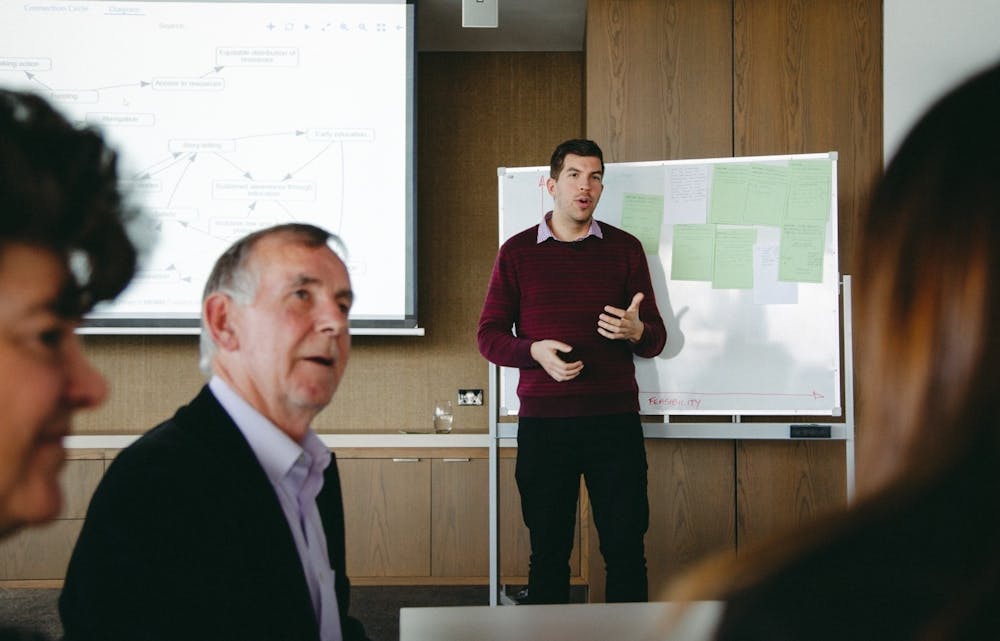 Tapping into local knowledge at a workshop at Deakin University.
Deakin University, Author provided
Tapping into local knowledge at a workshop at Deakin University.
Deakin University, Author provided
We found there are a series of things that could be implemented to improve accessibility and exclusion in Geelong.
Some things are simple, such as providing ramps instead of steps, and adequate restroom facilities; others involve remaking the city and may seem more difficult.
But the response from people with disability was typically modest, with one participant saying “we don’t expect the Taj Mahal”.
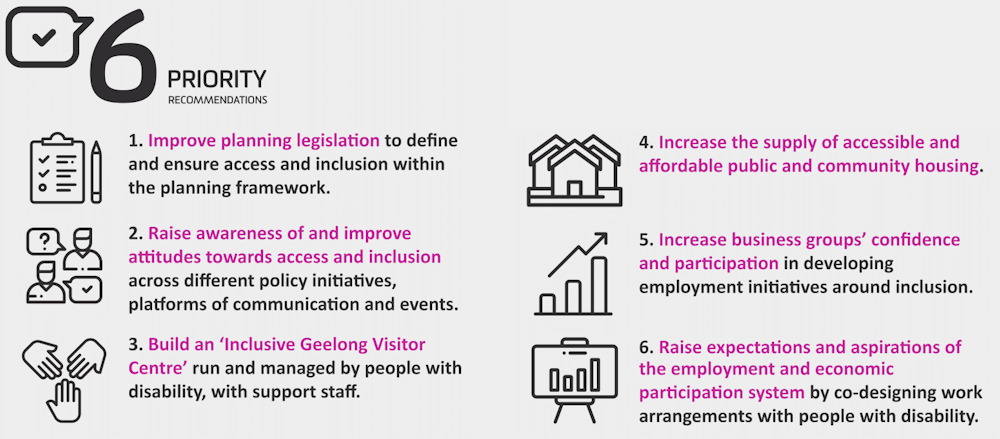
In all, we recommend six priority areas for action.
 Deakin University, Author provided
A number of problems continue to undermine efforts to rectify city-wide problems and these must be addressed. These include amendments to legislation to define and ensure “access” and “inclusion” are within the planning framework.
There also needs to be significant change to the business-as-usual approaches to housing, instead prioritising the supply of public and community housing in general, but especially for people with disability.
On employment, we need to co-design workplace arrangements so both the needs of people with disability and employers are met. This is key to ensuring those with a disability who seek work are able to attain it.
Access to information
One action identified was to build an Inclusive Geelong Visitor Centre (IGVC) run
and managed by people with disability, with accessibility support staff. The centre would provide accessibility information and serve as a landing pad where people can gather information before exploring the city.
Deakin University, Author provided
A number of problems continue to undermine efforts to rectify city-wide problems and these must be addressed. These include amendments to legislation to define and ensure “access” and “inclusion” are within the planning framework.
There also needs to be significant change to the business-as-usual approaches to housing, instead prioritising the supply of public and community housing in general, but especially for people with disability.
On employment, we need to co-design workplace arrangements so both the needs of people with disability and employers are met. This is key to ensuring those with a disability who seek work are able to attain it.
Access to information
One action identified was to build an Inclusive Geelong Visitor Centre (IGVC) run
and managed by people with disability, with accessibility support staff. The centre would provide accessibility information and serve as a landing pad where people can gather information before exploring the city.
 It helps to know where to go to find information on disabled access and services.
Deakin University, Author provided
Many participants noted this idea has been discussed in various forums for the past 30 years, but nothing had ever happened.
Projects like this are often seen as luxuries that are more symbolic than tangible. Our analysis shows that if implemented in coordination with a series of other actions, such as providing disability support services and empowering people with disability to lead conversations, it could encourage further change and reform.
In isolation, an IGVC was evaluated by the community as having a high impact rating (10/10), but a low feasibility rating (3/10). The low perception of feasibility perhaps explains why this project has never come to fruition.
At a bare minimum, an IGVC must have a full suite of accessibility support services and provide spaces for all abilities where people can access up-to-date information and plan activities for the length of their stay.
Read more:
Buried beneath the trees: a plan to solve our shortage of cemetery space
The centre would allow people with disability to make informed choices about accessible travel, accommodation, services, and other aspects of urban participation.
It should be staffed by qualified support workers and people with disability, connect people to different support agencies and work with providers to bring accommodation up to accessible standard.
But no meaningful impact can be realised by isolating any actions from the list of fixes. There needs to be consideration of how all other factors relate to issues of accessibility and inclusion across multiple scales.
These lessons are not just for Geelong, other cities could also follow these steps to make themselves more inclusive and accessible.
It helps to know where to go to find information on disabled access and services.
Deakin University, Author provided
Many participants noted this idea has been discussed in various forums for the past 30 years, but nothing had ever happened.
Projects like this are often seen as luxuries that are more symbolic than tangible. Our analysis shows that if implemented in coordination with a series of other actions, such as providing disability support services and empowering people with disability to lead conversations, it could encourage further change and reform.
In isolation, an IGVC was evaluated by the community as having a high impact rating (10/10), but a low feasibility rating (3/10). The low perception of feasibility perhaps explains why this project has never come to fruition.
At a bare minimum, an IGVC must have a full suite of accessibility support services and provide spaces for all abilities where people can access up-to-date information and plan activities for the length of their stay.
Read more:
Buried beneath the trees: a plan to solve our shortage of cemetery space
The centre would allow people with disability to make informed choices about accessible travel, accommodation, services, and other aspects of urban participation.
It should be staffed by qualified support workers and people with disability, connect people to different support agencies and work with providers to bring accommodation up to accessible standard.
But no meaningful impact can be realised by isolating any actions from the list of fixes. There needs to be consideration of how all other factors relate to issues of accessibility and inclusion across multiple scales.
These lessons are not just for Geelong, other cities could also follow these steps to make themselves more inclusive and accessible.
Authors: David Kelly, Human Geographer, Deakin University


 Daily Bulletin


