

Read The Times Australia

Daily Bulletin

Vital Signs. Untaxing childcare is a bold idea that seems unfair, but might benefit us all

  • Written by: Richard Holden, Professor of Economics, UNSW

Australia’s system of childcare support is pretty good.

It ensures high-quality care is provided to a large number of children, it is targeted through income-based subsidies, and it is attentive to the needs of disadvantaged children and families.

But it has significant weaknesses.

It is extremely complex, with four different rates of subsidy based on the type of care involved, six different income thresholds plus a sliding scale for how household income affects the subsidy, an annual cap of $10,373 per child for households earning more than $188,163, and an activity test to determine eligibility.

Worse, many families find it hard to get good childcare. Children are added to waiting lists from birth.

Read more: New childcare policy still leaves vulnerable families behind

And, as the Productivity Commission and others have pointed out, the sliding income scale and caps can mean that a parents looking to expand their working hours from 3 days to 4 days a week can face effective marginal tax rates approaching 100%.

This is not a good way to give parents choice about whether to work inside or outside of the home. By restricting (mainly female) choice it restricts the potential size of the workforce.

And that, in turn, contributes to the gender pay gap. On average, women earn only 86% of what men do.

Time out of the workforce is one of the key reasons.

How to do it
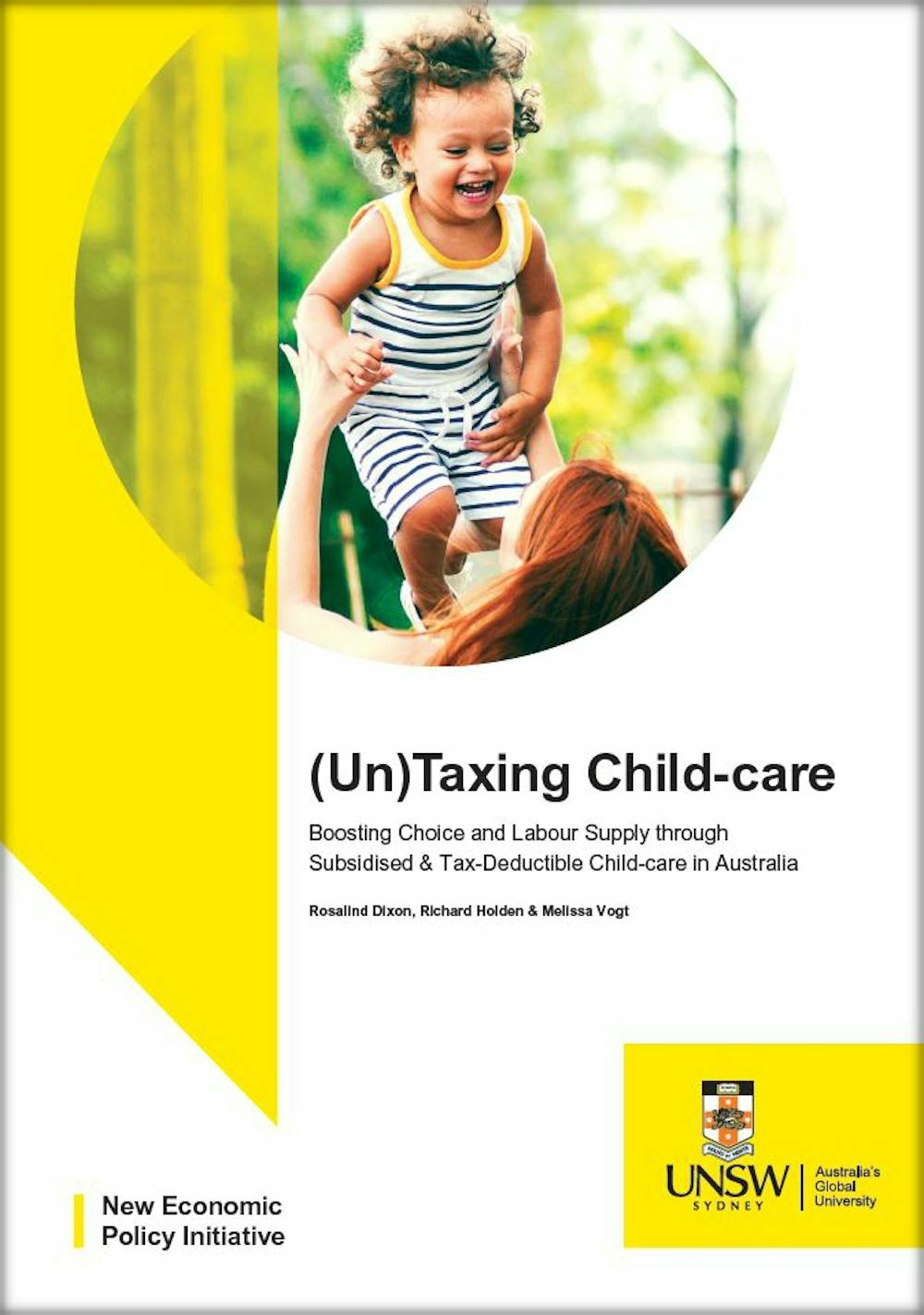
Vital Signs. Untaxing childcare is a bold idea that seems unfair, but might benefit us all UNSW New Economic Policy Initiative This week the New Economic Policy Initiative at the University of NSW launched a report coauthored by Rosalind Dixon, Melissa Vogt and myself entitled (Un)Taxing Childcare . Our proposal would allow households who want to to continue to use the current arrangements without modification. Household twho wanted to forego the current arrangements could instead receive a tax deduction for childcare expenses of up to A$60,000 per year. The money could be spent on centre-based childcare, home-based care, or a nanny. In two-parent households that took advantage of it, each parent would be able to deduct 50% of the cost at their marginal rate up to the limit. High earners would gain a lot… Modelling of the plan by Ben Phillips of the Australian National University finds our policy would leave more than 205,000 households better off – one in five households with children. The ability to pick systems means none would be worse off. The average couple with children would be $618 per year better off. Highest-earning households would benefit the most, with an average benefit for the top fifth of $1,080 per year. But the benefit for the second bottom fifth would also be high, at $626 per year, adding 1.9% to their disposable incomes. Objections will include the skew of benefits toward higher earners, an initial hit to budget of $608 million per year, and the possibility that the deduction will allow private providers to push up prices. …but the economy would gain the most Against them needs to be set the boost in the size of the potential workforce big enough to make the budget cost pay for itself, and an increase in the options available to parents considering returning to work. We estimate that if half of all eligible households took up the tax deduction option the economic benefit from additional work would amount to $3.9 billion per year, which is about the output of the entire Australian dairy industry. Read more: Election FactCheck Q&A: does the government spend more on negative gearing and capital gains tax discounts than on child care or higher education? The hybrid nature of our proposal means that low earners who stayed on the existing scheme would be no worse off. But the economy would be more vibrant, skills that have been built up would be retained and enhanced, and the gender pay gap could narrow.

Authors: Richard Holden, Professor of Economics, UNSW

Read more http://theconversation.com/vital-signs-untaxing-childcare-is-a-bold-idea-that-seems-unfair-but-might-benefit-us-all-127430

Business News

How Businesses Can Prepare for Unexpected Power Outages

Power failures can occur quickly. The supply may be interrupted by bad weather, issues with the electricity network, damaged equipment or local construction work. This can be just a hassle for a fam...

Daily Bulletin - avatar Daily Bulletin

How Chatswood Tutoring Can Fit Into a Student’s Weekly Routine

Create a Predictable Weekly Structure A consistent weekly routine can make study easier to manage when students are balancing several subjects. Chatswood tutoring can provide a fixed learning point a...

Daily Bulletin - avatar Daily Bulletin

The Rise of Digital Marketplaces in the Australian Trade Sector

For decades, the Australian trade and construction sector operated almost entirely on word-of-mouth recommendations and local community networks. Small business owners typically relied on local newspa...

Daily Bulletin - avatar Daily Bulletin

How Immigration Lawyers Can Help

Introduction Visa decisions can shape employment, family life, study plans, travel, and future residence. A small omission can lead to delay, added expense, or refusal. Immigration lawyers assess l...

Daily Bulletin - avatar Daily Bulletin

How Industrial Drying Equipment Supports Efficient Processing

Many industrial processes require moisture to be removed from compressed air, products or process materials before they move to the next stage. Excess moisture can affect equipment performance, produc...

Daily Bulletin - avatar Daily Bulletin

Practical Ways a Whiteboard Can Improve Workplace Communication

Effective communication helps teams stay organised, share ideas and keep track of important information. While digital tools are now common in many workplaces, a whiteboard continues to provide a simp...

Daily Bulletin - avatar Daily Bulletin

Designing Eco-Friendly Custom Water Bottles for Your Next Event

The Evolution of Sustainable Event Merchandise Event planning has undergone a massive transformation over the last decade. Gone are the days when organizers could hand out cheap, single use plastic...

Daily Bulletin - avatar Daily Bulletin

Why Choosing a Professional Florist Melbourne Makes Flower Delivery Impactful

Flowers have a great power to speak when humans cannot express their feelings with right words. Flowers are the best gifts when you are celebrating a birthday or welcoming a newborn child into your fa...

Daily Bulletin - avatar Daily Bulletin

The Business Case for Choosing Australian Fabricators Over Imported Alternatives

For a long time, you might have defaulted to overseas suppliers when sourcing fabricated metal components for a project. The unit price was lower on paper, and the maths seemed straightforward. That...

Daily Bulletin - avatar Daily Bulletin

The Daily Magazine

How fast can you charge an EV at home? Charger speeds explained

Ask new EV owners what worried them before buying and charging time comes up early. A petrol tank fi...

Crossing Several European Borders? How to Keep Your Phone Working the Whole Trip

A multi-country trip through Europe can cross three borders in a day. Take the coach from Split to...

Behind the Scenes: How Medicines Stay Safe Before They Reach Your Pharmacy

You pick up a prescription, glance at the label and pop the box in your bag without a second thought...

How Local Organisations Can Get Their Story Told in the Media

The local junior footy club raises enough money to send a team interstate. A community garden double...

Understanding the Compassionate Flexibility Built Into Religious Fasting Traditions

You've probably been aware of religious fasting as part of the cultural landscape, whether through...

The Rise of Australian-Made Spirits and What It Means for Local Drinkers

Not so long ago, ordering a local gin at the pub would earn you a blank look. Bottle shop shelves we...

How NDIS Providers Can Free Up Space and Run a Tighter Operation

Walk into the office of almost any growing NDIS provider and you will probably find a corner that ha...

Small Acts, Big Impact: How Australians Can Give Back to Their Communities

There is a common belief that giving back requires either a lot of money or a lot of time. Big chequ...

The Lost Art of Saying Thank You and Why It Still Matters

Somewhere between the arrival of email and the rise of the reaction emoji, the humble thank you shra...