

Coronavirus recovery: public transport is key to avoid repeating old and unsustainable mistakes
- Written by: Hussein Dia, Professor of Future Urban Mobility, Swinburne University of Technology
The coronavirus pandemic has affected our cities in profound ways. People adapted by teleworking, shopping locally and making only necessary trips. One of the many challenges of recovery will be to build on the momentum of the shift to more sustainable practices – and transport will be a particular challenge.
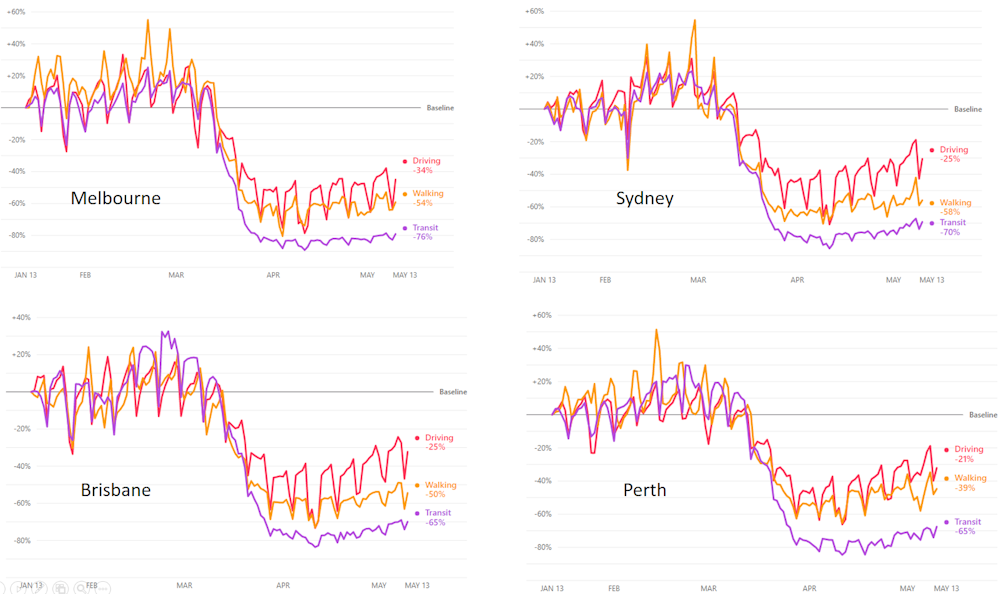 Reductions in trips from January to May, measured by change in trip routing requests.
Apple Maps COVID-19 Mobility Trends
Reductions in trips from January to May, measured by change in trip routing requests.
Apple Maps COVID-19 Mobility Trends
Read more: Transport is letting Australia down in the race to cut emissions
While restrictions are being eased, many measures in place today, including physical distancing and limits on group numbers, will remain for some time. As people try to avoid crowded spaces, public transport patronage will suffer. Thousands of journeys a day will need to be completed by other means.
If people switch from public transport to cars, road congestion will be even worse than before, emissions will soar, air quality will be poor and road safety will suffer.
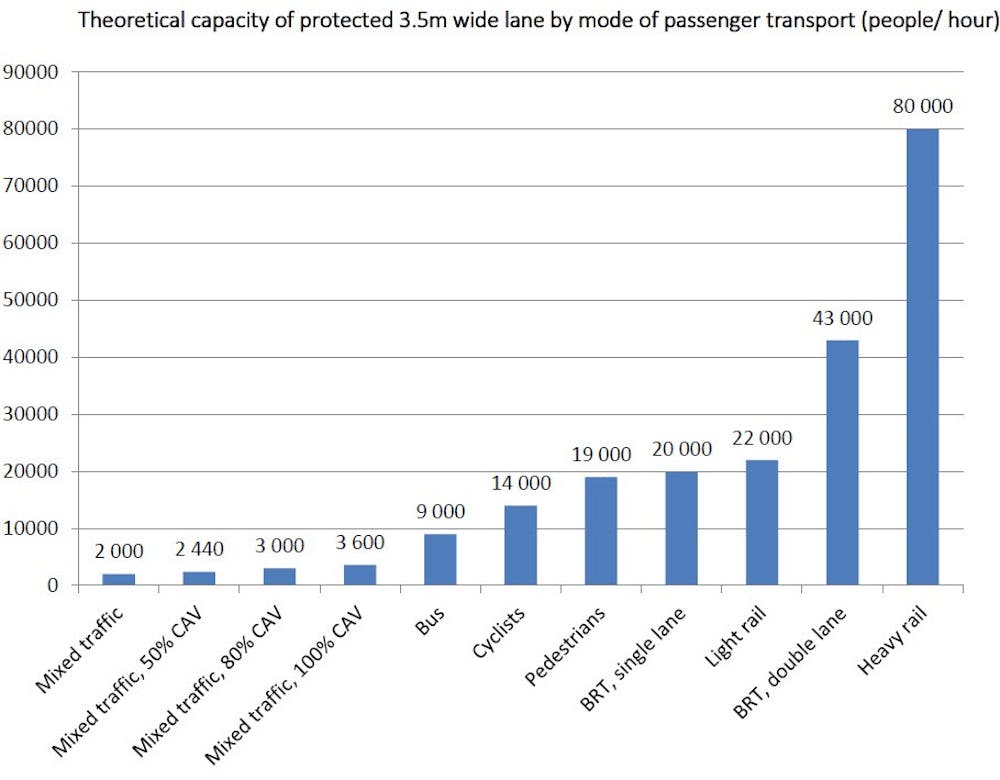 The capacity of mixed vehicle traffic is much lower than most people realise.
International Transport Forum, OECD. Data from Botma and Papandrecht 1991 and GIZ calculations 2009; CAV = connected and automated vehicles. Source: Synergine for Auckland Transport 2015, adapted from ADB and GIZ 2011; Shladover, Su and Lu 2012
The capacity of mixed vehicle traffic is much lower than most people realise.
International Transport Forum, OECD. Data from Botma and Papandrecht 1991 and GIZ calculations 2009; CAV = connected and automated vehicles. Source: Synergine for Auckland Transport 2015, adapted from ADB and GIZ 2011; Shladover, Su and Lu 2012
Re-imagining our cities
Cities are repurposing streets to meet higher demands for walking and cycling.
But not everyone can walk or ride a scooter or bike to their destination. Public transport must remain at the heart of urban mobility.
We will have to rethink public transport design to enable physical distancing, even though it reduces capacities.
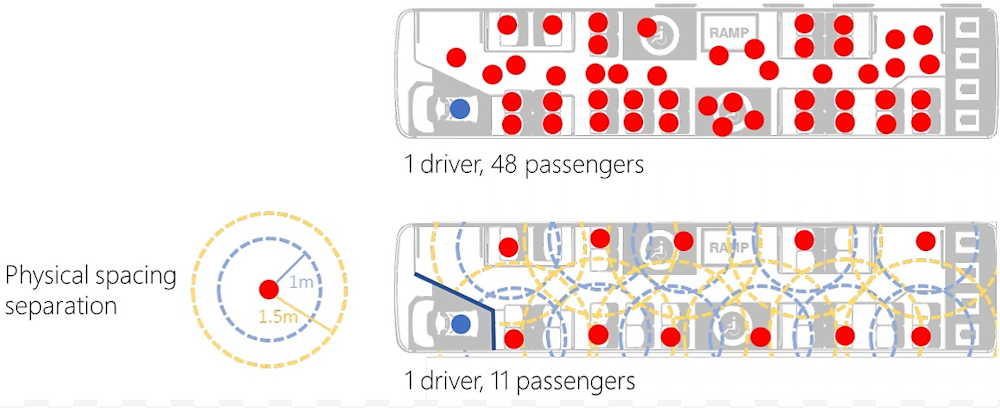 Impact of physical distancing on public transport capacity.
International Transport Forum, OECD
Impact of physical distancing on public transport capacity.
International Transport Forum, OECD
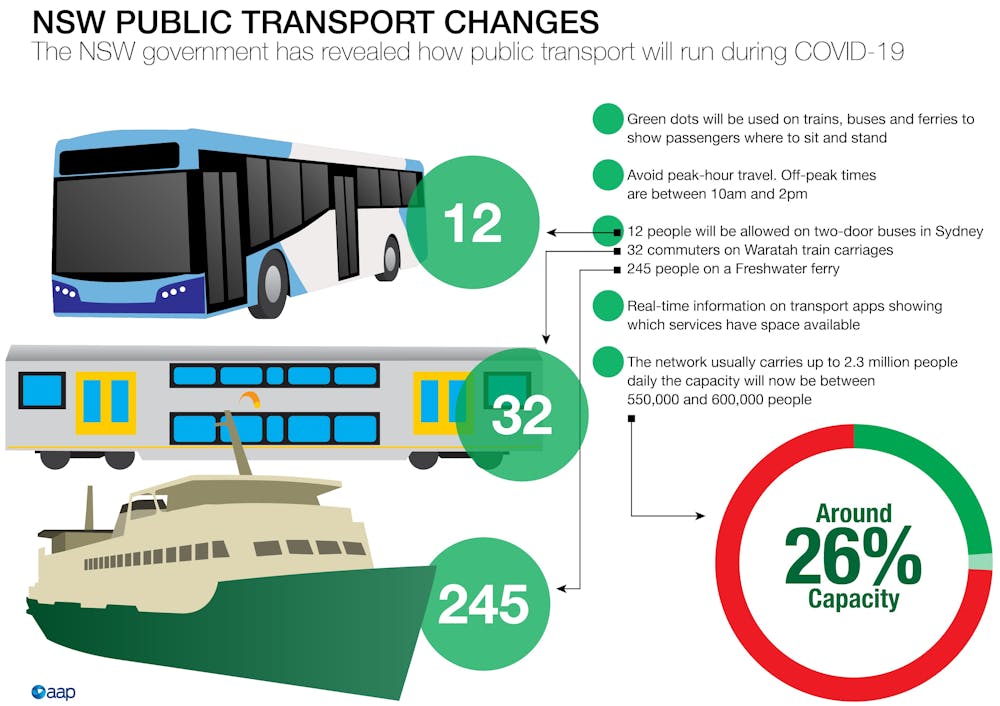 The NSW government estimates public transport will run at a quarter of its pre-pandemic capacity with physical distancing in place.
Sean Fitzpatrick/AAP Graphics
The NSW government estimates public transport will run at a quarter of its pre-pandemic capacity with physical distancing in place.
Sean Fitzpatrick/AAP Graphics
Public transport drivers need protection. Some responses such as boarding from back doors and sanitising rolling stock are needed but don’t reduce crowding. Crowding at platforms, bus and tram stops also has to be avoided.
Read more: To limit coronavirus risks on public transport, here's what we can learn from efforts overseas
Crowding on public transport puts lives at risk. A recent study that looked at smartcard data for the Metro in Washington DC showed that, with the same passenger demand as before the pandemic, only three initially infected passengers will lead to 55% of the passenger population being infected within 20 days. This would have alarming consequences.
More measures are needed. There are things we need to stop doing or start doing, and others that need to happen sooner.
Increasing capacities by running more services, where possible, will help. Staggering work hours will reduce peak demand. Transport demand management must also aim to reduce overall need for travel by having people continue to work from home if they can.
Read more: If more of us work from home after coronavirus we'll need to rethink city planning
Managing passenger flow and decreasing waiting times will also help avoid crowding. Passenger-counting technologies can be used to monitor passenger load restrictions, control flow and stagger ridership.
Passenger-counting technologies can be used to monitor and manage flows.We need to start trying new solutions using smart technologies. Passengers could use apps that let them find out how crowded a service is before boarding, or to book a seat in advance.
Other solutions to trial include thermal imaging at train stations and bus depots to identify passengers with fever. There will be many technical and deployment challenges, but trials can identify issues and ease the transition.
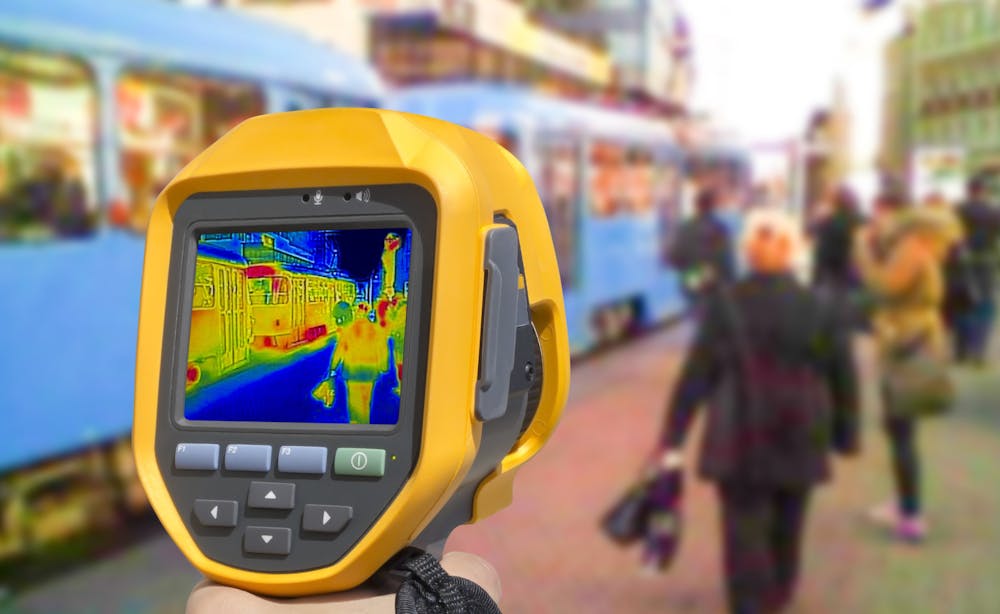 One solution for transport hubs is thermal imaging technology that detects passengers who have a fever.
Shutterstock
One solution for transport hubs is thermal imaging technology that detects passengers who have a fever.
Shutterstock
We need to accelerate digitalisation and automation of public transport. This includes solutions for contactless operations, automated train doors and passenger safety across the whole journey.
Public transport also has to be expanded and diversified to be effective in dense areas and deliver social value to residents. In some areas, it may function as a demand-responsive service and be more agile in its ability to transport people safely and quickly.
Read more: 1 million rides and counting: on-demand services bring public transport to the suburbs
Improving resilience
The lessons we have learnt about adapting how we live and work should guide recovery efforts. The recovery must improve the resilience of public transport.
Infrastructure investments, which are crucial for rebuilding the economy, must target projects that protect against future threats. Public transport will need reliable financial investment to provide quality of service and revive passenger confidence.
Read more: For public transport to keep running, operators must find ways to outlast coronavirus
 The pandemic has shown how fragile urban systems like public transport are in the face of acute stresses.
Shutterstock
The pandemic has shown how fragile urban systems like public transport are in the face of acute stresses.
Shutterstock
Importantly, the harm this pandemic is causing has not been equitable. The most vulnerable and the most disadvantaged have been hit hardest by both its health and economic impacts.
While many people are able to work from home, staying at home remains a luxury many others cannot afford. People who need to return to work must be able to rely on safe public transport.
Read more: Who's most affected on public transport in the time of coronavirus?
Building on momentum
By the time the lockdown is over, many of our old habits will have changed. The notion that we need to leave home to work every day has been challenged. The new habits emerging today, if sustained, could help us solve tricky problems like traffic congestion and accessibility, which have challenged our cities for a long time.
If there’s one principle that should underpin recovery efforts, it should be to make choices today that in future we’d want us to have made. If driving becomes an established new habit, congestion will spike and persist, as will greenhouse gas emissions. Faced with these kinds of challenges, rash “business as usual” measures and behaviours will not protect us from this emergency or future crises.
Cities that seize this moment and boost investment in social infrastructure will enter the post-coronavirus world stronger, more equitable and more resilient.
Let us commit to shaping a recovery that rebuilds lives and promotes equality and sustainability. By building on sustainable practices and a momentum of behavioural change, we can avoid repeating the unsustainable mistakes of the past.
Authors: Hussein Dia, Professor of Future Urban Mobility, Swinburne University of Technology


 Daily Bulletin


