

'We are in a bubble that is set to burst'. Why urgent support must be given to domestic violence workers
- Written by: Dr Naomi Pfitzner, Postdoctoral Research fellow with the Monash Gender and Family Violence Prevention Centre, Monash University
During lockdown, we have seen an increase in demand for domestic violence services in Australia and around the world.
The United Nations recognised this problem in April, declaring a “shadow pandemic” of violence against women and girls.
Read more: How do we keep family violence perpetrators ‘in view’ during the COVID-19 lockdown?
But while we look at specific supports to victims, we cannot forget the people who work to help them.
Our research highlights how we risk losing the essential workers on the frontlines of our domestic violence response, as a result of overwhelming workloads and potential burn out.
Thousands of workers involved
While there is no national data on the Australian domestic violence workforce, in Victoria alone there are around 3,000 specialist practitioners and an additional 30,000 workers who provide core support for, or interventions to address, domestic and family violence.
These include workers from specialist domestic violence services, men’s behaviour change services as well as child and family services.
A 2017 Victorian family violence workforce census revealed that almost one third of specialist practitioners were considering leaving their job due to burn out.
Our new research demonstrates why this is likely to be exacerbated by the pandemic.
Our research
In partnership with the Queensland Domestic Violence Services Network and Monash University’s Melbourne Experiment, we have surveyed Victorian and Queensland practitioners responding to violence against women during the COVID-19 restrictions.
 COVID-19 has seen domestic violence support being delivered from people’s homes.
www.shutterstock.com
COVID-19 has seen domestic violence support being delivered from people’s homes.
www.shutterstock.com
This included 166 workers in Victoria and 56 and 117 workers over two surveys in Queensland.
As shutdown commenced in March, many services moved to remote delivery, with 73% of specialist practitioners in Queensland reporting they now worked from home.
This change resulted in frontline workers providing crisis counselling and conducting risk assessments and planning with traumatised and abused women from their homes. Often they were doing this incredibly challenging work from their living rooms.
The ‘shadow pandemic’
According to our recent surveys, the incidence and severity of domestic violence has increased in Australia during the COVID-19 restrictions. Over 50% of workers in Victoria reported an increase in the frequency and severity of domestic violence. These findings were mirrored in Queensland, with 70% of practitioners observing an escalation in the violence experienced by women in May.
Read more: Reports of 'revenge porn' skyrocketed during lockdown, we must stop blaming victims for it
The pandemic conditions have also made providing support to victims more difficult and more complex. The lack of face-to-face services and the constant presence of perpetrators in victims’ homes limits workers’ ability to respond to violence. As one practitioner explained
You can’t see the hole in the wall, the bruise on her jaw, the fear in the kid’s eyes when dad’s name is mentioned.
Our Victorian and Queensland survey findings also showed during COVID-19, perpetrators have adapted their abusive behaviours, finding new opportunities to control and isolate their victims.
Frontline workers told us in some cases perpetrators are using the pandemic to force women into residing in homes with their abusers where there are children involved.
Perpetrators have also pressured women to wash their hands to the point they are experiencing cracks and bleeding, and have used the threat of COVID-19 infection to isolate women from friends, family and other supports.
Flow on effect to the workforce
Queensland domestic violence workers reported a decline in their mental well-being during April and May. More than 40% of practitioners surveyed in April said working during the pandemic was causing additional pressure and stress.
They tended to attribute this to their challenging work coming into their homes.
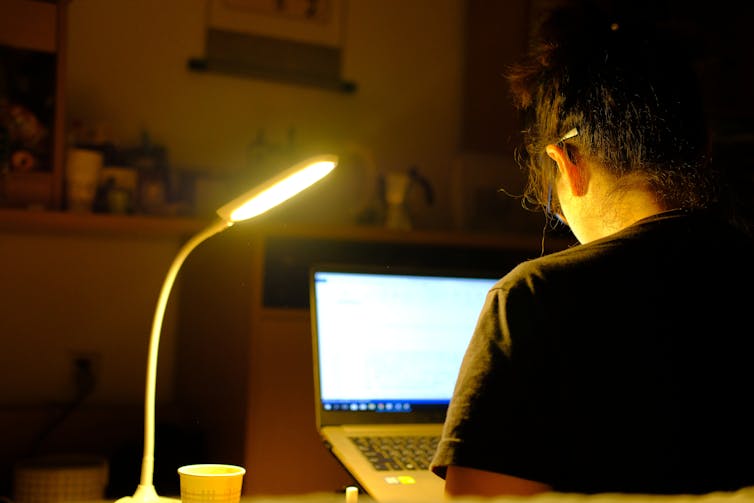 Frontline domestic violence workers say it has been difficult working from home during COVID-19.
www.shutterstock.com
Frontline domestic violence workers say it has been difficult working from home during COVID-19.
www.shutterstock.com
Queensland workers also revealed the transition to remote work alongside an increased demand for their services during COVID-19 has been harmful to their mental health.
I have already used a week of personal leave due to potential burn out. The impact on domestic violence workers needs to be considered by government.
Similar reports have emerged from Victorian workers. As one survey respondent explained
We are all working from home, which has been emotionally, extremely difficult. Having this work in my bedroom, my safe space, has been frankly awful and has wreaked havoc on my work/life balance and self-care routines. Most significantly of all, not being around my colleagues for support, guidance and debriefing has really been the worst.
Self-care strategies and well-being supports
Positively, some workers involved in the Queensland surveys talked about new self-care strategies developed during the lockdown. For example, many Queensland workers said their services had implemented regular online catch-ups and debriefing sessions to check in with staff and provide regular contact and support.
Read more: The Senate inquiry into family violence has closed, missing an important opportunity
Other well-being supports shared in the Queensland surveys included dedicated counsellors to provide individual counselling services to workers and their families during the pandemic.
We need to protect these essential workers
Historically, there has been limited attention paid to the support needs of the domestic and family violence workforce, beyond a general emphasis on self-care in social work training.
Our research shows why this must change moving forward.
As Australia navigates the easing of restrictions in some locations, funding and resources must be increased to ensure the sector can meet the demands of the increasing number of women seeking help from violence.
Victoria and Queensland have already provided multi-million dollar emergency funding packages, to address increased demand on the sector and the scarcity of short-term accommodation for victims fleeing violence.
Equal investments are now needed to ensure the health and well-being of support workers now and into the future.
The specifics of what this entails should be decided in close consultation with the sector, but we note workers said they benefited from counselling for themselves and their families and flexible working conditions, including additional leave days.
Without dedicating the resources needed to support practitioners, we run the risk of seeing an exodus due to burn out in the coming months and years. As one practitioner warned
I feel like we are all in a bubble that is set to burst very soon, in terms of capacity. And when it does burst, I don’t know what it will look like but I know who will pay the ultimate price – victims.
If you or someone you know is impacted by sexual assault or family violence, call 1800RESPECT on 1800 737 732 or visit www.1800RESPECT.org.au. In an emergency, call 000.
Authors: Dr Naomi Pfitzner, Postdoctoral Research fellow with the Monash Gender and Family Violence Prevention Centre, Monash University


 Daily Bulletin


