

South Korea's Green New Deal shows the world what a smart economic recovery looks like
- Written by: Sung-Young Kim, Senior Lecturer in International Relations, Discipline of Politics & International Relations, Macquarie School of Social Sciences, Macquarie University
As the COVID-19 pandemic devastates the global economy, there’s an opportunity for governments to support a green-led recovery. This involves spending fiscal stimulus on renewable energy and other clean technologies to create jobs while addressing climate change.
The chorus calling for such a move is strong and diverse: banks, investors, academics, energy companies, climate advocates and politicians.
Unfortunately, some national governments have not heeded the calls. This includes Australia, where the Morrison government is spruiking a “gas-led recovery” and talking up fossil fuel-derived hydrogen. At the same time, our government is refusing to extend the renewable energy target beyond 2020, and there are strong signs it wants to change the investment mandates of Australia’s clean energy agencies to encourage funding of gas projects.
However some countries, such as South Korea, are using the crisis to kickstart environmentally sustainable economic growth. Australia can learn a lot from the smart strategy of our Asian neighbour.
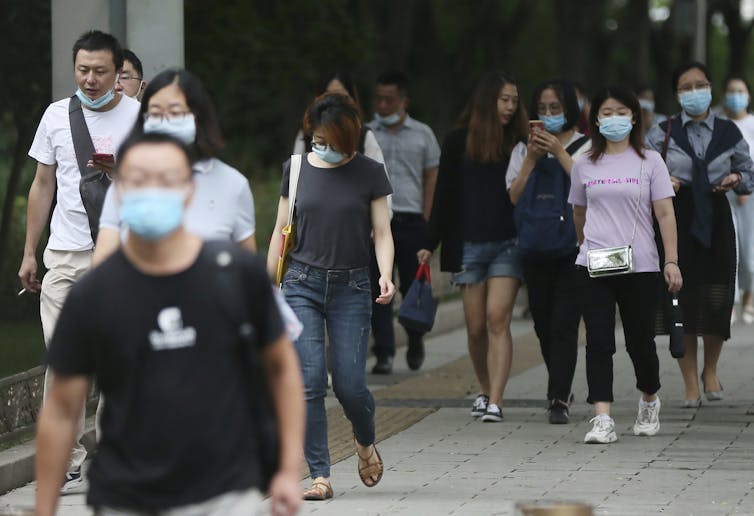 The South Korean government is spending big to encourage a green-led recovery from COVID-19.
Koki Kataoka/AP
The South Korean government is spending big to encourage a green-led recovery from COVID-19.
Koki Kataoka/AP
Rising from a COVID battering
South Korea’s economy, like those across the world, has been hit hard by the pandemic. In particular, its export industries dropped by 24% in May as demand for the nation’s mainstay products, such as cars, semiconductors, machinery, petrochemicals and steel, fell away.
In April, 26.93 million Koreans were reportedly employed – 392,000 fewer than a year earlier. Job losses were highest in the wholesale and retail sectors, accommodation and food services.
In response, Korean President Moon Jae-in in July launched the Korean New Deal or “K-New Deal”. The US$135 billion investment in green and digital technology comprises:
- US$96.3 billion from Treasury
- US$21.2 billion from local governments
- US$17.3 billion from the private sector.
The “green” part of the plan is known as the Green New Deal (not to be confused with the US’ proposed package of climate policies, of the same name). The Korean green plan involves US$61.9 billion targeting the creation of 319,000 jobs by 2022 and 659,000 by 2025.
President Moon will personally chair a monthly strategy meeting on the K-New Deal to monitor the performance of government ministers, and ensure the private sector meets its commitments.
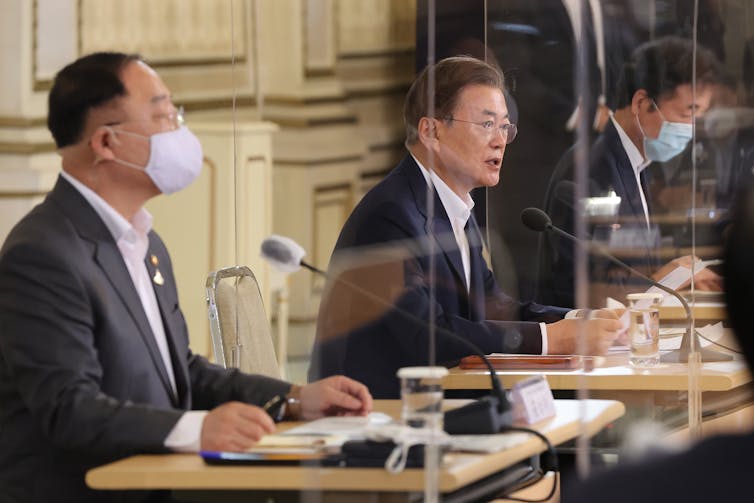 South Korean President Moon Jae-in, centre, discussing the K-New Deal. It includes huge investment in green technology.
Yonhap/EPA
South Korean President Moon Jae-in, centre, discussing the K-New Deal. It includes huge investment in green technology.
Yonhap/EPA
What the green recovery looks like
The Green New Deal involves investing in advanced technology initiatives to create jobs.
The plan calls for an expansion of solar panels and wind turbines to 42.7 gigawatts in 2025, up from 12.7 gigawatts last year. The government will also install solar panels on 225,000 public buildings.
Central to the plan are so-called “smart grids” – digital technology that allows an energy utility to communicate with and respond to its customers, and vice-versa. Korea plans to install “smart meters” in five million more apartments, to help consumers reduce their electricity use.
The government will also invest in microgrid communities. This involves using renewable energy and energy storage systems in regional areas, and those with many islands, creating decentralised, low-carbon energy systems.
Read more: 4 reasons why a gas-led economic recovery is a terrible, naïve idea
The Green New Deal also sets a target of 1.13 million electric vehicles and 200,000 hydrogen-powered fuel-cell electric vehicles on Korean roads by 2025. This creates a domestic market for Korean car manufacturers such as Hyundai.
Money will also be spent building electric vehicle recharging stations (15,000 rapid and 30,000 standard). About 450 hydrogen refuelling units will also be built, benefiting homegrown firms such as EM Korea.
Circular economy initiatives will also be implemented such as reducing and recycling energy using advanced computerised power grids in factories. The plan also involves technology to capture and store carbon emitted from industrial processes and re-using industrial materials.
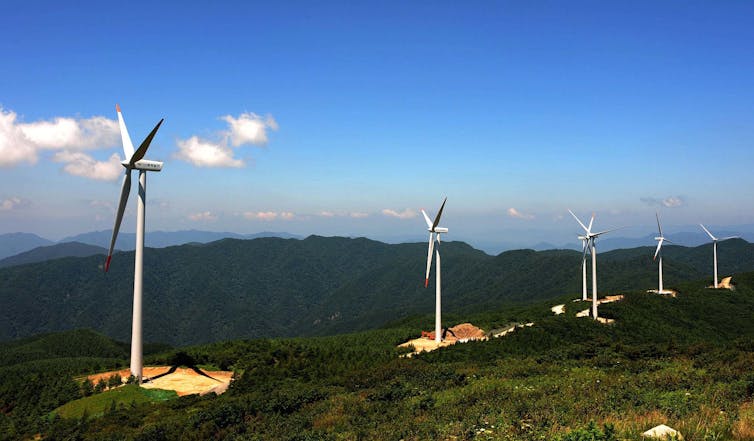 Wind turbines along South Korea’s Mount Taegi range. The Green New Deal involves big investment in renewable technology.
Yonhap/AAP
Wind turbines along South Korea’s Mount Taegi range. The Green New Deal involves big investment in renewable technology.
Yonhap/AAP
More grey than green?
Critics have cast the K-New Deal as more grey than green. For example, they argue while the dirtiest fossil fuels, such as coal, are being phased out, they’ve been replaced with ‘cleaner’ fossil fuels such as liquified natural gas, or LNG.
LNG will be used to provide baseload power, but it is intended only as a “bridging fuel”. Importantly, unlike Australia, the Korean government has set an end date to the use of fossil fuels, aiming for zero net emissions by 2050. Korea has already gone far towards meeting its renewables targets of 20% by 2030 and 30-35% by 2040.
Read more: Time to get real: amid the hydrogen hype, let's talk about what will actually work
Critics also question if hydrogen is a realistic and affordable way to decarbonise transport. The scepticism is valid. But around the world, there is enormous investment into research, development and demonstration of hydrogen projects, including in Australia. Hydrogen produced using renewables is expected to be competitive with fossil fuel-derived hydrogen by 2040, if not earlier.
Korea’s focus on controversial carbon capture and storage technologies may also come under scrutiny, for good reason. And the recent government bail-out of a nuclear reactor and coal power plant manufacturer shows Korea cannot yet claim it has perfect green credentials.
Lessons for Australia
Throughout the developed world, many voices are calling for a green-led recovery. South Korea stands out for its decisiveness, despite some valid criticism of its approach. Its Green New Deal is an opportunity to build the high-tech, high-wage green industries of the future, with massive export and job creation potential.
The Morrison government should take note: this is what a real green-led recovery looks like. With a bit of political vision, risk-taking and a national strategy led by government, Australia too can kickstart green investment in the post-COVID recovery.
Read more: Want an economic tonic, Mr Morrison? Use that stimulus money to turbocharge renewables
Authors: Sung-Young Kim, Senior Lecturer in International Relations, Discipline of Politics & International Relations, Macquarie School of Social Sciences, Macquarie University


 Daily Bulletin


