

Our new model shows Australia can expect 11 tropical cyclones this season
- Written by: Andrew Magee, Postdoctoral Researcher, University of Newcastle
Tropical cyclones are considered one of the most devastating weather events in Australia. But they’re erratic — where, when and how many tropical cyclones form each year is highly variable, which makes them difficult to predict.
In our new research published today, we created a statistical model that predicts the number of tropical cyclones up to four months before the start of the tropical cyclone season from November to April.
The model, the Long-Range Tropical Cyclone Outlook for Australia (TCO-AU), indicates normal to above normal tropical cyclone activity with 11 cyclones expected in total, Australia-wide. Though not all make landfall.
This is above Australia’s average of ten tropical cyclones per season, thanks to a climate phenomenon brewing in the Pacific that brings conditions favourable for tropical cyclone activity closer to Australia.
La Niña and tropical cyclones
As we’ve seen most recently with Tropical Storm Sally in the US, tropical cyclones can cause massive damage over vast areas. This includes extreme and damaging winds, intense rainfall and flooding, storm surges, large waves and coastal erosion.
Australian tropical cyclone behaviour is largely driven by the El Niño-Southern Oscillation (ENSO) — a global climate phenomenon that changes ocean and atmospheric circulation.
“La Niña” is one phase of ENSO. It’s typically associated with higher than normal tropical cyclone numbers in the Australian region. And the Bureau of Meteorology’s weather and climate model indicates there’s a 95% chance a La Niña will be established by October this year.
Read more: Explainer: El Niño and La Niña
Around ten tropical cyclones occur in the Australian region every season, and about four of those usually make landfall.
Historically, La Niña has resulted in double the number of landfalling tropical cyclones in Australia, compared to El Niño phases. An “El Niño” event is associated with warmer and drier conditions for eastern Australia.
During La Niña events, the first tropical cyclone to make landfall also tends to occur earlier in the season. In fact, in Queensland, the only tropical cyclone seasons with multiple severe tropical cyclone landfalls have been during La Niña events.
Severe Tropical Cyclone Yasi, one of the most intense tropical cyclones to have hit Queensland, occurred during a La Niña in 2011. So did the infamous Severe Tropical Cyclone Tracy, which made landfall around Darwin in 1974, killing 71 people and leaving more than 80% of all buildings destroyed or damaged.
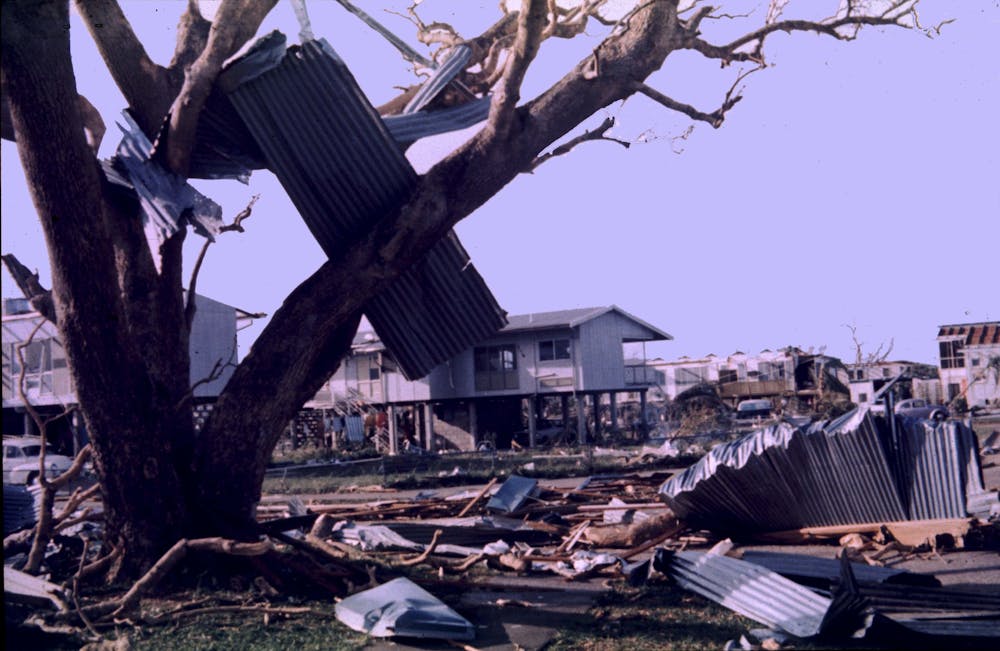 The aftermath of Cyclone Tracy, December 1974.
AP
The aftermath of Cyclone Tracy, December 1974.
AP
While naturally occurring climate drivers, such as La Niña, influence the characteristics of tropical cyclone activity, climate change is also expected to cause changes to future tropical cyclone risk, including frequency and intensity.
Australian tropical cyclone outlooks
Tropical cyclone outlooks provide important information about how many tropical cyclones may pass within the Australian region and subregions, before the start of the cyclone season. Decision-makers, government, industry and people living in tropical cyclone regions use them to prepare for the coming cyclone season.
Read more: I've always wondered: how do cyclones get their names?
The Australian Bureau of Meteorology has led the way in producing tropical cyclone outlooks for Australia, usually a couple of weeks before the official start of the tropical cyclone season.
But with monthly guidance up to four months before the start of the season, our new model, TCO-AU, is unmatched in lead time. It considers the most recent changes in ENSO and other climate drivers to predict how many tropical cyclones may occur in Australia and its sub-regions.
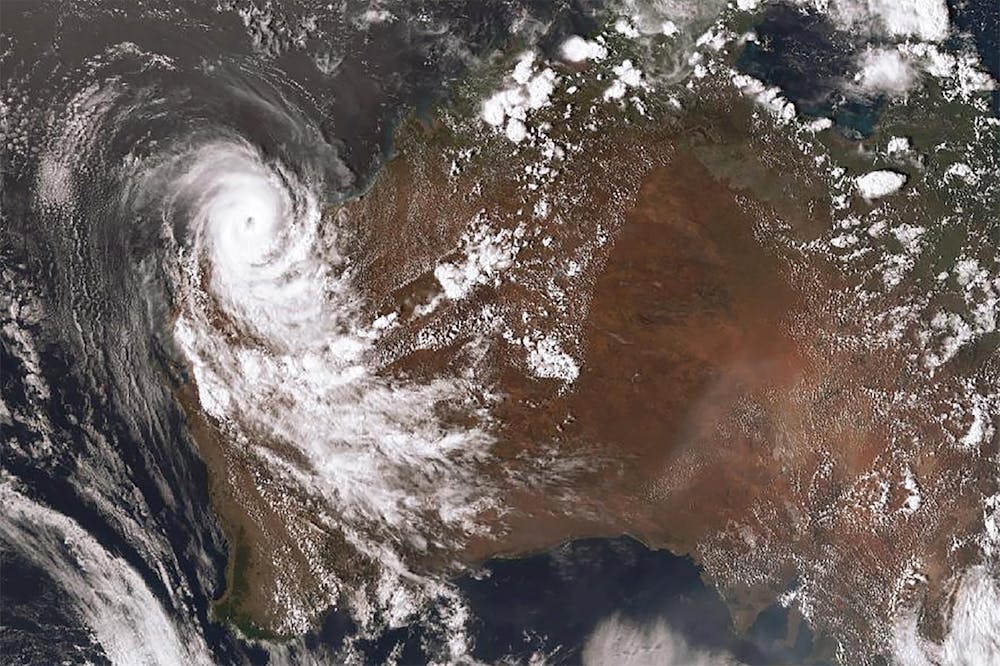 Tropical Cyclone Damien as it crosses the coast of Western Australia’s Pilbara region, February 8, 2020.
(AAP Image/Bureau of Meteorology
Tropical Cyclone Damien as it crosses the coast of Western Australia’s Pilbara region, February 8, 2020.
(AAP Image/Bureau of Meteorology
As a statistical model, TCO-AU is trained on historical relationships between ocean-atmosphere processes and the number of tropical cyclones per season.
For each region, hundreds of potential model combinations are tested, and the one that performs best in predicting historical tropical cyclone counts is selected to make the prediction for the coming season.
So what can we expect this season?
September’s TCO-AU guidance suggests normal to above normal risk for Australia for the coming tropical cyclone season (November 2020 – April 2021).
With an emerging La Niña and warmer than normal sea surface temperatures in the eastern Indian Ocean, 11 tropical cyclones are expected for Australia. There’s a 47% chance of 12 or more cyclones, and a probable range of between nine and 15.
For the Australian sub-regions, TCO-AU suggests the following:
above normal activity is expected for the Eastern region (eastern Australia) with four cyclones expected. Probable range between three and six cyclones; with a 55% chance of four or more cyclones
normal activity is expected for the Western region (west/northwest Western Australia) with six cyclones expected. Probable range between five and eight cyclones; 39% chance of seven or more cyclones
below normal activity is expected for the Northern region (northwest Queensland and Northern Territory) with three cyclones expected. Probable range between two and five cyclones; 37% chance of four cyclones or more
below normal activity is also expected for the Northwestern region (northwest Western Australia) with four cyclones expected. Probable range between three and six cyclones; 45% chance of five cyclones or more.
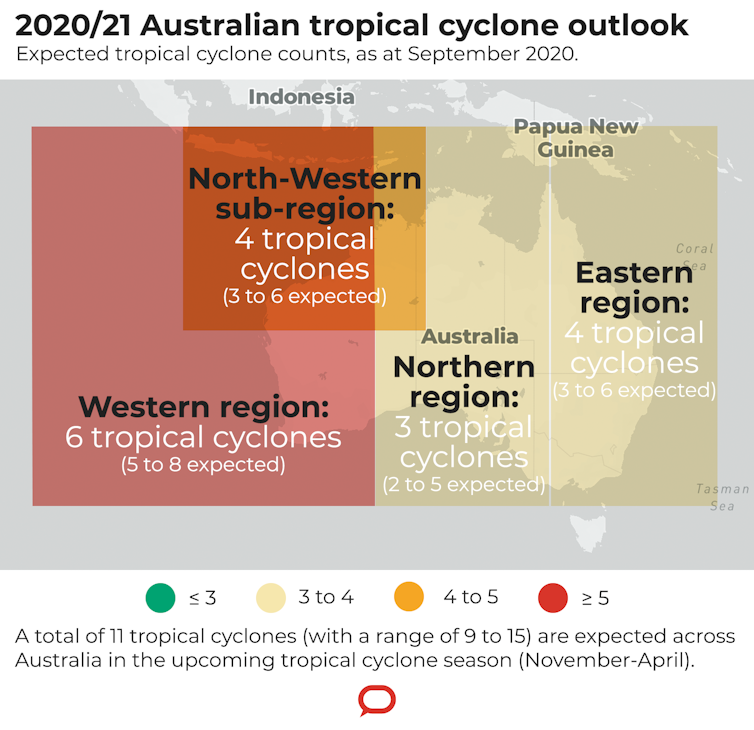 TCO-SP – Long-range Tropical Cyclone Outlook for the Southwest Pacific/The Conversation, CC BY-ND
Guidance from TCO-AU does not and should not replace advice provided by the Australian Bureau of Meteorology. Instead, it should be used to provide a complementary perspective to regional outlooks and provide a “heads-up” in the months leading up to the start of and within the cyclone season.
Regardless of what’s expected for the coming cyclone season, people living in tropical cyclone regions should always prepare for the cyclone season and follow the advice provided by emergency services.
Read more:
Advanced cyclone forecasting is leading to early action – and it's saving thousands of lives
TCO-SP – Long-range Tropical Cyclone Outlook for the Southwest Pacific/The Conversation, CC BY-ND
Guidance from TCO-AU does not and should not replace advice provided by the Australian Bureau of Meteorology. Instead, it should be used to provide a complementary perspective to regional outlooks and provide a “heads-up” in the months leading up to the start of and within the cyclone season.
Regardless of what’s expected for the coming cyclone season, people living in tropical cyclone regions should always prepare for the cyclone season and follow the advice provided by emergency services.
Read more:
Advanced cyclone forecasting is leading to early action – and it's saving thousands of lives
Authors: Andrew Magee, Postdoctoral Researcher, University of Newcastle


 Daily Bulletin


