

COVID has proved working from home is the best policy to beat congestion
- Written by: David Hensher, Director, Institute of Transport and Logistics Studies, University of Sydney
As almost anyone who wastes countless hours stuck in traffic would agree, there’s little more frustrating for workers than starting or ending the day with an overly long commute. But, while we might not like it, more of us are doing it. In 2019, the average daily commute time for Australian metro workers was 66 minutes. Then COVID happened.
Although the pandemic has forced change without choice on almost all of us, there have been some positive unintended consequences. Commuting times are one winner, particularly in larger cities. The increase in working from home turns out to be the best policy lever the transport sector has ever pulled for reducing traffic congestion in our cities.
Read more: Australian city workers' average commute has blown out to 66 minutes a day. How does yours compare?
We began looking at the impacts of the increase in working from home on our roads and public transport from March to September. We found a 10-15% drop in peak-period congestion. That’s similar to traffic during school holidays.
COVID-19, it turns out, has done something that nobody in government has been able to achieve – cutting road congestion almost overnight.
For commuters, time is money
It’s possible to calculate how much these kinds of shifts are worth to us as a society. If we weren’t stuck in traffic, what else might we do with that time? And just how much is it worth to us?
 All that time spent stuck in traffic has a cost.
Syda Productions/Shutterstock
All that time spent stuck in traffic has a cost.
Syda Productions/Shutterstock
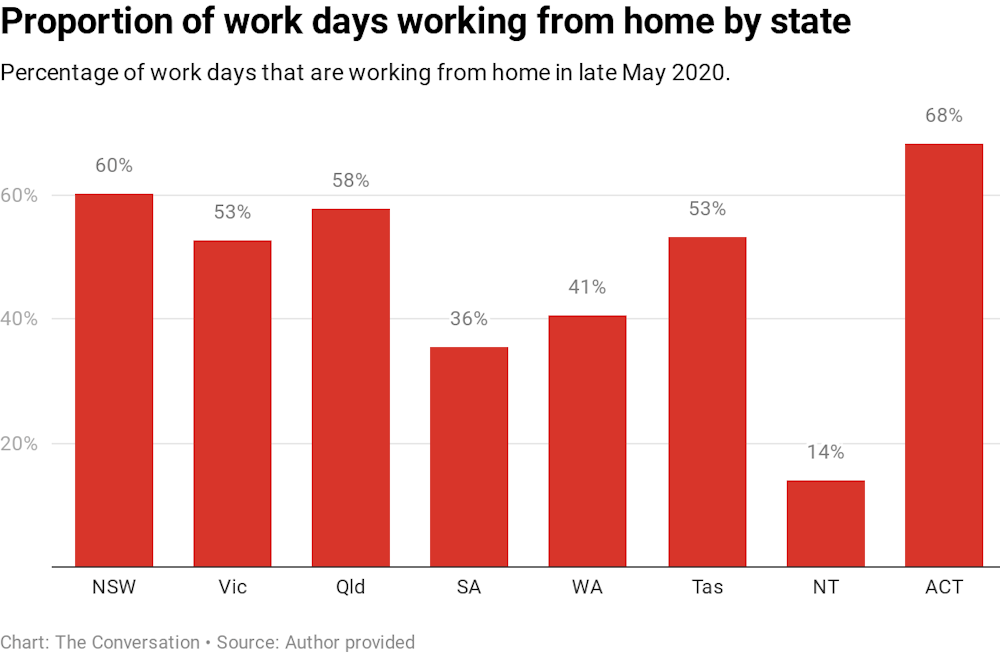
The Greater Sydney metropolitan area, covering Newcastle to Wollongong, is a good example. From late May 2020, commuting times declined as working from home boomed. We calculate this cut total commuting time costs by 54%, from A$10.5 billion a year to A$5.58 billion.
Naturally, commuters want to know the impact on their own metaphorical hip pockets. In Greater Sydney, we calculate the average annual reduction in time costs per car commuter was A$2,312 as at May 2020. That’s equivalent to A$48.16 per week, or A$9.63 per weekday.
For the public transport commuter, the “time cost” of being stuck in traffic is higher as their commute is often longer. Their time saving is worth A$5,203 per person, an equivalent of A$108.39 per week or A$21.68 per weekday.
It’s all money that could be better spent elsewhere, especially in the current economic environment.
 Transport planning priorities will change
Congestion shows us working from home is changing more than the workplace: it could have profound implications for road investment and transport policy.
Our data show the increase in working from home is spread evenly across the five weekdays. This is important, since infrastructure and service capacity are typically determined by peak demand. If demand can be flattened, as the data suggest it can be, then the implications for transport planning priorities will be significant.
Read more:
If more of us work from home after coronavirus we'll need to rethink city planning
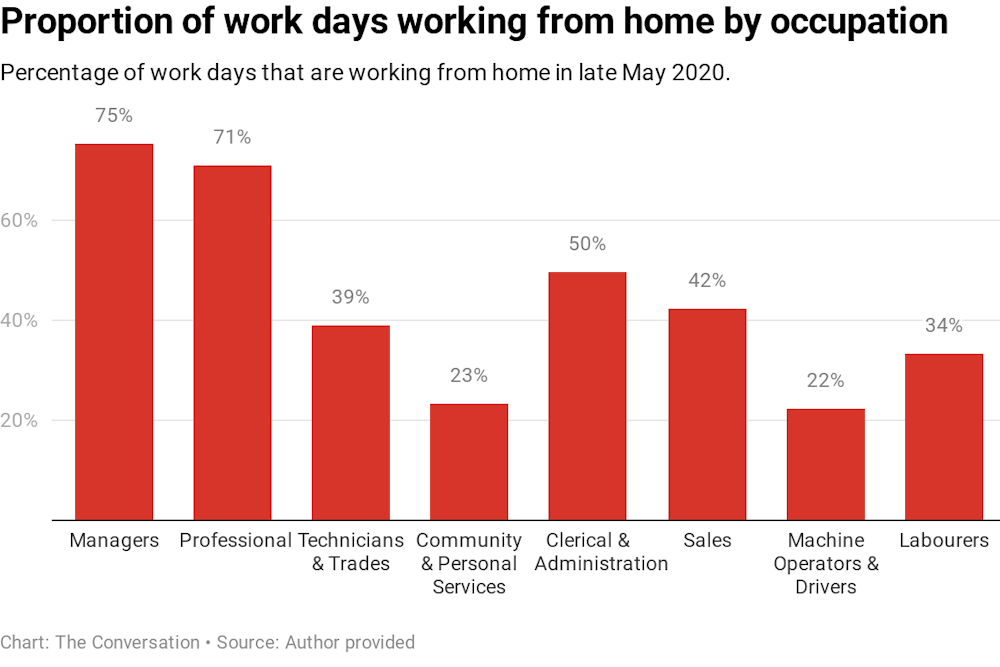
Of course, now that full-time working from home is easing for many, we don’t expect this level of benefit to be sustained. But we believe we’ll still be left with a significant improvement on pre-COVID congestion. Early signs, including from our surveys in September, suggest many people in certain occupations are likely to work from home one to two days a week in the future, with full employer support.
Transport planning priorities will change
Congestion shows us working from home is changing more than the workplace: it could have profound implications for road investment and transport policy.
Our data show the increase in working from home is spread evenly across the five weekdays. This is important, since infrastructure and service capacity are typically determined by peak demand. If demand can be flattened, as the data suggest it can be, then the implications for transport planning priorities will be significant.
Read more:
If more of us work from home after coronavirus we'll need to rethink city planning
Of course, now that full-time working from home is easing for many, we don’t expect this level of benefit to be sustained. But we believe we’ll still be left with a significant improvement on pre-COVID congestion. Early signs, including from our surveys in September, suggest many people in certain occupations are likely to work from home one to two days a week in the future, with full employer support.
 But to really capture the benefits of this welcome shift on our roads, we need governments to play a role. They need to publicly support working from home as a way of reducing pressure on transport networks, especially in our big cities.
2020 has proven traffic congestion can be reduced without building more roads. What’s more, doing so brings other benefits: in addition to myriad environmental benefits, our increased ability to work from home will open up new opportunities for revitalising suburbia. These adjustments align well with the concept of the 20- or 30-minute city, a strategy many Australian city planners are grappling with.
Read more:
People love the idea of 20-minute neighbourhoods. So why isn't it top of the agenda?
Is there a downside to fewer commutes?
As more of us spend fewer days commuting, there are risks. For example, we might move more permanently to using private cars for commuting (even once COVID safety issues subside).
If we commute for only three or four days a week, rather than five, we may be more tolerant of the costs associated with driving, such as parking fees and tolls. Even congestion itself may bother us less.
If this occurs, we may have to find other ways to contain this increase in car use if we want to keep those shorter commutes.
Read more:
Cars rule as coronavirus shakes up travel trends in our cities
Strategies to limit car use in peak periods
One option is road-pricing reform – a user-pays system. One well-researched user charge is to replace vehicle registration charges (in part or in full) with a distance-based charge (cents/km) during periods of heavy congestion – for example, peak periods in cities.
What makes this option appealing is the ability to set charges at a level that leaves most people no worse off financially (the hip-pocket test), while at the same time reducing peak-period car use to improve travel times. We estimate 5-7c/km would be the right price.
Read more:
Three charts on: why congestion charging is fairer than you might think
Surveys show over 70% of commuters could switch to other times of the day and still use their cars if keen to avoid the distance-based charge. Our modelling suggests this would deliver an 8% improvement in travel times. That’s equivalent to school holiday periods and the shift we’ve seen from the increase in working from home.
It is likely this shift would only increase in a world where working from home means people can work more flexibly.
An alternative strategy to keep congestion low, even if our love for private car travel increases, centres on incentives – rewards similar to those used by supermarkets or airlines.
Why not create incentives like loyalty points for drivers willing to switch to off-peak car use or to public transport? Drivers’ decisions could be tracked via GPS, and resulting reward points converted to cash payments or discounts on travel and other non-transport-related purchases.
Read more:
Coronavirus recovery: public transport is key to avoid repeating old and unsustainable mistakes
Travel post-COVID-19: alternative views from leading academics.
Travel post-COVID-19: Q&A session.
But to really capture the benefits of this welcome shift on our roads, we need governments to play a role. They need to publicly support working from home as a way of reducing pressure on transport networks, especially in our big cities.
2020 has proven traffic congestion can be reduced without building more roads. What’s more, doing so brings other benefits: in addition to myriad environmental benefits, our increased ability to work from home will open up new opportunities for revitalising suburbia. These adjustments align well with the concept of the 20- or 30-minute city, a strategy many Australian city planners are grappling with.
Read more:
People love the idea of 20-minute neighbourhoods. So why isn't it top of the agenda?
Is there a downside to fewer commutes?
As more of us spend fewer days commuting, there are risks. For example, we might move more permanently to using private cars for commuting (even once COVID safety issues subside).
If we commute for only three or four days a week, rather than five, we may be more tolerant of the costs associated with driving, such as parking fees and tolls. Even congestion itself may bother us less.
If this occurs, we may have to find other ways to contain this increase in car use if we want to keep those shorter commutes.
Read more:
Cars rule as coronavirus shakes up travel trends in our cities
Strategies to limit car use in peak periods
One option is road-pricing reform – a user-pays system. One well-researched user charge is to replace vehicle registration charges (in part or in full) with a distance-based charge (cents/km) during periods of heavy congestion – for example, peak periods in cities.
What makes this option appealing is the ability to set charges at a level that leaves most people no worse off financially (the hip-pocket test), while at the same time reducing peak-period car use to improve travel times. We estimate 5-7c/km would be the right price.
Read more:
Three charts on: why congestion charging is fairer than you might think
Surveys show over 70% of commuters could switch to other times of the day and still use their cars if keen to avoid the distance-based charge. Our modelling suggests this would deliver an 8% improvement in travel times. That’s equivalent to school holiday periods and the shift we’ve seen from the increase in working from home.
It is likely this shift would only increase in a world where working from home means people can work more flexibly.
An alternative strategy to keep congestion low, even if our love for private car travel increases, centres on incentives – rewards similar to those used by supermarkets or airlines.
Why not create incentives like loyalty points for drivers willing to switch to off-peak car use or to public transport? Drivers’ decisions could be tracked via GPS, and resulting reward points converted to cash payments or discounts on travel and other non-transport-related purchases.
Read more:
Coronavirus recovery: public transport is key to avoid repeating old and unsustainable mistakes
Travel post-COVID-19: alternative views from leading academics.
Travel post-COVID-19: Q&A session.Authors: David Hensher, Director, Institute of Transport and Logistics Studies, University of Sydney


 Daily Bulletin


