

Why the way we approach transgender and non-binary healthcare needs to change
- Written by: Rona Carroll, Senior Lecturer, Department of Primary Health Care and General Practice, University of Otago
Demand for healthcare for transgender people is on the rise in New Zealand but training for health professionals to develop basic competencies is lagging behind.
There is little teaching on gender and sexuality at either of New Zealand’s medical schools. It’s partly due to lack of time, but also lack of confidence and knowledge to teach the topic.
Medical education needs to change urgently to prepare doctors to adequately care for their transgender and non-binary patients.
Transgender and non-binary health
We use the term transgender (or trans) to refer to people who identify with a gender different to that assigned to them at birth. The term non-binary describes people who don’t identify with the male/female gender binary.
There are other gender identities such as takatāpui, a traditional Māori term which has been reclaimed to embrace all Māori who identify with diverse genders and sexualities. Not everyone will identify with these umbrella descriptors.
Transgender identities are not an illness or a mental health problem. They are a variation of human experience.
Read more: Supporting trans people: 3 simple things teachers and researchers can do
Problems arise because of negative societal attitudes. Trans and non-binary people still face discrimination, stigmatisation and marginalisation. These experiences can lead to psychological distress.
In the Youth’12 survey of 8,500 high school students carried out in 2012, almost half of the transgender students reported experiencing depressive symptoms. One in five had attempted suicide in the year prior to the survey.
The Counting Ourselves survey in 2018 also showed high rates of mental health problems and a higher risk of suicide and substance abuse.
It highlighted the difficulty many transgender and non-binary people face in accessing gender-affirming healthcare. Many already had negative experiences and said they avoided seeing a doctor because they were worried about being disrespected.
Not all trans people will require access to hormone therapy or surgery, but many do. Removing barriers to healthcare is essential. Trans and non-binary people have specific health needs to affirm their gender identity and to reduce gender dysphoria — the distress that can occur when someone’s gender identity differs from the sex assigned to them at birth.
Read more: Informed consent, individual care vital to ensure reproductive rights of transgender Australians
Changing medical education and training
Case studies used to teach medical students rarely show diversity of sexuality or gender identity. When you don’t see yourself or the population reflected in your learning, it can send a message that this isn’t important or relevant to future practice.
Just as we want our future doctors to reflect the population they will treat, the medical curriculum should evolve to do so, too.
Transgender healthcare teaching needs to be part of all medical speciality, nursing and allied health training, so that trans and non-binary patients can expect some basic cultural competence in all areas of our health service. Care and sensitivity are required in certain specialities — including endocrinology, obstetrics, gynaecology, sexual health, mental health, urology and breast surgery. But it is most important in general practice where we receive most of our healthcare.
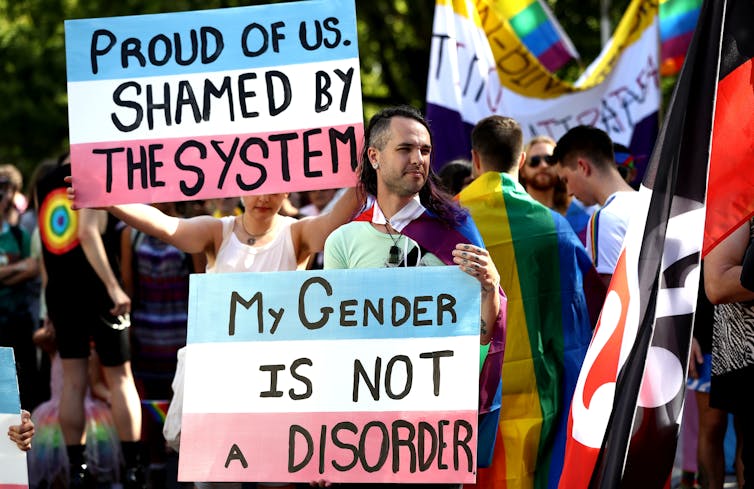 Best healthcare practice for transgender people is based on an informed consent model, which views the patient as the expert in their identity.
Hannah Peters/Getty Images
Best healthcare practice for transgender people is based on an informed consent model, which views the patient as the expert in their identity.
Hannah Peters/Getty Images
From dysphoria to celebration
While some care requires hospital specialists, general practitioners (GPs) can provide much gender-affirming care.
GPs are experts in supporting people with normal life issues, as well as addressing physical and psychological needs in a holistic manner.
GPs who wish to provide gender-affirming care based on an informed consent model, should be supported and encouraged to do so. This aligns with best practice models that view the patient as the expert in their identity and recognise them as a competent adult who can make choices about their own healthcare.
A multidisciplinary approach with the GP at the centre, supported by other specialists where necessary, is an ideal model. Financial and educational support for primary care to take the lead in this area would increase patients’ access to care and reduce the need for referrals to secondary care, freeing up appointments for people who need them.
There are simple steps health providers can take to make transgender and non-binary patients feel more welcome and respected, including:
- Outward signs of acceptance in the practice environment, such as a rainbow flag, relevant posters and pamphlets
- gender-neutral toilets
- enrolment forms with appropriate questions around gender identity, names and pronouns.
These things in themselves can make a difference, but need to be backed up by staff who use people’s correct names and pronouns and do not make assumptions around gender or sexuality.
Healthcare providers who treat their transgender and non-binary patients with respect and support them to affirm their individual gender identity contribute to making them comfortable attending appointments. The result is improved health and well-being.
Better medical training and practice also require changes in societal attitudes, and that’s where we all have a role to play.
Authors: Rona Carroll, Senior Lecturer, Department of Primary Health Care and General Practice, University of Otago


 Daily Bulletin


