

Birds that play with others have the biggest brains - and the same may go for humans
- Written by: Gisela Kaplan, Emeritus Professor in Animal Behaviour, University of New England
Have you ever seen magpies play-fighting with one another, or rolling around in high spirits? Or an apostlebird running at full speed with a stick in its beak, chased by a troop of other apostlebirds? Well, such play behaviour may be associated with a larger brain and a longer life.
For the past 50 years, international animal cognition research has often related the use of tools such as rocks and sticks to cognitive abilities in animals. But my research on Australian native birds, published in Scientific Reports, casts doubt on long-held assumptions about the links between large brains and tool use.
My study found no significant association between tool use and brain mass. However, very clear differences in relative brain mass emerged when birds showing play behaviour were compared to those that didn’t play. In particular, birds that played with others (known as social play) had the largest brain mass, relative to body size, and even the longest lifespans.
The results suggest play behaviour may be an important driver in the evolution of large brains in a number of species, including humans.
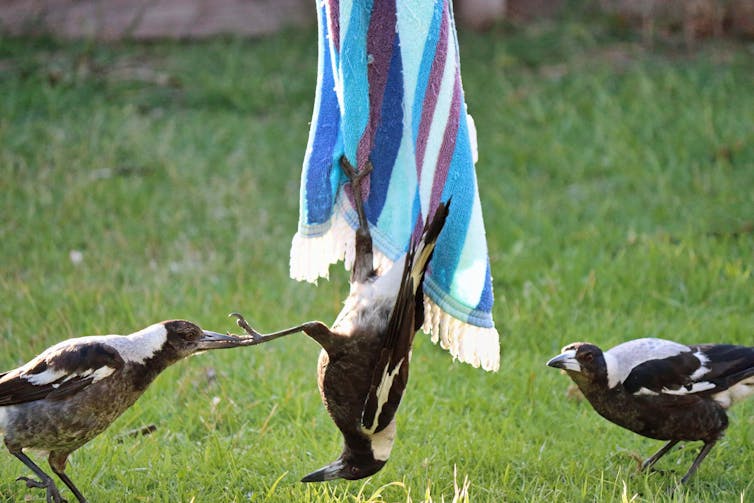 Magpies engaged in complex social play. One magpie hung solo from a towel on a washing line then was joined by others. One newcomer pulled the hanging magpie’s foot to make it swing, and the other gave it a push back the other way, and so on.
The Magpie Whisperer
Magpies engaged in complex social play. One magpie hung solo from a towel on a washing line then was joined by others. One newcomer pulled the hanging magpie’s foot to make it swing, and the other gave it a push back the other way, and so on.
The Magpie Whisperer
Tool use in birds
Tool use has been studied in a wider range of species than play behaviour. Some internationally famous Australian examples include:
the black-breasted buzzard releasing rocks from their beaks to crack emu eggs
the black kite picking up burning embers and twigs and dropping them on dry grass areas to start a fire. The bird then feasts on fleeing or injured insects and vertebrates
palm cockatoos that drum with a stick.
According to a classic theory known as the “technical intelligence hypothesis”, humans and other animals developed large brains because circumstances forced them into ever more sophisticated tool use.
Read more: Bird-brained and brilliant: Australia's avians are smarter than you think
Palm cockatoos drum with a stick.So what is bird play?
Play behaviour usually occurs in juveniles but in some species, such as little corellas or galahs, it extends into adulthood. Play behaviour occurs in species which tend to have long juvenile periods, long-term support from parents and which grow up in stable social groups.
Play behaviour is usually subdivided into three categories: solo play, object play and social play.
Solo play: this may involve a single bird running, skipping, jumping, ducking, rolling, hanging, swinging, dancing, sliding and snow-romping. Solo play is the most widespread form of play, common among honeyeaters, parrots, magpies, currawongs, butcherbirds, riflebirds and some pigeon species.
The best acrobat among the pigeons is probably the topknot pigeon, but rainbow lorikeets are also known to love swinging.
Object play: this involves objects of any kind, including sticks, stones and small household items. Object players might carry a stick or stone or even just a leaf around, drop it, then pick it up again and run with it.
Object players are not as numerous as solo players but still widespread across species. Click here to read a lovely description of a kookaburra absorbed in playing with a stone.
Social play: involves two or more individuals. Social play is so far the rarest category. It might involve one bird holding an object in its beak and the others chasing it. Published cases are largely limited to parrots and corvids, and are known in magpies and ravens.
Read more: What Australian birds can teach us about choosing a partner and making it last
White-winged choughs are known to play a game in which two youngsters simultaneously grab a small stick or a bunch of grass, then each tries to wrest it from the other.
It’s important to note that social players are also solo and object players, but solo or object players may not be social players. The latter is considered a more complex form of play.
It turns out these categories are meaningful when used to analyse a potential link to brain mass. Information on brain weight/mass in Australian birds has been available only since an important study in 2014. It identified brain volumes and body sizes of all Australian bird species, enabling researchers to link these biological data to behavioural data.
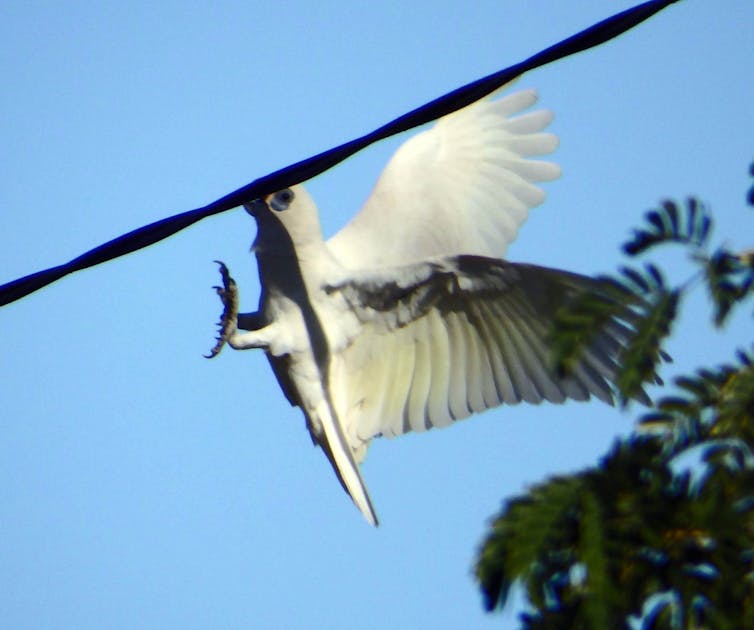 A little corella performing a daredevil solo stunt — holding onto a wire by the beak and trying to swing.
Gisela Kaplan
A little corella performing a daredevil solo stunt — holding onto a wire by the beak and trying to swing.
Gisela Kaplan
A surprising link
My study involved 77 native Australian bird species for which full data sets were available. The results were more than surprising. In the samples used, tool use seems to confer no advantage whatsoever in terms of brain size or life expectancy: no matter whether a species showed tool using or not, relative brain masses were not different. However the results showed, rather dramatically, that brain size and forms of play are associated.
Social players, versus other players and versus non-players showed significantly different average brain sizes in each category:
non players have the lowest average brain size
solo players had slightly larger brains than non-players
object players had larger brains again
social players had by far the largest average brain size relative to body weight.
These results are by no means confined to parrots, but are found in songbirds and other orders. Whether this holds for birds globally is not yet known. However, since parrots and songbirds first evolved in Australia, then spread to the rest of the world, the results may indeed hold for birds outside Australia. More research will be needed.
Read more: Magpies can form friendships with people – here's how
Which came first – play resulting in large brains or large brains triggering play behaviour – is not known. But whichever way one looks at it, playing socially or even just playing at all, is related to a bigger brain and a long life.
So what does all this mean for human brain evolution? It may be a long shot, but the stages of development in humans and birds seem to have some similarities and this may be significant.
Offspring in humans, as in great apes and other primates, also develop slowly, have protracted childhoods and play extensively as do a surprising number of Australian native birds. It may mean playing together offers more than just passing the time. It could be an evolutionary driver for intelligence, and even for a long life.
Authors: Gisela Kaplan, Emeritus Professor in Animal Behaviour, University of New England


 Daily Bulletin


