

Humans force wild animals into tight spots, or send them far from home. We calculated just how big the impact is
- Written by: Tim Doherty, ARC DECRA Fellow, University of Sydney
The COVID pandemic has shown us that disruptions to the way we move around, complete daily activities and interact with each other can shatter our wellbeing.
This doesn’t apply only to humans. Wildlife across the globe find themselves in this situation every day, irrespective of a global pandemic.
Our latest research published today in Nature Ecology and Evolution has, for the first time, quantified the repercussions of logging, pollution, hunting, and other human disturbances, on the movements of a wide range of animal species.
Our findings were eye-opening. We found human disturbances, on average, restricted an animal’s movements by 37%, or increased it by 70%. That’s like needing to travel an extra 11 km to get to work each day (Australia’s average is 16 km).
Disruptions cascade through the ecosystem
The ability to travel is essential to animal survival because it allows animals to find mates, food and shelter, escape predators and competitors, and avoid disturbances and threats.
And because animal movement is linked to many important ecological processes — such as pollination, seed dispersal and soil turnover — disruptions to movement can cascade through ecosystems.
Our study involved analysing published data on changes in animal movement in response to different types of disturbance or habitat modification by humans. This included agriculture, logging, grazing, recreation, hunting, and pollution, amongst others.
All up, we looked at 719 records of animal movement, spanning 208 studies and 167 species of birds, mammals, reptiles, fish, insects and amphibians. The size of the species we studied ranged from the sleepy orange butterfly to the white shark.
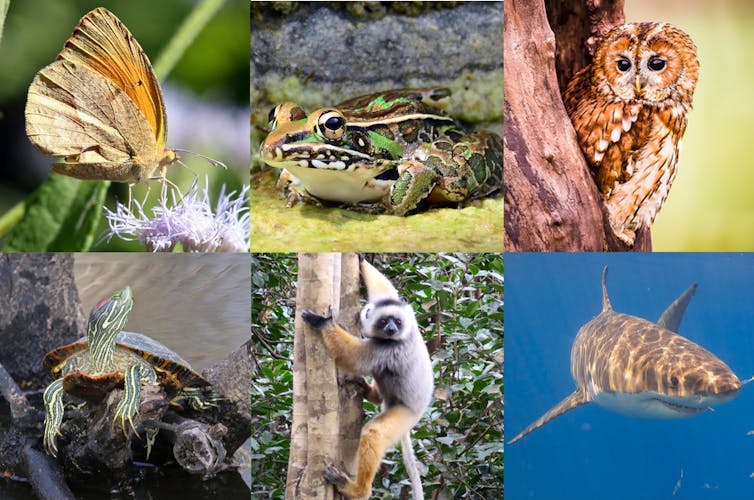 Species included in our study, clockwise from top-left: sleepy orange butterfly, southern leopard frog, tawny owl, white shark, diademed sifaka and red-eared slider turtle.
Photos adapted from Flickr under Creative Commons license CC BY 2.0. Clockwise from top-left: Anne Toal; Trish Hartmann; Les Pickstock; Elias Levy; John Crane; USFWS Midwest Region.
Species included in our study, clockwise from top-left: sleepy orange butterfly, southern leopard frog, tawny owl, white shark, diademed sifaka and red-eared slider turtle.
Photos adapted from Flickr under Creative Commons license CC BY 2.0. Clockwise from top-left: Anne Toal; Trish Hartmann; Les Pickstock; Elias Levy; John Crane; USFWS Midwest Region.
What we found
We found changes in movement are very common, with two-thirds of the 719 cases comprising an increase or decrease in movement of 20% or more. More than one-third of cases changed by 50% or more.
Whether an animal increases or decreases its movement in response to disturbance from humans depends on the situation.
Animals may run away from humans, or move further in search of food and nesting sites. For example, a 2020 study on koalas found their movements were longer and more directed in areas where habitats weren’t well connected, because they had to travel further to reach food patches.
Likewise, the daily movement distances of mountain brushtail possums in central Victoria were 57% higher in remnant bushland along roadsides, compared to large forest areas.
 Land clearing can cause animals to move through risky areas in search of suitable habitat.
Tim Doherty, Author provided
Land clearing can cause animals to move through risky areas in search of suitable habitat.
Tim Doherty, Author provided
Decreases in movement can occur where animals encounter barriers (such as highways), if they need to shelter from a disturbance, or can’t move as efficiently through altered habitats. In the United States, for example, researchers played a recording of humans talking and found it caused a 34% decrease in the speed that mountain lions move.
On the other hand, some decreases in movement occur where an animal actually benefits from habitat changes. A wide range of animals — including storks, vultures, crows, foxes, mongooses, hyenas and monitor lizards — have shorter movements around garbage dumps because they don’t have to move very far to get the food they need.
Huge changes in movement make animals vulnerable
Overall, we found the average increase in animal movement was +70% and the average decrease was -37%, which are substantial changes.
Imagine having to increase the distance you travel to work, the shops and to see family and friends, by 70%. You would spend a lot more time and energy travelling and have less time to rest or do fun things. And if you live in Melbourne, you know what substantial reductions in movement are like due to COVID-related lockdowns.
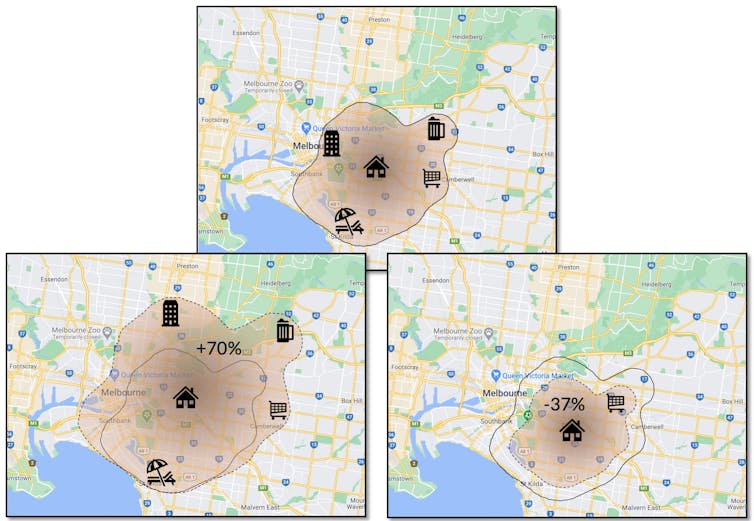 Examples of what a 70% increase (bottom left) and a 37% decrease (bottom right) in your normal home range (top) might look life if you lived in Melbourne.
In addition to greater energy expenditure, increased movements can mean animals need to move through risky areas where they are more vulnerable to predation.
And decreases in movement can be harmful if animals can’t find adequate food or disperse to find mates, or if ecological processes such as seed dispersal are disrupted.
Read more: Predators, prey and moonlight singing: how phases of the Moon affect native wildlife
For example, flightless rails, birds native to New Zealand, are important for dispersing seeds. But research showed birds in areas of high human activity (campgrounds) moved 35–41% shorter distances than birds away from campgrounds. This could limit the population growth of plants if their seeds are not being dispersed as far.
When disturbances are unpredictable
We compared the effects of different disturbance types on animals by splitting them into two categories: human activities (such as hunting, military procedures and recreation like tourism) and habitat modification (such as agriculture and logging).
Both disturbance types can have severe impacts, ranging from a 90% decrease to 1,800% increase in movement for human activities, and a 97% decrease to a 3,300% increase for habitat modifications.
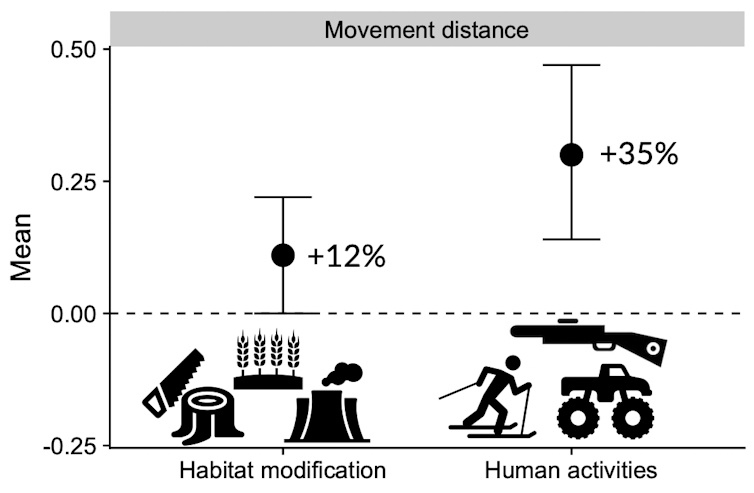 Changes in animal movement distances in response to different types of disturbance. Positive values mean movement was higher in disturbed compared to undisturbed areas.
But we found human activities caused much stronger increases in animal movement distances (averaging +35%) than habitat modifications (averaging +12%).
This might be because human activities are more episodic in nature. In other words, animals are more likely to run away from these unpredictable disturbances.
Read more: Be still, my beating wings: hunters kill migrating birds on their 10,000km journey to Australia
For example, military manoeuvres in Norway led to 84% increase in the home range of moose. And when moose in Sweden were exposed to back-country skiers, their movement speed increased 33-fold.
In contrast, habitat modifications like logging generally represent more persistent changes to the environment, which animals can sometimes adapt to over time.
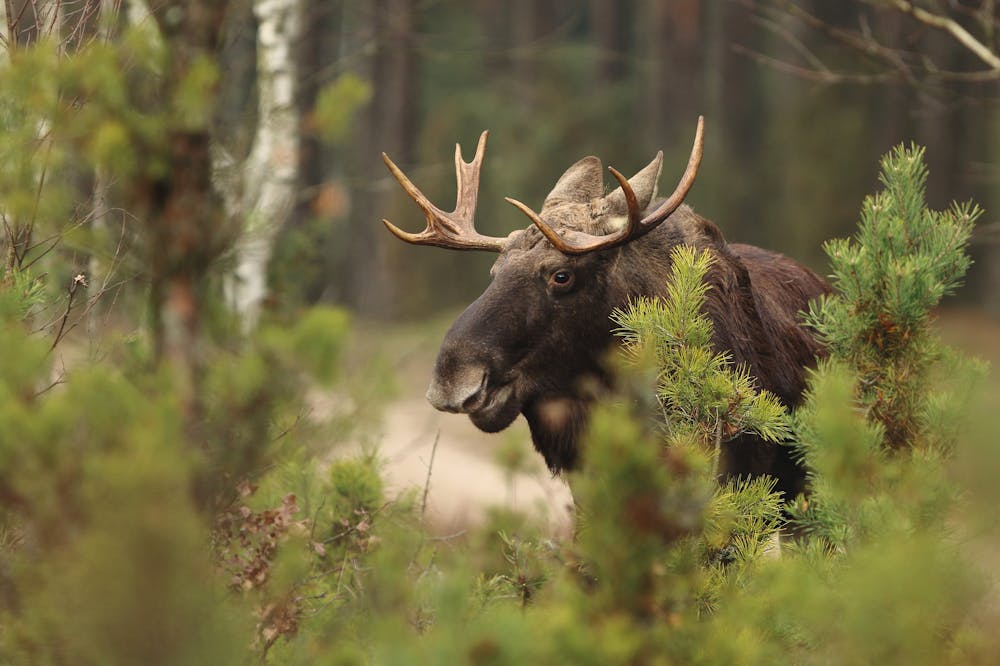 Human activities can lead to huge changes in the movement of animals, such as moose.
Shutterstock
Human activities can lead to huge changes in the movement of animals, such as moose.
Shutterstock
Reducing harms on wildlife
To reduce the harms we inflict on wildlife, we must protect habitats in relatively intact sea and landscapes from getting degraded or transformed. This could include establishing and managing new national parks and marine protected areas.
Where ecosystems are already modified, improving the connections between habitats and the availability of resources (food and water) can help animals move more easily and populations persist.
And with regards to human activities, which generally caused stronger increases in movement, better managing disturbances such as hunting, recreation and tourism can help to minimise or avoid impacts on animal movement. This could include, for example, establishing a no-take zone in a marine protected area, or enforcing restrictions to activities during breeding periods.
Authors: Tim Doherty, ARC DECRA Fellow, University of Sydney


 Daily Bulletin


