

Why we should release New Zealand's strangled rivers to lessen the impact of future floods
- Written by: Gary John Brierley, Professor, Chair of Physical Geography, University of Auckland
When two West Coast rivers flooded on the same day in 2019, the Waiho tore down a bridge and cut off local communities for 18 days, and the Fox eroded a landfill, exposing 135 tonnes of rubbish that contaminated beaches more than 100km away.
A flood on the Rangitata River during the same year severed road, rail and power connections along the east coast of the South Island and cut a 25km path to the sea through prime dairy country.
We shouldn’t be surprised when our rivers break their banks — that’s just a river being a river. Current management practices in Aotearoa treat rivers as static, in the hope of making them more predictable.
But this can lead to disasters.
The recently announced reform of the Resource Management Act (RMA) is an opportunity to address river confinement, but it isn’t enough. We need to change the way we think about rivers.
By forcing rivers into confined channels, we are strangling the life out of them and creating “zombie rivers”.
Unless we change management practices to work with a river, giving it space to move and allowing channels to adjust, we will continue to put people and rivers on a collision course.
When flood risk is managed poorly, disadvantaged groups of the population are often disproportionately impacted. Given climate change predictions of more extreme floods and drought, the problem will only get worse.
Read more: Letting rivers run wild could reduce UK flooding – new research

Working with a river, not against it
A healthy river is resilient, constantly adjusting its path and regenerating habitats, with significant capacity to self-heal and recover from disturbance.
Although New Zealanders associate with the ecological and cultural values of living rivers, such as ancestral connections and places of food gathering (mahingai kai), our management practices continue to treat rivers as unchanging. This reflects a colonial approach that tries to confine rivers within defined corridors to maximise the availability of land and manage flood risk.
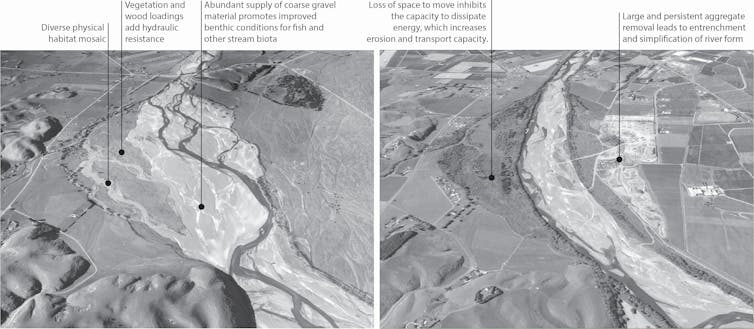 Photogrammetric and satellite images from identical positions show how a section of the Ngaruroro River, in the Hawkes Bay, changed between 1950 (left) and 2020 (right).
NZ Aerial Photography (via Retrolens), SN541 (1950) and Google Earth/Digital Globe (2000)., Author provided
Photogrammetric and satellite images from identical positions show how a section of the Ngaruroro River, in the Hawkes Bay, changed between 1950 (left) and 2020 (right).
NZ Aerial Photography (via Retrolens), SN541 (1950) and Google Earth/Digital Globe (2000)., Author provided
River confinement in New Zealand is the result of both engineering works such as stop banks, intentionally focused on flood defence, and the slow creep of agricultural encroachment. Current river management practices are funded by targeted rates paid by landowners. Their goal is to protect as much land as possible as cheaply as possible.
This has arguably been very effective to date and is understandable, but ignores other river values. It also misses the point that when design limits are exceeded, disaster usually follows.
Effective river management
There are always trade-offs. For example, planting introduced willows along river banks is a cost-effective way of trying to control the river in the short term. But willows spread aggressively and choke the river, diminishing habitat diversity and reducing the river’s capacity to transport flood waters and gravel. This exacerbates risk in the medium to long term.
In scientific terms, effective approaches to river management look after the geomorphology of river systems — the interactions that shape the changing mosaic of river habitats — alongside concerns for water quality and aquatic ecology. This requires analysis of flows and sediment deposition to assess how a river uses its energy.
Read more: When dams cause more problems than they solve, removing them can pay off for people and nature
When a river has space to move, it dissipates its energy. This builds its capacity to recover from disturbances and maintain a dynamic but stable state. Constraining a river’s flow into a restricted space concentrates flow energy, increases flood magnitude and accentuates problems downstream.
Rather than forcing a river into a defined place (which also often limits people’s access to it), more responsive and low-impact practices would embrace a harmonious relationship with dynamic, living and adjusting rivers.
Reframing environmental law
Just as landowners often perceive wetlands as potential farm land once drained, planted river margins are sometimes considered “wasted” land. Agricultural encroachment removed more than 11,000 hectares of braided river bed on the Canterbury Plains between 1990 and 2012.
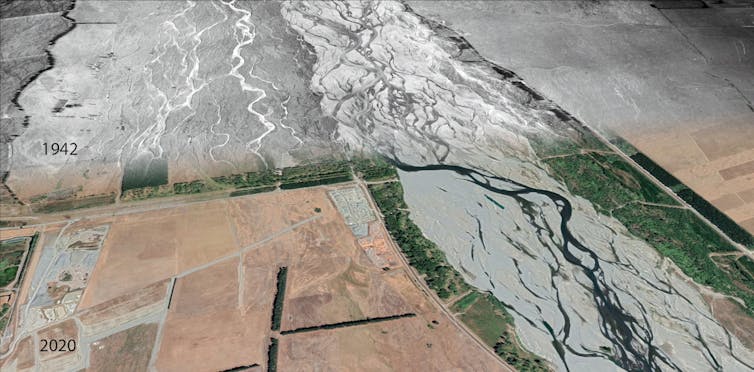 Changing flows of the braided Waimakariri river between 1942 and 2020.
Author provided
Changing flows of the braided Waimakariri river between 1942 and 2020.
Author provided
The current wording of the Resource Management Act (RMA) allows this, as its definition of river bed assumes a static river channel. This is clearly inappropriate for braided rivers, which have multiple shifting channels.
That said, we are cautiously optimistic about reframing the RMA to promote more judicious choices of land for development.
Reducing the impacts of future disaster
International studies show that allowing a river to self-adjust is cheaper and more effective than active interventions that force a river into a particular place.
Europe and Japan have a long history of confining rivers. Once management practices start on this path, they become locked into progressively building more and more expensive hard engineering structures. Many rivers in Aotearoa New Zealand are less modified than those in other parts of the world. Changing management practices now can have a significant positive effect.
Contemporary scientifically-informed approaches to river management directly align with te ao Māori, wherein practices respect ancestral connections, living with rivers rather than seeking to control them. This presents an opportunity for regenerative relations to living rivers, recognising and enhancing their mana so they can function unimpeded.
Although rivers in Aotearoa are well described and we have some of the best databases and monitoring practices, this does not mean we are giving effect to the principle of Te Mana o te Wai, which aims to respect the natural need of a river to adjust as a living entity.
Working with the processes that create and rework a river channel and its floodplain will reduce the impacts of future disasters. Recognising the links between sections of a river and the whole catchment will help us assess how likely it is that the river will adjust to accommodate larger and more frequent future floods.
An honest discussion now could save us the direct and indirect costs of future clean-up and repair. Reanimating rivers seeks to respect the rights of healthy, living rivers that erode and flood in the right place and at the right rate.
This article is part of a series The Conversation is running on the nexus between disaster, disadvantage and resilience. You can read the rest of the series here.
Authors: Gary John Brierley, Professor, Chair of Physical Geography, University of Auckland


 Daily Bulletin


