

The Boy Who Talked to Dogs: a story of trauma brought to the stage with honesty and grace
- Written by: William Peterson, Associate Professor, Flinders University
Review: The Boy Who Talked to Dogs, directed by Andy Packer. Slingsby and the State Theatre Company of South Australia for the Adelaide Festival.
Telling the story of a living person truthfully is difficult. Adapting the memoir of a trauma survivor for the stage is even harder. The Boy Who Talked to Dogs rises to these twin challenges with brazen theatricality, thrilling acting, rousing Irish music and shadow puppetry, connecting equally with youth and adult audiences.
Irish playwright Amy Conroy’s text draws from Martin McKenna’s 2014 memoir, the story of a boy bullied both at home and school who finds his family in a band of stray dogs. It is a tale of bravery and resilience and of finding love — but without a happy ending.
The real-life McKenna grew up in Limerick, Ireland and came to Australia in 1988. To many Australians he known as “The Dog Man” from his books, videos and ABC radio interviews.
Channelling Martin is the brilliant Irish actor Bryan Burroughs, who began rehearsals virtually from hotel quarantine. Burroughs’ physical and verbal dexterity brings to life the homeless child, and the adult bearing the scars of an abusive childhood.
Early in the play, a young Martin articulates the feelings that created strife at school and at home:
It’s like my brain won’t listen to my body and my body won’t listen to my brain and they’re screaming at each other all the time.
Such a child would likely be diagnosed with ADHD today; no adult in his world knows how to deal with him.
At school, his sadistic teacher Mr. Keeley verbally and physically abuses him and prevails on his classmates to call him “Mr. Stupid”. At home, his alcoholic father beats him, his siblings regard him as a nuisance, and his mother gives up on him.
At 13, Martin ran away from home and for three years lived with a pack of stray dogs. Wisely, the show sticks largely to these early years, resisting the temptation to tell the story of his adult life in Australia.
Challenging stories for young ears
Presented with ingenuity and skill under the direction of Andy Packer, who has a long history of staging challenging subjects that speak to youth, The Boy Who Talked to Dogs will inspire young people to have conversations about how to find the strength to carry on under seemingly impossible circumstances.
Sharing the stage with Burroughs is Victoria Falconer, welcoming us in as emcee and occasionally goading Martin and drawing out aspects of his character.
 This is a story of adversity: not a story of overcoming adversity.
Andy Rasheed/Slingsby/State Theatre Company South Australia
This is a story of adversity: not a story of overcoming adversity.
Andy Rasheed/Slingsby/State Theatre Company South Australia
In one exchange she prevails on Martin to lighten up, noting this is “supposed to be a family show.” The audience was surveyed, she adds, and they expressed a preference for an “heroic tale of overcoming adversity.”
Martin, lacking sentimentality, states dryly: “that’s not my story.”
The show’s chief strength is presenting this harrowing story with honesty. Martin emerges strong but not unscathed. While he finds strength and resilience among his canine companions, trauma cannot be magically overcome by the power of love.
Ireland in Australia
Reflecting McKenna’s Irish heritage, the storytelling alternates with song (composer Quincy Grant and songwriter Lisa O’Neill) in this highly theatrical presentation. Seated at tables of six, lively banter and music create the feeling of an Irish pub.
Martin’s life is narrated and acted out in contained spaces — his childhood home and a ramshackle hut — designed by Wendy Todd. As the story unfolds, three additional playing areas open up like giant books. Burroughs and Falconer move freely throughout the vast space, weaving in and out of the audience.
Martin’s beloved dogs are represented as shadow puppets or as animated cut-outs, moving and leaping through space. These low-tech creations imbue the dogs with a sweet, gentle quality that reflects the intimacy of communication between humans and our canine companions.
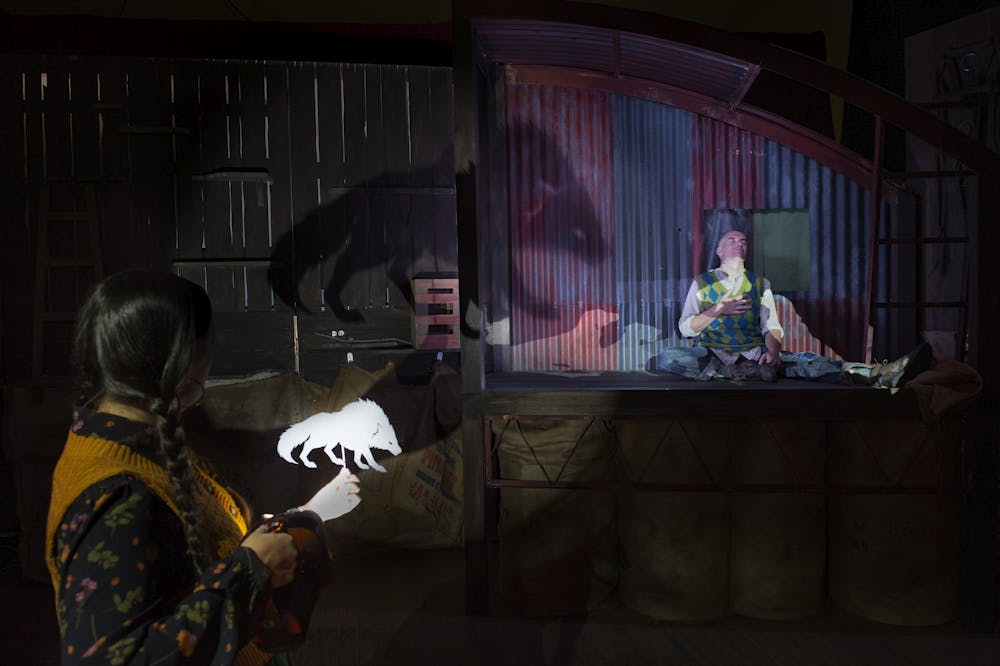 The dogs, brought to life through low-tech shadow puppetry, lend a sense of intimacy to the production.
Andy Rasheed/Slingsby/State Theatre Company South Australia
The dogs, brought to life through low-tech shadow puppetry, lend a sense of intimacy to the production.
Andy Rasheed/Slingsby/State Theatre Company South Australia
In the program notes for the show, director Packer observes “theatre can be an empathy machine”.
“The power we have as theatre makers,” he adds, is “to amplify Martin’s voice.”
Martin’s story is difficult, even extreme. With stories of abuse and neglect acted out by Burroughs using stylised choreography and punctuated by rhythmic beats from the onstage band, the play is recommended for children over age 12.
But in presenting that story with honesty, charm, inventiveness and a spirit of play, Slingsby once again demonstrates its skill in holding up the most difficult of human experiences for scrutiny and understanding.
The Boy Who Talked to Dogs runs until March 14.
Authors: William Peterson, Associate Professor, Flinders University


 Daily Bulletin


