

Even after the rains, Australia's environment scores a 3 out of 10. These regions are struggling the most
- Written by: Albert Van Dijk, Professor, Water and Landscape Dynamics, Fenner School of Environment & Society, Australian National University
Improved weather conditions have pulled Australia’s environment out of its worst state on record, but recovery remains partial and precarious, new research reveals.
Each year, we collate a vast number of measurements on the state of our environment. The data are collected in many different ways – including satellites, field stations and surveys – then combined to produce an overall national score.
A year ago, after prolonged drought and devastating bushfires, Australia’s environment scored a shocking 0.8 out of ten. Our new research shows nature started its long road to recovery in 2020, especially in New South Wales and Victoria. Some of the regions with the poorest scores have high levels of social disadvantage, which risks being further entrenched by environmental disasters such as drought, bushfire and heatwaves.
Nationally, Australia’s environmental condition score increased by 2.6 points last year, to reach a (still very low) score of 3.2. But overall conditions across large swathes of the country remain poor.
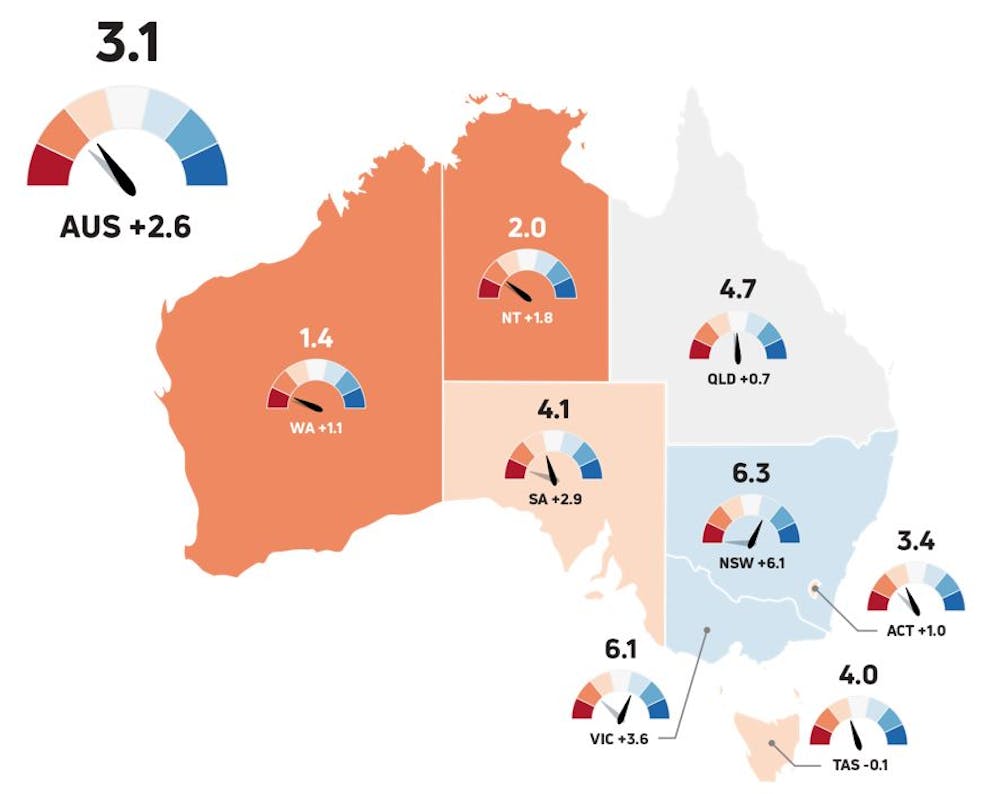 Environmental Condition Score for 2020 by state and territory.
ANU Fenner School
Environmental Condition Score for 2020 by state and territory.
ANU Fenner School
Scores rising but still in the red
From a long list of environmental indicators we report on, seven are selected to calculate an overall score for each region, as well as nationally.
These indicators – high temperatures, river flows, wetlands, soil health, vegetation condition, growth conditions and tree cover – are chosen because they allow a comparison against previous years. See the graphic below to find the score for your region.
The largest improvements occurred in NSW and Victoria thanks to good rains. The poorest conditions occurred in the Northern Territory and Western Australia, where there was little solace from dry conditions.
Comparing local government areas, the best conditions occurred in Nillubik Shire on the northern edge of Melbourne. In contrast, the worst conditions occurred in Katherine in the Northern Territory and in the Shire of Ngaanyatjarraku in remote WA.
From drought to rain
2020 started as badly as 2019 ended – with extreme temperatures, drought and fires, especially in Australia’s southeast. The Sydney suburb of Penrith was the hottest place on Earth on January 4 and, following the bushfires, Canberra had the most dangerous air quality in the world for several days. Clearly, climate change is already affecting our cities and nature.
By the end of summer, the high temperatures also caused another mass coral bleaching in the Great Barrier Reef – the third such event in five years.
Only in February-March did the weather turn, providing good and in some areas very plentiful rains – for example along the NSW coast. Later in the year officials declared an La Niña event – an ocean circulation pattern that normally encourages rainfall in Australia.
While rainfall was not extraordinarily high, it lifted most regions in eastern Australia out of extreme drought. Some parts of northern and western Australia missed out, however, and in some areas the drought deepened.
Taken as an average over the year and over the country, rainfall was 10% above the average for the previous two decades. The number of hot days – those reaching 35℃ – was 11% or nine days more than the 20-year average.
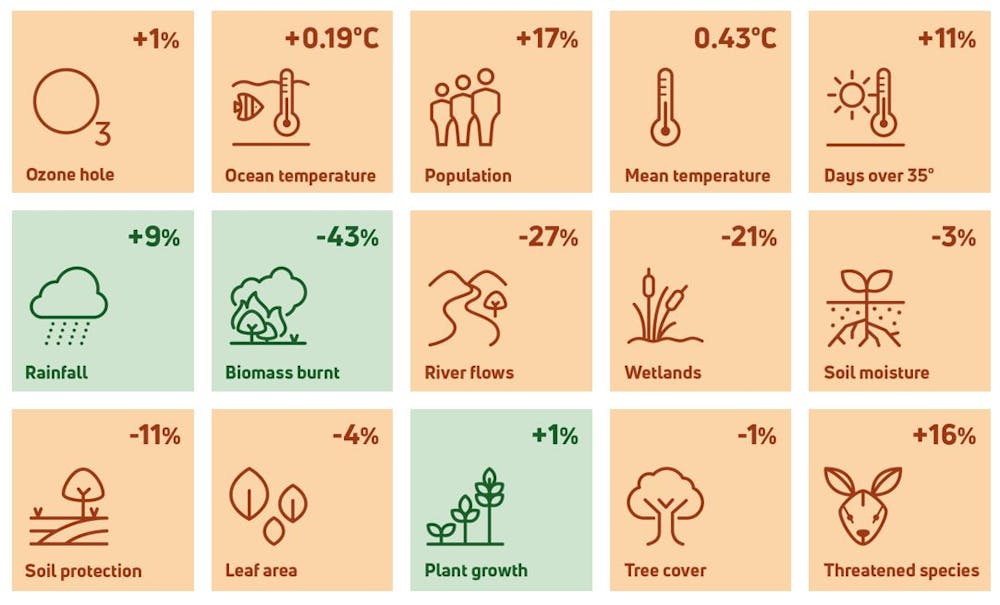 Values for 15 environmental indicators in 2020, expressed as the change from average 2000-2019 conditions. Similar to national economic indicators, they provide a summary but also hide regional variations, complex interactions and long-term context.
ANU Fenner School
Values for 15 environmental indicators in 2020, expressed as the change from average 2000-2019 conditions. Similar to national economic indicators, they provide a summary but also hide regional variations, complex interactions and long-term context.
ANU Fenner School
The improved rainfall helped replenish dried soils, and national average soil moisture was close to average. Growth conditions for the NSW wheatbelt were the best in many years and tree cover increased in northern and eastern Australia.
The rain refilled many dams and reservoirs, especially in Canberra and Sydney. It also made some eastern rivers flow again, including the Darling River in NSW. But with such dry starting conditions, wetlands in inland eastern Australia filled only modestly and waterbird numbers remained low.
Drought persisted across large swathes of inland northern and western Australia, where in some parts, vegetation growth conditions were the worst in decades. And the surplus rain was often not enough to reach wetlands, which continued to shrink.
Read more: Wake up, Mr Morrison: Australia's slack climate effort leaves our children 10 times more work to do
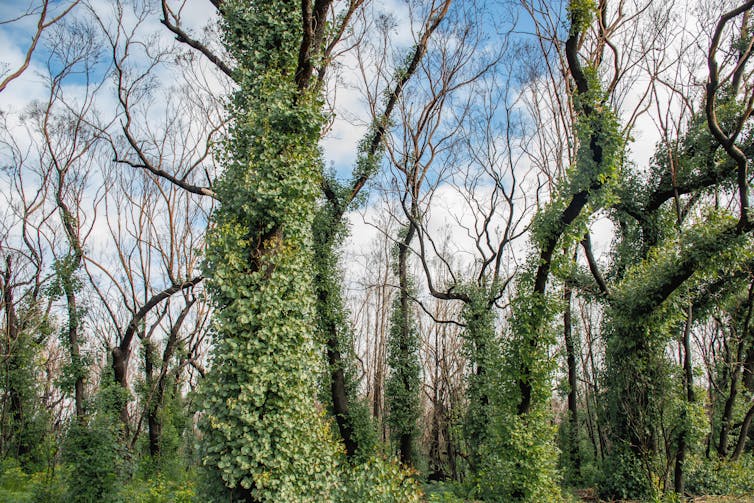 Signs of life: some parts of Australia have benefited from recent rain.
Shutterstock
Signs of life: some parts of Australia have benefited from recent rain.
Shutterstock
Bushfires: few but locally severe
Fire activity in vast areas of inland Australia was very low, because a run of dry years did not leave much dry grass to burn.
Nationally, the total area burnt was 17 million hectares – 90% below the 20-year average. This led to 80 million tonnes of carbon emissions (43% below average).
Fire activity was not low everywhere. In southeast Australia, fires in southern NSW, East Gippsland and the ACT severely damaged forests and other ecosystems as well as people and property.
The full ecological damage of the Black Summer fires was not entirely apparent in 2020. That’s partly because COVID-19 restrictions made the situation difficult to assess.
The fires burned more than 80% of the habitat of 30 threatened species, and may have been the death blow for several. Food shortages and feral cats further reduced populations of surviving animals in the burnt ecosystems.
But some wildlife proved unexpectedly resilient. For example, a great effort by citizen scientists showed frogs rebounded well after the rains.
Another 15 species were added to the Threatened Species List in 2020. In good news, three species were removed from the list, including two species of tree frogs that recovered from the global chytrid fungus.
Read more: 5 remarkable stories of flora and fauna in the aftermath of Australia’s horror bushfire season
Stopping the slow train wreck
The accelerating impacts of climate change will not stop here. New records will inevitably be broken. Heat, drought and fire will again damage our environment and lives. Some ecosystems will be lost forever. But even worse outcomes can be avoided – if the world can rein in greenhouse gas pollution.
There’s cause for cautious optimism. International pressure may force the Morrison government’s hand on climate action. Several states and territories have already taken decisive climate action. Low-emission energy and transport are advancing quickly. As individuals we can fly and drive less, get solar panels and divest from fossil fuel companies.
In the meantime, we must adapt to inevitable climate change and reduce other pressures on our ecosystems. Citizen scientists have proven essential in monitoring how individual species are faring – so download that app and enjoy nature even more. And plant a few trees to help nature along.
Finally, pressure your local, state and national politicians. Ask them: how are you addressing vegetation loss, invasive pests and over-extraction from rivers? If you don’t like the answer, tell them, or try to vote them out.
With greater urgency and some luck, there is still much to be salvaged.
The full report and a video summary are available here.
Read more: Our turtle program shows citizen science isn't just great for data, it makes science feel personal
This story is part of a series The Conversation is running on the nexus between disaster, disadvantage and resilience. You can read the rest of the stories here.
Authors: Albert Van Dijk, Professor, Water and Landscape Dynamics, Fenner School of Environment & Society, Australian National University


 Daily Bulletin


