

Ferdinand Magellan's death 500 years ago is being remembered as an act of Indigenous resistance
- Written by: Kate Fullagar, Professor of History, Institute for Humanities and Social Sciences, Australian Catholic University
This week, the Philippines is marking a significant event in the history of European colonialism in the Asia-Pacific region — the 500th anniversary of the death of Portuguese explorer Fernão de Magalhães (more commonly known as Ferdinand Magellan).
The Philippines government is hosting a series of events to mark the role that Indigenous people played in Magellan’s contested first circumnavigation of the earth in the 16th century.
European history books celebrate the expedition as a three-year Spanish-led voyage, carrying 270 men on five ships. But Filipino commemorations remind audiences that Magellan died halfway through the expedition in the Philippines and that only one ship with just 18 survivors limped home to Seville.
In particular, Filipinos remember how Lapu Lapu, the datu (leader) of the island of Mactan, inspired a force of Indigenous warriors to defeat Magellan’s crew — and the Spanish threat to their sovereignty — on April 27, 1521.
The Filipino commemorations show what an Indigenous-centred government approach to imperial history in the Pacific can look like. They also sit in stark contrast to the exhibitions, reenactments and publications that marked the 250th anniversary of James Cook’s arrival in Australia and New Zealand in recent years.
These commemorations mostly upheld the unique bravery of the British navigator, sidelining potentially deeper discussions of the violence to Indigenous people he and his crew also brought.
What happened to Magellan in 1521
Magellan reached what are now the Philippines in March 1521 after an arduous 100-day Pacific crossing. He set about using a combination of diplomacy and force to get local leaders and their followers to convert to Catholicism and submit to the authority of the far-away Spanish king.
Rajah Humabon of Cebu and other local rulers embraced an alliance with the Spanish, hoping to gain an advantage against their rivals.
Magellan decided to attack Mactan, however, when Lapu Lapu refused to negotiate. About 60 European sailors and soldiers joined forces with Humabon and attacked Mactan at dawn, but they were met on the beach by Lapu Lapu and his armed warriors.
Weighed down by their armour, the Europeans stumbled in the shallows under arrow fire. Filipino folk histories say that an army of sea animals were also part of the resistance. Octopus wound their tentacles around the legs of the invaders, dragging them to their deaths. The battle was over within an hour.
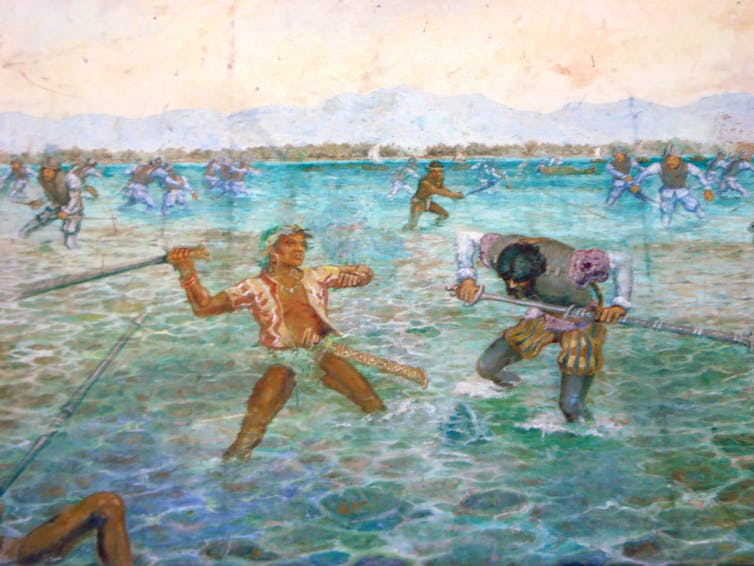 A mural painting of the Mactan battle at the Mactan shrine in Cebu, Philippines.
Shutterstock
A mural painting of the Mactan battle at the Mactan shrine in Cebu, Philippines.
Shutterstock
Celebrating the victory at Mactan
The events organised by the Filipino government’s National Quincentennial Committee to mark Magellan’s death include a drone show, military parade and the televised unveiling of a new shrine to Lapu Lapu. All of these commemorations are designed to pay “tribute and recognition to Lapu Lapu and the Mactan heroes”.
The NQC also sponsored a national art competition centred on four themes connected to the Mactan victory — sovereignty, magnanimity, unity and legacy.
Matthius B. Garcia’s painting, Hindi Pasisiil (Never to be Conquered), recently took the grand prize in the “sovereignty” category.
In his work, the viewer’s eyes are drawn to the strong figure of Lapu Lapu. He is covered in Visayan tattoos and wears the bright red bandana and thick gold chains of a warrior and ruler. He leaps into the centre of the canvas, kampilan (sword) raised above his head, leading the charge of men rushing at the European invaders.
Magellan and his men, decked out in armour over puffy sleeves and stockings, fall over each other and into the sea to their deaths.
The artwork is Indigenous-centred because it was crafted by a Filipino artist for a Filipino audience. It is telling the story of what happened at Mactan from the point of view of the locals rather than the strangers.
Ordinary Filipinos have also been sharing their own artistic representations of the battle of Mactan on the NQC’s Facebook page, such as 5-year-old Miguel Alfonso Manzano Noriel’s painting, entitled The Battle of Mactan, below.
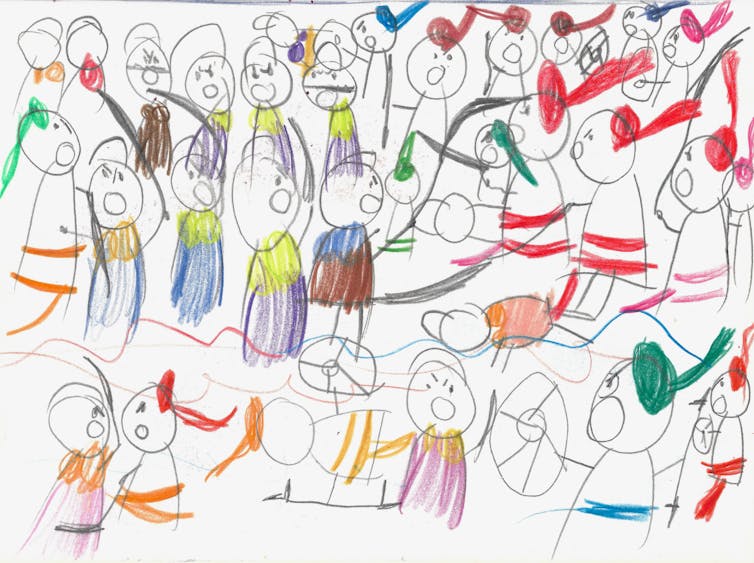 The Battle of Mactan by Miguel Alfonso Manzano Noriel.
Author provided
The Battle of Mactan by Miguel Alfonso Manzano Noriel.
Author provided
The NCQ has also encouraged children to print paper doll figures of Lapu Lapu and Magellan so they can re-enact the battle of Mactan at home.
In contrast to Garcia and Noriel’s fiery scenes of mayhem, the winning entries in the art competition’s “magnanimity” section remember the compassion that Filipinos showed to the explorers.
In Romane Elmira D. Contawi’s prize-winning painting, a local man holds out fruit to a bedraggled, hollow-eyed white man. The work illustrates the key role locals played in the expedition, giving provisions to Magellan’s fleet and sharing their expert knowledge on surviving the dangerous seas.
Remembering Cook in Australia and NZ
From 2018–20, the Australian and New Zealand governments also sponsored events related to a significant anniversary of European incursion into their lands — the arrival of Cook’s ship, the Endeavour, in 1769–70.
Some did aspire to take an Indigenous-centred viewpoint. But the majority ended up pushing, at best, a “shared histories” approach. They encouraged audiences to consider “both sides” of the beach when the Endeavour docked on Indigenous shores.
Read more: Explorer, navigator, coloniser: revisit Captain Cook’s legacy with the click of a mouse
National institutions in Australia held exhibitions entitled “Cook and the Pacific” or “Cook and the First Australians”. The New Zealand centrepiece event was a six-vessel flotilla — three European, three Pasifika — that stopped off at 14 communities to instigate “a balanced telling of a shared Māori and Pākehā history.”
In these performances, Cook was made to forego some of the limelight, but never to step off his pedestal entirely.
Other memorials did not achieve even this fuzzy sense of mutuality. Pre-existing statues of Cook, for instance, not only remained standing through the anniversary years, they were often protected from being defaced. In the case of the Cook statue in Sydney’s Hyde Park, this came in the form of dozens of police officers.
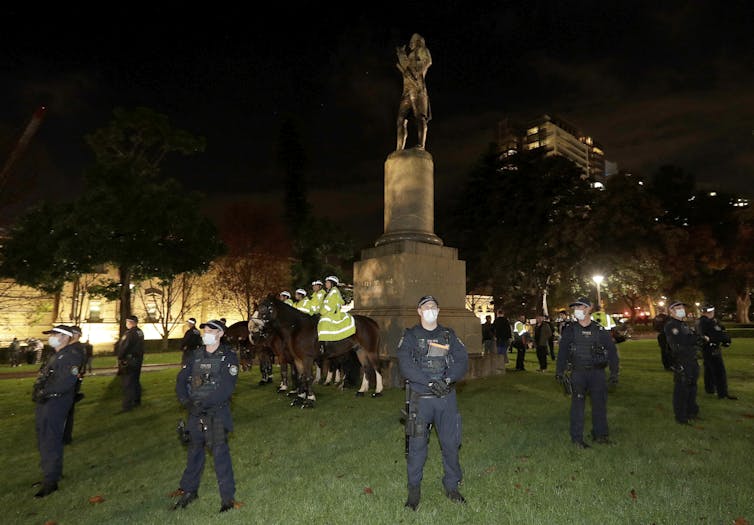 Police encircling the Cook statue in Sydney last year.
Rick Rycroft/AP
Police encircling the Cook statue in Sydney last year.
Rick Rycroft/AP
Decolonised public histories
The Philippines’ approach to a more Indigenous-focused and critical form of public history is imperfect. The government has come under attack for silencing “unpatriotic” criticism" of national leaders today — and in the past.
And the government was criticised for its handling of the death of another Ferdinand – the Philippines’ former president Ferdinand Marcos, who ruled the country through martial law for nearly a decade. He was given a hero’s burial to the outrage of many.
Similarly, public histories that happily remember 16th-century rebellions against Spanish conquistadors so as to “uplift the cultural confidence of the Filipino people” can render invisible some modern Indigenous struggles for autonomy, particularly in the Philippines’ Islamic south. There is only room for patriotic versions of the country’s history that emphasise unity.
Despite these serious concerns, the Filipino approach to the era of European expansion offers a refreshing contrast to the dominant stories about Cook in Australia and New Zealand. It is not simply adding in Indigenous voices or awarding Indigenous people co-star status on commemorative occasions.
Rather, the Filipino attitude to Magellan flips colonial history on its head by focusing on Indigenous resistance.
The promise of decolonised public histories in the Pacific is not to punish, shame or settle scores. It is instead intended to help forge as-yet undreamed futures for the region that place original sovereigns at their heart.
Authors: Kate Fullagar, Professor of History, Institute for Humanities and Social Sciences, Australian Catholic University


 Daily Bulletin


