

'Green steel' is hailed as the next big thing in Australian industry. Here's what the hype is all about
- Written by: Jessica Allen, Senior Lecturer and DECRA Fellow, University of Newcastle
Steel is a major building block of our modern world, used to make everything from cutlery to bridges and wind turbines. But the way it’s made – using coal – is making climate change worse.
On average, almost two tonnes of carbon dioxide (CO₂) are emitted for every tonne of steel produced. This accounts for about 7% of global greenhouse gas emissions. Cleaning up steel production is clearly key to Earth’s low-carbon future.
Fortunately, a new path is emerging. So-called “green steel”, made using hydrogen rather than coal, represents a huge opportunity for Australia. It would boost our exports, help offset inevitable job losses in the fossil fuel industry and go a long way to tackling climate change.
Australia’s abundant and cheap wind and solar resources mean we’re well placed to produce the hydrogen a green steel industry needs. So let’s take a look at how green steel is made, and the challenges ahead.
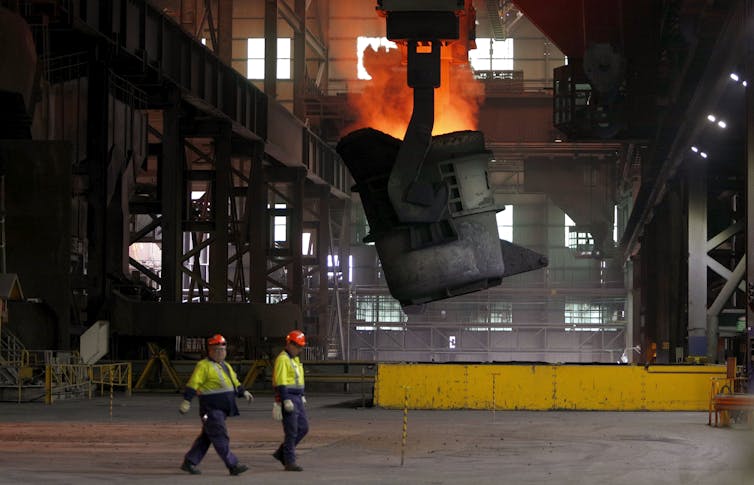 A green steel industry would give Australia a slice of the low-emissions manufacturing boom.
Daniel Munoz/AAP
A green steel industry would give Australia a slice of the low-emissions manufacturing boom.
Daniel Munoz/AAP
Steeling for change
Steel-making requires stripping oxygen from iron ore to produce pure iron metal. In traditional steel-making, this is done using coal or natural gas in a process that releases CO₂. In green steel production, hydrogen made from renewable energy replaces fossil fuels.
Australia exports almost 900 million tonnes of iron ore each year, but only makes 5.5 million tonnes of steel. This means we have great capacity to ramp up steel production.
A Grattan Institute report last year found if Australia captured about 6.5% of the global steel market, this could generate about A$65 billion in annual export revenue and create 25,000 manufacturing jobs in Queensland and New South Wales.
Steel-making is a complex process and is primarily achieved via one of three processes. Each of them, in theory, can be adapted to produce green steel. We examine each process below.
Read more: Australia could fall apart under climate change. But there's a way to avoid it
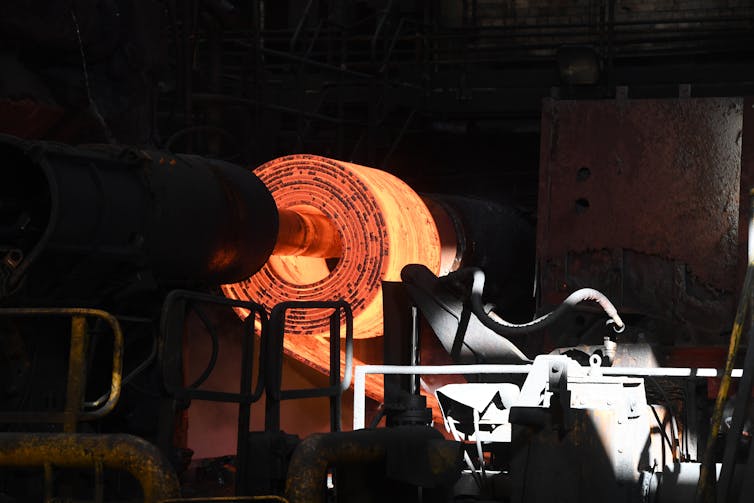 Steel-making is a complex process.
Dean Lewins/AAP
Steel-making is a complex process.
Dean Lewins/AAP
1. Blast furnace
Globally, about 70% of steel is produced using the blast furnace method.
As part of this process, processed coal (also known as coke) is used in the main body of the furnace. It acts as a physical support structure for materials entering and leaving the furnace, among other functions. It’s also partially burnt at the bottom of the furnace to both produce heat and make carbon monoxide, which strips oxygen from iron ore leaving metallic iron.
This coal-driven process leads to CO₂ emissions. It’s feasible to replace a portion of the carbon monoxide with hydrogen. The hydrogen can strip oxygen away from the ore, generating water instead of CO₂. This requires renewable electricity to produce green hydrogen.
And hydrogen cannot replace carbon monoxide at a ratio of 1:1. If hydrogen is used, the blast furnace needs more externally added heat to keep the temperature high, compared with the coal method.
More importantly, solid coal in the main body of the furnace cannot be replaced with hydrogen. Some alternatives have been developed, involving biomass – a fuel developed from living organisms – blended with coal.
But sourcing biomass sustainably and at scale would be a challenge. And this process would still likely create some fossil-fuel derived emissions. So to ensure the process is “green”, these emissions would have to be captured and stored – a technology which is currently expensive and unproven at scale.
Read more: Australians want industry, and they'd like it green. Steel is the place to start
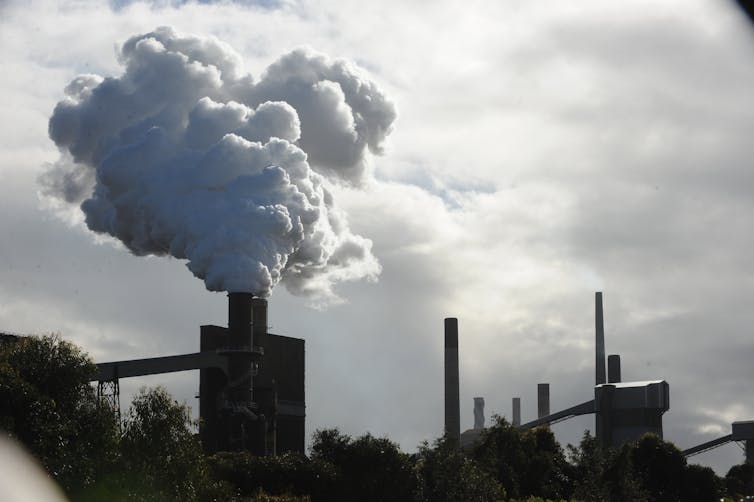 Producing steel using the blast furnace method produces substantial emissions.
Dean Lewins/AAP
Producing steel using the blast furnace method produces substantial emissions.
Dean Lewins/AAP
2. Recycled steel
Around 30% of the world’s steel is made from recycled steel. Steel has one of the highest recycling rates of any material.
Steel recycling is mainly done in arc furnaces, driven by electricity. Each tonne of steel produced using this method produces about 0.4 tonnes of CO₂ – mostly due to emissions produced by burning fossil fuels for electricity generation. If the electricity was produced from renewable sources, the CO₂ output would be greatly reduced.
But steel cannot continuously be recycled. After a while, unwanted elements such as copper, nickel and tin begin to accumulate in the steel, reducing its quality. Also, steel has a long lifetime and low turnover rate. This means recycled steel cannot meet all steel demand, and some new steel must be produced.
3. Direct reduced iron
“Direct reduced iron” (DRI) technology often uses methane gas to produce hydrogen and carbon monoxide, which are then used to turn iron ore into iron. This method still creates CO₂ emissions, and requires more electricity than the blast furnace method. However its overall emission intensity can be substantially lower.
The method currently accounts for less than 5% of production, and offers the greatest opportunity for using green hydrogen.
Up to 70% of the hydrogen derived from methane could be replaced with green hydrogen without having to modify the production process too much. However work on using 100% green hydrogen in this method is ongoing.
Read more: For hydrogen to be truly 'clean' it must be made with renewables, not coal
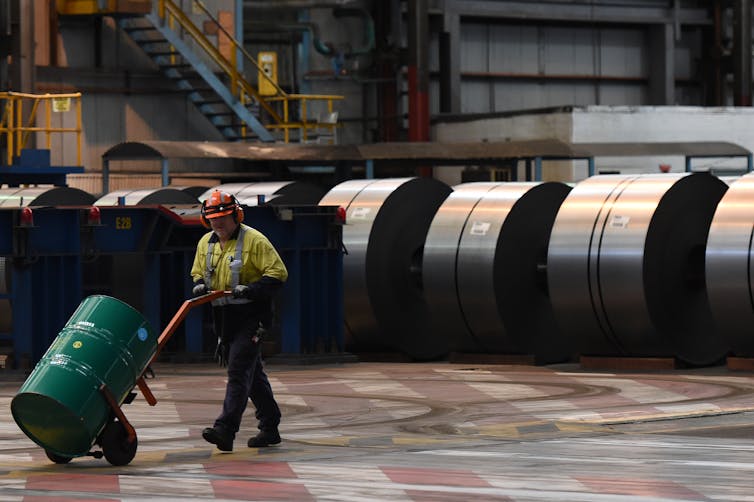 New steel must be produced because not enough steel is available for recycling.
Dean Lewins/AAP
New steel must be produced because not enough steel is available for recycling.
Dean Lewins/AAP
Becoming a green steel superpower
The green steel transition won’t happen overnight and significant challenges remain.
Cheap, large-scale green hydrogen and renewable electricity will be required. And even if green hydrogen is used, to achieve net-zero emissions the blast furnace method will still require carbon-capture and storage technologies – and so too will DRI, for the time being.
Private sector investment is needed to create a global-scale export industry. Australian governments also have a big role to play, in building skills and capability, helping workers retrain, funding research and coordinating land-use planning.
Revolutionising Australia’s steel industry is a daunting task. But if we play our cards right, Australia can be a major player in the green manufacturing revolution.
Authors: Jessica Allen, Senior Lecturer and DECRA Fellow, University of Newcastle


 Daily Bulletin


