

Hotel quarantine causes 1 outbreak for every 204 infected travellers. It's far from ‘fit for purpose’
- Written by: Driss Ait Ouakrim, Research Fellow, Population Interventions Unit, Centre for Epidemiology and Biostatistics, Melbourne School of Population and Global Health, The University of Melbourne
With Melbourne under lockdown for another seven days, the consequences of Australia’s inefficient and dangerous quarantine system continue.
This outbreak started with just one leak from hotel quarantine in South Australia in early May. And unless the hotel quarantine system gets a serious shake up – and fast – we’re likely to see more outbreaks.
Our analysis shows for every 204 infected travellers in hotel quarantine in Australia, there is one leak.
We have known since August 2020, through the World Health Organization, of the risks associated with quarantine in hotels with their shared spaces and inadequate ventilation systems.
Over the past ten months, a plethora of epidemiologists, public health experts, engineers and state premiers have consistently highlighted the shortcomings of a hotel-based quarantine system and the need for purpose-built facilities.
These calls have been largely ignored by the federal government, which continues to consider the current hotel-based quarantine system as “fit for purpose” and “a system that is achieving 99.99% effectiveness” and is “serving Australia very well”.
But is this true?
Rethinking the data
We teamed up with colleagues from the University of Otago to analyse hotel quarantine data from Australia and New Zealand (some of which is outlined in this pre-print paper, meaning it’s yet to be peer reviewed).
We attempted to identify all COVID-19 outbreaks and border control failures associated with quarantine systems and to estimate the failure risks in terms of the spread of COVID-19 infection into the community.
Read more: Another day, another hotel quarantine fail. So what can Australia learn from other countries?
We identified 21 failures that have occurred between April 2020 and June 2021 in Australia:
- three in Queensland
- eight in New South Wales
- two in South Australia
- five in Victoria
- three in Western Australia.
One of these caused more than 800 deaths and the most recent is causing the current lockdown in Victoria.
There were 4.9 failures per 1,000 SARS-CoV-2 positive cases in quarantine. This means that one outbreak from hotel quarantine is expected every 204 infected travellers.
Since April 2020, on average 308 infected travellers arrived in Australia each month, so that is 1.5 expected outbreaks per month.
This doesn’t sound like a system that is 99.99% effective.
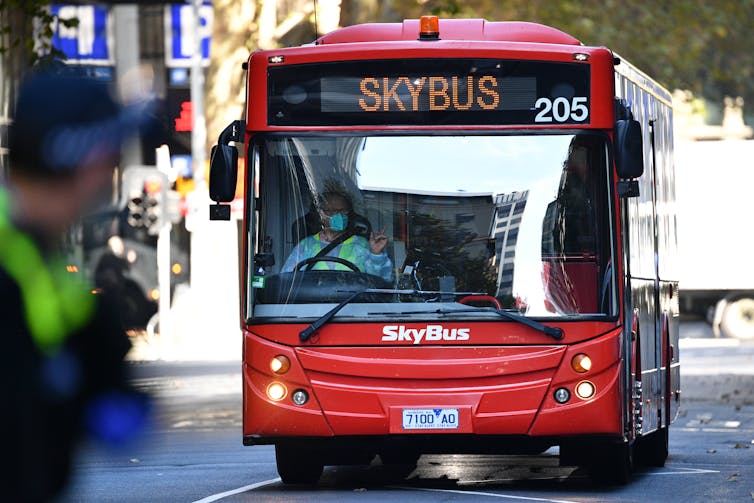 More than 300 infected travellers have arrived in Australia each month.
James Ross/AAP
More than 300 infected travellers have arrived in Australia each month.
James Ross/AAP
So what needs to happen?
The proportion of returning travellers who are infected is increasing due to the global intensification of the pandemic and the increasing infectivity of new SARS-CoV-2 variants.
Australia’s quarantine system is our first and most important line of defence against COVID-19. If it’s not improved, the risk of outbreaks will increase.
So how can we improve the quarantine system? Based on our analysis, we recommend:
1. Capping or temporarily suspending travel from high-risk areas.
The most obvious action is to reduce arrivals, or even suspend arrivals, from high-infection locations.
Australia and New Zealand temporarily did for travel from India in April 2021 and other high-risk countries earlier in the pandemic .
This is the “red light” we need to hit from time to time.
2. Establishing adequate quarantine facilities.
Every state and territory should be equipped with Howard Spring-style facilities, with outdoor-facing cabins with free-flowing air.
These facilities could be used in priority for travellers coming from high-risk countries.
This won’t reduce the risk of leaks to zero, although we have not yet seen any leakage out of Howard Springs.
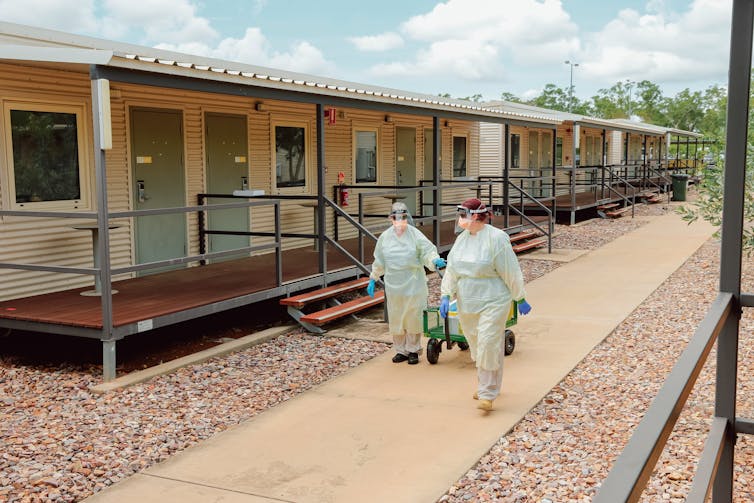 Outdoor-facing cabins, such as those at Howard Springs, ensure returned travellers aren’t sharing the same ventilation systems.
AAP/Glenn Campbell
Outdoor-facing cabins, such as those at Howard Springs, ensure returned travellers aren’t sharing the same ventilation systems.
AAP/Glenn Campbell
The Victorian government recently announced a project to build a 3,000-bed facility for returning travellers with support from the federal government, and other states should do the same.
Hotels could then be used just for arrivals from lower-risk countries such as Singapore and South Korea – though the classification of countries as “low risk” would change over time.
Some countries may be so low risk quarantine is not needed and may place returned travellers at increased risk of acquiring COVID-19 while in quarantine. This is the case for NZ at the moment, and should be expanded to other countries that meet suitable thresholds.
3. Expanding the use of saliva testing among facility workers and travellers.
We need to expand the daily use of PCR (polymerase chain reaction) saliva testing to workers at all facilities.
So far, as of April 2021, Victoria, WA, NSW and SA have all updated their testing rules to make daily saliva testing mandatory for quarantine staff. Other states should follow suit.
4. Protect and test border workers.
Most of the quarantine system failures in Australia involved the infection of quarantine workers.
The vaccination of all quarantine workers against COVID-19 will have reduced this risk of transmission, though no public data are available to confirm all workers have been vaccinated.
While vaccination is not mandatory for border workers, staff who refuse the jab are removed from the front line.
Read more: Why strict border control remains crucial if we want to keep the travel bubble safe
We can’t afford to wait
Quarantine system failures can be very costly in terms of health, lives and economic impacts. The likely economic cost of the current outbreak in Victoria, A$1 billion or more, is enough to build two or more new facilities.
Embracing a more rigorous quarantine system for high-risk arrivals, in combination with an effective vaccination strategy that allows low-risk arrivals to (eventually) come in with no quarantine, is the necessary path forward.
Authors: Driss Ait Ouakrim, Research Fellow, Population Interventions Unit, Centre for Epidemiology and Biostatistics, Melbourne School of Population and Global Health, The University of Melbourne


 Daily Bulletin


