

Read The Times Australia

Daily Bulletin

After decades of loss, the world's largest mangrove forests are set for a comeback

  • Written by: Benjamin Brown, Postdoctoral research associate, Charles Darwin University
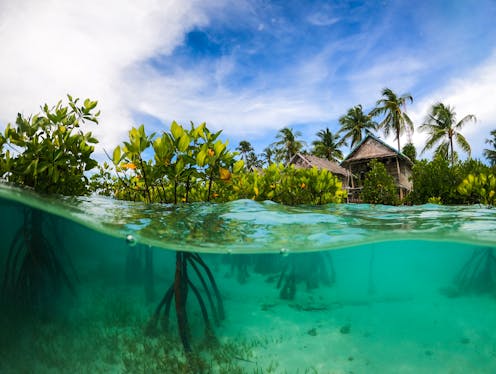
After decades of loss, the world's largest mangrove forests are set for a comeback

Mangroves ring the shores of many of Indonesia’s more than 17,000 islands. But in the most populated areas, the world’s largest mangrove forests have been steadily whittled away, and with them, the ability to store blue carbon.

As the world’s fourth-most populous nation has grown, pressure on the mangroves has too. More than 756,000 hectares of mangroves have been cleared and turned into brackish ponds to farm water shrimp and milkfish.

Every year for the past three decades, another 19,000 hectares has been ripped out for aquaculture and increasingly, for oil palm plantations. As of 2015, an estimated 40% of the country’s mangroves had been degraded or lost.

Is this another predictable bad news story about the environment? No. This is a good news story. That’s because Indonesia’s government is, rising to the challenge of conserving its mangroves – and restoring lost forests.

Government investment in mangroves is rising and the political will is in place. Indonesia’s ambitious goal is to restore almost all of what’s been lost, rehabilitating 600,000 hectares of mangroves by 2024.

Why have Indonesia’s mangroves been hard hit?

In a 2012 interview, former Indonesian forestry official Eko Warsito explained why his country’s mangroves were disappearing:

More than 50% of Indonesia’s population lives in coastal areas, and most of them are poor. An ordinary plot of mangroves is worth $84 a hectare. But if it’s cleared and planted with oil palms, it can be worth more than $20,000 a hectare.

Unfortunately, this difference in perceived value has seen mangroves degraded or replaced. You can glimpse the current state of Indonesia’s 3.3 million hectares of mangrove area in the map below, which was released last year by Indonesia’s environment and forestry ministry.

Mangroves are broadly in good condition in the provinces of Papua and West Papua. But in the more populated areas – especially around the densely populated island of Java – mangroves have been largely deforested and degraded.
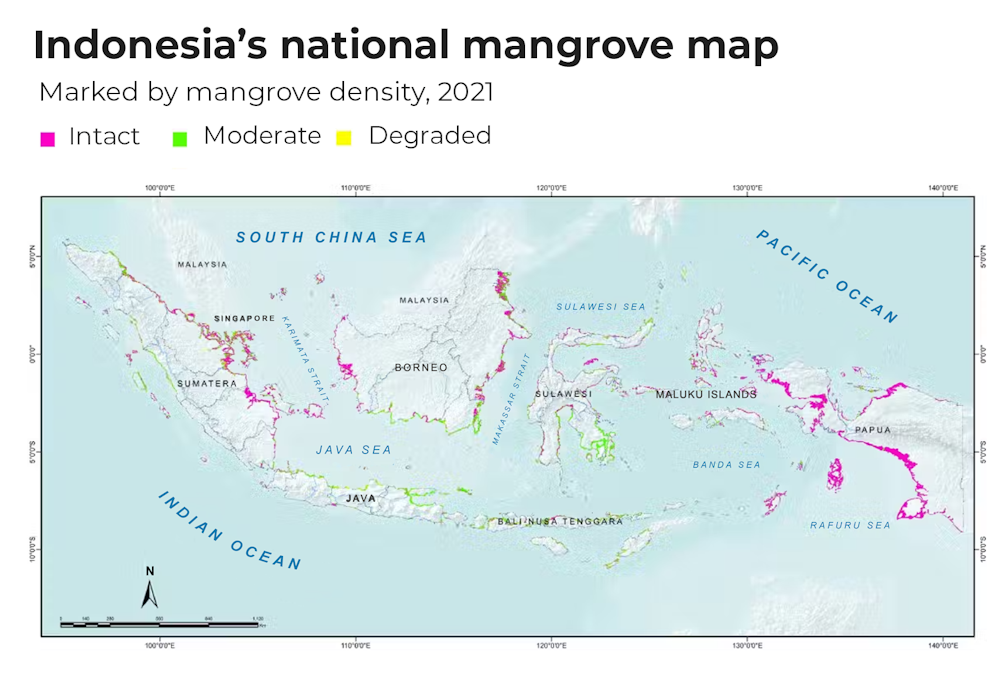
Adapted from a Ministry of Environment and Forestry, Republic of Indonesia map Recent analysis by the World Bank puts the value of mangrove ecosystems at between A$21,000 to $70,000 per hectare per year. Similarly, a 2020 cost-benefit analysis of mangrove conservation versus conversion to shrimp aquaculture in Indonesia’s Papua province estimated the direct and indirect value of mangroves at A$34,000 per hectare per year. But these valuations are heavily influenced by the role mangroves play in providing ecosystem services. Without these services, mangroves are worth two orders of magnitude less, at around A$340 per hectare. Their real value lies in their ability to store large amounts of carbon, averaging almost 4000 tonnes of carbon dioxide equivalents per hectare. Until now, however, policy bottlenecks at the national level have stopped Indonesia from investing in better mangrove management and producing new revenue streams from stemming mangrove losses. Mangroves like these from a village forest in Sumatra store an average of 1083 tonnes of carbon in their living tissues and the soil beneath. Benjamin Brown Indonesia’s mangroves have suffered because of this disconnect between their real value and government policies and institutions. Over 20 institutions have some level of responsibility for mangrove management in Indonesia. It’s no wonder their agendas often conflict. Read more: Indonesia's vast mangroves are a treasure worth saving But progress is being made. Two years ago, President Joko Widodo added mangroves to the mandate of the country’s peatland restoration agency, after its success at restoring damaged peatlands. The goal for mangroves is to restore 600,000 hectares of mangroves by 2024. There are alternatives to aquaculture You might think it’s too hard to restore mangroves once they’ve been turned into shrimp farms. Previously, this has been true, with an over-reliance on simply planting more seedlings rather than tackling the harder work of social and economic reliance on former mangrove habitat. In response, Indonesia’s government has mapped around 77,000 hectares of the best restoration candidate areas across 300 villages in Sumatra and Kalimantan (Indonesian Borneo), working in full collaboration with coastal villagers. Restoring mangroves requires human labour and machinery, as in this image of villagers in Sulawesi improving water flow and drainage into disused shrimp ponds. Rio Ahmad (Director of Yayasan Hutan Biru) 5° 1'59.95 This Google Earth image shows how quickly mangroves can rebound after hydrological restoration to make water flows more natural. Google Earth To create alternatives to aquaculture, Indonesia’s national farmer field school program will expand to include hundreds of coastal villages. These coastal field schools help local villages improve their management of the coasts and develop alternative sources of income. These include learning to use Nypah palms alongside mangroves, to allow villagers to harvest the valuable sugar from the sap. This species is the only palm considered a true mangrove. They can produce 800,000 litres of sap per hectare per year, forming a sustainable commodity base for organic palm sugar production as well as bio-ethanol. Other options include encouraging production of honey, gluten-free flour, tea, juice, jam, and cosmetics. For some villages, eco-tourism could be an option, or shifting to more sustainable aquaculture. Ratna Fadillah, an expert in non-timber forest product use, harvests holly mangrove leaves to make herbal green tea. These teas offer a low-cost opportunity to create a business, which many women and youth across Indonesia are adopting. Benjamin Brown What’s next? Indonesia’s government is drafting a new mangrove policy, focused on balancing mangrove protection, sustainable use and restoration. We’re already seeing welcome realignment between the nation’s ministries. These efforts are being funded by the Indonesian government, with more financial support sought from other governments and multilateral organisations to scale up their mangrove management to a national scale. Indonesia’s work to turn around the fate of their ailing mangroves will be shown on the world stage at the G20 summit in Bali in November. By then, there will be a public dashboard to represent progress captured by field-based and satellite monitoring. Read more: Can blue carbon help Indonesia meets its 2030 emission targets? World Bank natural resources expert André Rodrigues de Aquino contributed to the research underlying this article Authors: Benjamin Brown, Postdoctoral research associate, Charles Darwin University

Read more https://theconversation.com/after-decades-of-loss-the-worlds-largest-mangrove-forests-are-set-for-a-comeback-182951

Business News

Reducing Sales Friction Through Centralized Content Delivery

Sales friction appears whenever buyers or sales teams face unnecessary obstacles in the buying journey. It can happen when information is hard to find, when messaging feels inconsistent, when product ...

Daily Bulletin - avatar Daily Bulletin

Why Choosing the Right Bollard Supplier Matters for Australian Businesses and Public Spaces

From busy CBD streetscapes to sprawling warehouse loading docks, bollards have become one of the most essential safety and security fixtures across Australia. Whether protecting pedestrians from veh...

Daily Bulletin - avatar Daily Bulletin

Why Modular Content Is Transforming Modern Marketing Teams

Modern marketing teams are expected to produce more content than ever before. They need to support websites, landing pages, email campaigns, social channels, product pages, sales enablement material...

Daily Bulletin - avatar Daily Bulletin

Everything You Need to Know About Getting Support from Optus

Whether you've been an Optus customer for years or you've just switched over, at some point you'll probably need to contact their support team. Maybe your bill looks different from what you expected. ...

Daily Bulletin - avatar Daily Bulletin

The Marketing Strategy That’s Quietly Draining Sydney Business Owners’ Bank Accounts

Sydney businesses are investing more in digital marketing than ever before. The intention is clear. More visibility should mean more leads, more customers, and steady growth. However, many business ...

Daily Bulletin - avatar Daily Bulletin

Why Mining Hose Solutions Are Essential For High-Performance Industrial Operations

In environments where the ground itself is constantly shifting, breaking, and being reshaped, every component must be built to endure. Mining operations are among the most demanding in the industria...

Daily Bulletin - avatar Daily Bulletin

The Reason Talented Teams Underperform

If you’re in business, you might have seen it before. A team of capable and smart people just suddenly slows down, and things start spiraling out of control. On paper, everything looks perfect, but ...

Daily Bulletin - avatar Daily Bulletin

Why More Aussie Tradies Are Moving Away From Paid Ads

Across Australia, a lot of tradies are busy. There’s no shortage of demand in industries like plumbing, electrical, landscaping, and building. But being busy doesn’t always mean running a smooth or...

Daily Bulletin - avatar Daily Bulletin

Why Careers In The Defence Industry Are Growing Rapidly

The defence sector has evolved far beyond traditional roles, opening doors to a wide range of opportunities across technology, engineering, intelligence, and operations. This is where defense industry...

Daily Bulletin - avatar Daily Bulletin

The Daily Magazine

Australia’s Best Walking Trails and the Shoes You Need to Tackle Them

Australia is not short on spectacular walks. You can follow ocean cliffs in Victoria, cross ancien...

Why Pre-Purchase Building Inspections Are Essential Before Buying a Home in Australia

source Have you ever walked through an open home and started picturing your furniture, family d...

5 Signs Your Car Needs Immediate Attention Before It Breaks Down

Car problems rarely appear without warning. In most cases, your vehicle gives clear signals before...

Ensuring Safety and Efficiency with Professional Electrical Solutions

For businesses in Newcastle, a safe and fully functioning workplace remains a key part of day-to-d...

Choosing The Right Bin Hire Solution For Hassle-Free Waste Management

When it comes to managing waste efficiently, finding the right solution can save both time and eff...

Why Cleanliness Is Critical In Childcare Environments

Children explore the world with curiosity, often touching surfaces, sharing toys, and interacting ...

What to Look for in a Reliable Australian Engineering Partner

Choosing an engineering partner is rarely just about technical capability. Most businesses can fin...

How to Choose a Funeral Home That Supports Families with Care

Choosing a funeral home is rarely something families do under ideal circumstances. It often happen...

Why Premium Coffee Matters in Modern Hospitality Venues

In hospitality, details shape perception long before a guest consciously evaluates them.  Lightin...