

Australia's temporary visa system is unfair, expensive, impractical and inconsistent. Here's how the new government could fix it
- Written by: Mary Anne Kenny, Associate Professor, School of Law, Murdoch University
The election of the Albanese Labor government brings an opportunity to end one of the most detrimental elements of Australian refugee law and policy in the past decade: the use of temporary visas.
Temporary protection has been the only option available for asylum seekers who arrived by boat a decade ago and were recognised as refugees. Known as the “legacy caseload”, these people are caught in a system of law and policy that keeps them in a state of perpetual limbo.
As the new government committed to end temporary protection, we have just published a policy brief with the Kaldor Centre for International Refugee Law outlining how this could be achieved.
Our report sets out practical reforms that can be implemented relatively simply, within existing legislative provisions and with only minimal changes to policy and regulations.
The 17 recommendations were produced in consultation with refugees and asylum seekers living on temporary protection visas and bridging visas. We also consulted civil society, including former and current temporary protection visa holders and legal groups working with refugees.
The impact of temporary protection and the fast-track system on refugees and asylum seekers has left many depressed and suicidal. Expectations from those living on temporary visas and the wider refugee advocates are high and there is significant apprehension about the transition.
The new government understands it will need to approach reforms carefully. Our recommendations are accompanied by a trauma-informed strategy to help reduce mental distress, deterioration and retraumatisation of asylum seekers, while also increasing community engagement.

The current system is damaging
Australia’s temporary protection system is unfair, expensive, impractical and inconsistent with our international human rights obligations.
In 2014, the Coalition government reintroduced a Howard-era three-year Temporary Protection Visa (TPV) and a five-year Safe Haven Enterprise Visa (SHEV) for the more than 30,000 people who arrived by boat between August 13 2012 and January 1 2014.
However, unlike the earlier Howard policy, the temporary visas this time provided no realistic prospect of applying for permanent protection.
The number of people in this “legacy caseload” as of May 2022 is 31,256.
They come from many countries. The largest number are from Afghanistan, Iran, Pakistan and Sri Lanka. The majority – around 19,500 people – have been found to be refugees and have been granted TPV and SHEV.
The 10,000 who have been refused a visa were assessed through a “fast-track” process that has been neither fair nor fast.
People who have been refused have been living in the Australian community for ten years or more while awaiting the outcome of appeals.
Some (such as the Nadeselingham family) are working or have had children in Australia.
There are also many asylum seekers from Afghanistan who have been refused visas but who cannot return due to the reemergence of the Taliban in August 2021.
In other words, some of those refused visas may well be refugees or have other ties to the Australian community. However, the current legal system does not allow them to apply for other visas without going through cumbersome, expensive appeals and ministerial intervention processes.
People who hold TPVs and SHEVs are allowed to work but not to reunite with family or travel freely overseas.
Others live on precarious short-term bridging visas, some without the right to work. Many are without access to income support. In either situation, the uncertainty is damaging people’s mental health and well-being.
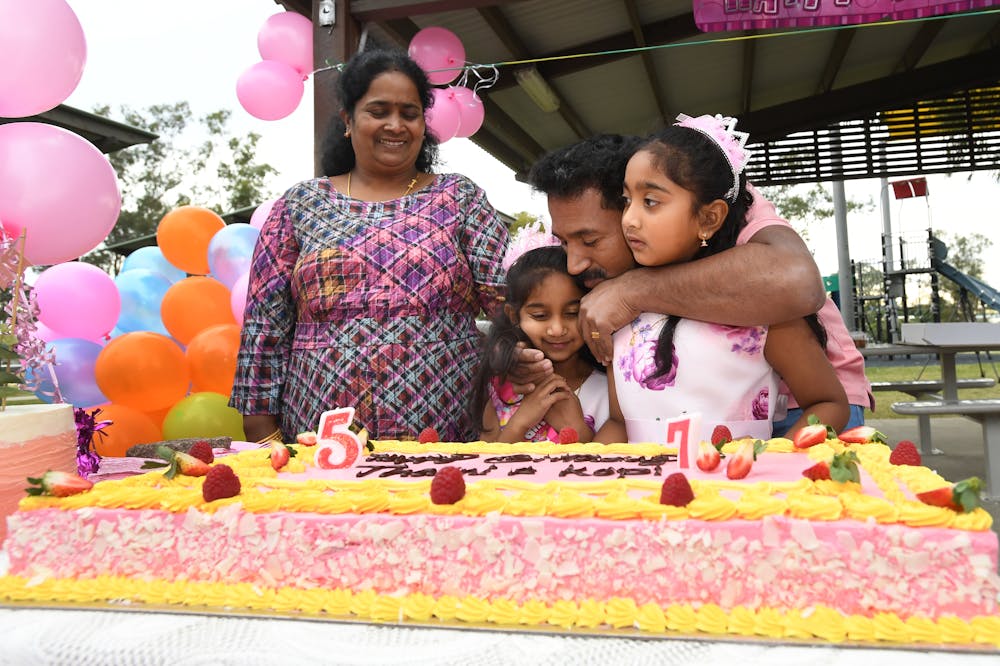 Many ‘legacy caseload’ people (such as the Nadeselingham family) are working or have had children in Australia.
AAP Image/Darren England
Many ‘legacy caseload’ people (such as the Nadeselingham family) are working or have had children in Australia.
AAP Image/Darren England
Key recommendations
The focus of the policy brief was to set out reforms either within the current legislative and policy framework, or with minimal changes.
This means changes can occur within a relatively short time frame.
Key recommendations include:
refugees on TPVs and SHEVs should be moved onto permanent visas known as Resolution of Status visas. People who have not yet been assessed or who have previously been refused protection should also be able to apply for a permanent visa that does not require another assessment of their protection claims
restrictions on travel for TPV and SHEV holders should be removed, pending the grant of a permanent visa and includes specific recommendations in relation to travel documents. Travel is essential for re-establishing links to separated family
family reunion, particularly partners and children, should be prioritised. Granting people permanent visas allows them to begin the process of family reunion through the family or humanitarian programs
the government should establish a specialised team in the Department of Home Affairs to work closely with migration agents, lawyers and refugee communities. This group could identify other options for allowing reunification of close relatives and children who, under current law, may not fall within the definition of “member of a family unit”. Families have been separated for at least 10 years; many left children at home who have now reached ages where they will no longer be considered dependent.
 Some families have been separated for very long periods of time.
Barat Ali Batoor, Author provided (no reuse)
Some families have been separated for very long periods of time.
Barat Ali Batoor, Author provided (no reuse)
In 2014, the new minister for immigration, citizenship and multicultural affairs Andrew Giles said
Labor has a longstanding policy of opposing TPVs, for good reason. They do not provide a sustainable solution for refugees. The uncertainty exacerbates real mental health issues and denies people the capacity to live full lives. As well as significant international law concerns with these provisions, they put people in limbo. There is no deterrence value here, even if you accept that to be a valid policy objective – they only place vulnerable people in a place of uncertainty.
He now has significant power to put those words into action.
Authors: Mary Anne Kenny, Associate Professor, School of Law, Murdoch University


 Daily Bulletin


