

Read The Times Australia

Daily Bulletin

Australia is failing on electric vehicles. California shows it's possible to pick up the pace

  • Written by: Scott Hardman, Professional Researcher, Electric Vehicle Research Center, University of California, Davis
Australia is failing on electric vehicles. California shows it's possible to pick up the pace

Among the many similarities between California and Australia, both are impacted by bushfires and climate change, and both are home to larger cars and trucks than is the norm in developed countries. They are dissimilar, though, when it comes to electric vehicles and vehicle regulations. While California has been pursuing low-carbon and electric vehicles for decades, Australia has trailed most developed nations.

Plug-in electric vehicles accounted for 16% of new light-duty vehicle sales in California in the first half of 2022. In Australia, electric vehicle sales are only 2% of the market, and mostly from one carmaker, Tesla.

Australia, a country with no vehicle fuel economy or CO₂ emissions regulations, is debating how to move forward. The local auto industry suggests Australia needs a slow transition to electric vehicles and should lag the United States, Europe, China and neighbouring New Zealand. Compared to proposed European vehicle emission standards of 43 grams of carbon dioxide per kilometre in 2030, the local industry proposes 98-143g CO₂/km (for light cars and SUVs).

Read more: The road to new fuel efficiency rules is filled with potholes. Here's how Australia can avoid them

The proposed Australian target would result in a slow transition, which new research suggests will have little or no effect on the transport sector’s CO₂ emissions.

The rationale for a slow transition is the same as was heard for decades in California: electric vehicle prices are too high, there isn’t enough infrastructure to support these vehicles, their driving ranges are too short, and certain models aren’t available (electric utes, for example).

Read more: The surprising history of how electric vehicles have played the long game and won

These concerns have some validity, but are largely out of date. Australia in 2022 faces a very different situation from California when it started down the electric vehicle path.

Let’s deal with why each of these four concerns might now be overstated.

1. Limited range

Drivers in both Australia and California travel similar distances per year. In both regions, most trips are well within electric vehicle range.

Further, in both regions most households own two vehicles. This means buyers can, if needed, use another vehicle for longer trips.

Electric vehicle range has also improved: the average range of available electric vehicles in 2013 when electric vehicle sales in California reached Australia’s current level of 2% was 179 kilometres (111 miles). Now, it’s 443 kilometres.
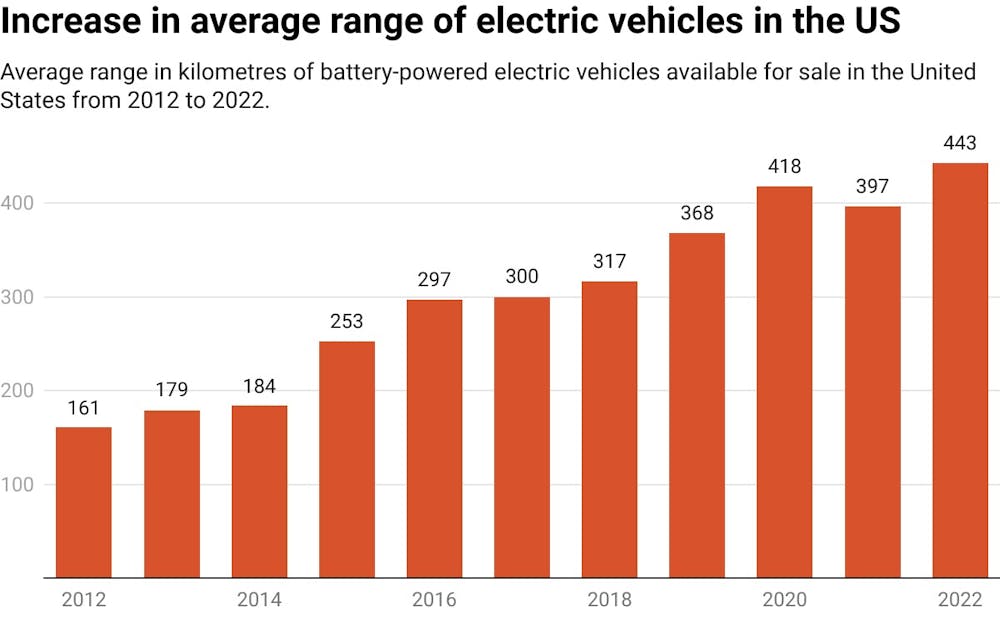
Vertical bar chart show increases in average range of all electric vehicles sold in US from 2012 to 2022
Chart: The Conversation. Data: EPA, CC BY 2. Lack of charging infrastructure In California and other markets like Norway, most early electric vehicle buyers charge at home on their driveway or in a garage. In Australia even more people live in a detached house than in California. Drivers in these households could charge their vehicle at home, which reduces the need for public charging stations. Public charging may be needed to support occasional charging, to enable longer journeys and to support the smaller proportion of households without home charging. But public infrastructure is not a prerequisite for early market growth. Australia already has as many charging stations per person as California had in 2016. In fact, Australia might be only a few years behind. 3. High prices In Australia the average new car is AU$40,729 (US$28,000). Electric vehicles with ranges of around 400km could be made available at that price. For example, the 2023 Chevrolet Bolt starts at US$25,600 (AU$37,000) in the US. And until 2020 the Renault ZOE was sold in Australia for AU$37,400. Both models have a range of about 400km. Consumers have also been shown to be willing to pay more for an electric vehicle compared to a conventional vehicle. This might be partly due to the savings on fuel and maintenance costs. Read more: Why Labor's new tax cut on electric vehicles won't help you buy one anytime soon 4. Lack of models In 2022, 316 electric and 162 plug-in hybrid models are on sale globally. These models include SUVs, utes and pick-up trucks. The lack of choice and of lower-cost electric vehicles in Australia is because carmakers prefer to send these models to markets with supportive electric vehicle policies . Making these models available in Australia may be as simple as giving carmakers the motivation to sell them there. Australia may be well positioned for a rapid transition to electric vehicles if it adopts more supportive policies. If Australia brings in policies such as ambitious fuel-economy standards or a zero-emission-vehicle sales mandate, the country could benefit in the same ways as California did. Read more: Making EVs without China's supply chain is hard, but not impossible – 3 supply chain experts outline a strategy All that’s needed now is supportive policy Supportive policies like these help set the stage for the early electric vehicle market to grow. They do this by: giving carmakers the confidence to develop and supply electric vehicles at multiple price points, in multiple body styles and with long driving ranges giving providers confidence to roll out charging infrastructure giving consumers the supply of electric vehicles they are waiting for. An electric vehicle mandate can also protect consumers from supply ebbs and flows that are common in import-only markets. Read more: Who's holding back electric cars in Australia? We've long known the answer – and it's time to clear the road Other nations have been down this road Australia is not the first nation to grapple with these challenges. South Korea, despite being a global producer of electric vehicles, was experiencing slow domestic market growth. Many Korean electric vehicles were exported to regions with policies more friendly to the technology. The government responded with policies to support electric vehicles. Since then, domestic sales have tripled. South Korea is now the seventh-largest electric vehicle market in the world, up from 11th in 2019. And as federal Energy Minister Chris Bowen noted at the EV Summit last month, with the right policy settings, Sweden increased its proportion of electric vehicle sales from 18% to 62% in just two years. Similar approaches could yield similar results for Australia. While some nations may need a slower transition for a variety of reasons, Australia need not be one of them. Concerns about range, infrastructure and model availability can be readily overcome. The country is well placed for early market growth. All states already offer incentives for electric vehicle buyers, including rebates, registration discounts and road tax exemptions. All that may be needed is for the federal government to adopt policies that support electric vehicles. Based on the remarkable improvements in the technology and what has been learned in California and elsewhere, Australia is well placed for rapid market growth. Authors: Scott Hardman, Professional Researcher, Electric Vehicle Research Center, University of California, Davis

Read more https://theconversation.com/australia-is-failing-on-electric-vehicles-california-shows-its-possible-to-pick-up-the-pace-189871

Business News

How Australian Businesses Can Measure SEO ROI

SEO can feel vague when you are staring at a dashboard full of numbers that do not clearly connect to revenue. The key is to measure the right signals in the right order, then tie them back to outcome...

Daily Bulletin - avatar Daily Bulletin

How Commercial Roller Shutters Improve Site Security Without Slowing Operations

Security upgrades can be frustrating when they make everyday work harder. A door that takes too long to open, creates bottlenecks at shift change, or fails at the worst time can turn “better protectio...

Daily Bulletin - avatar Daily Bulletin

Why a Document Destruction Service Still Matters for Modern Businesses

Businesses generate large volumes of information every day, from staff records and contracts to invoices, reports and customer files. While attention often focuses on how documents are stored, the way...

Daily Bulletin - avatar Daily Bulletin

Bicycle Rack Safety and Space-Smart Storage

Bike storage problems usually show up as small annoyances first: tangled handlebars, scratched frames, and bikes that topple when you pull one out. Over time, those issues become safety risks, especia...

Daily Bulletin - avatar Daily Bulletin

How to Tell if a Childcare Centre Is a Good Fit for Your Child

Choosing childcare can feel like you’re making a huge decision with limited information. Tours are short, centres are often on their best behaviour, and your child might act differently in a new space...

Daily Bulletin - avatar Daily Bulletin

Car Import Timeline: What Usually Happens at Each Stage

Importing a car into Australia can feel confusing because multiple agencies and checkpoints are involved, and the timeline is shaped as much by paperwork quality as it is by shipping speed. The most u...

Daily Bulletin - avatar Daily Bulletin

Portable Toilet Hygiene Standards Explained: Clean vs Sanitised vs Disinfected

In portable toilet servicing, the words clean, sanitised, and disinfected often get used as if they mean the same thing. They don’t. And that difference matters because a unit can look tidy and still ...

Daily Bulletin - avatar Daily Bulletin

Options Available When a Company Faces Financial Distress

Financial distress can develop gradually or arrive suddenly, and when it does, the decisions made in the early stages often determine what options remain available later. Directors who act promptly ...

Daily Bulletin - avatar Daily Bulletin

What Healthcare Teams Look for When Choosing Specialist Surgical Supplies

In clinical environments, small details rarely stay small. A delayed instrument, a poorly matched device or inconsistent supply quality can affect theatre flow, staff confidence and patient outcomes. ...

Daily Bulletin - avatar Daily Bulletin

The Daily Magazine

How to Choose the Right Football for Every Level

Choosing a football may seem straightforward, but the right option depends on who will be using it a...

What to Ask a Wedding Photographer Before You Book

Booking a wedding photographer can feel deceptively simple: you like the photos, you like the vibe...

Why Stress Relief For Dogs Is Essential For Emotional Balance And Long-Term Wellbeing

Managing emotional health is just as important as physical care when it comes to pets, which is why ...

Australia’s Best Walking Trails and the Shoes You Need to Tackle Them

Australia is not short on spectacular walks. You can follow ocean cliffs in Victoria, cross ancien...

Why Pre-Purchase Building Inspections Are Essential Before Buying a Home in Australia

source Have you ever walked through an open home and started picturing your furniture, family d...

5 Signs Your Car Needs Immediate Attention Before It Breaks Down

Car problems rarely appear without warning. In most cases, your vehicle gives clear signals before...

Ensuring Safety and Efficiency with Professional Electrical Solutions

For businesses in Newcastle, a safe and fully functioning workplace remains a key part of day-to-d...

Choosing The Right Bin Hire Solution For Hassle-Free Waste Management

When it comes to managing waste efficiently, finding the right solution can save both time and eff...

Why Cleanliness Is Critical In Childcare Environments

Children explore the world with curiosity, often touching surfaces, sharing toys, and interacting ...