

Every Australian will be touched by climate change. So let's start a national conversation about how we'll cope
- Written by: Robert Glasser, Honorary Professor, Institute for Climate, Energy & Disaster Solutions, Australian National University
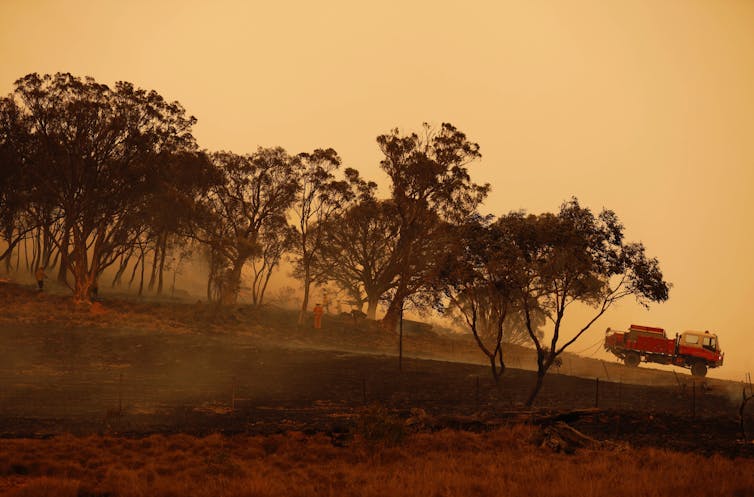
In an address to the National Press Club this month, Home Affairs Minister Clare O'Neil expressed deep concern about the national security implications of climate change.
“When Home Affairs was created, the discussion about climate change and national security was largely academic. Indeed, it was derided by the former government,” O'Neil said. “Just five years on, climate change is a recognised, growing part of Australia’s national security picture.”
Such a grave threat requires a flexible, nuanced and comprehensive national response. It should recognise the complex risks associated with cascading natural disasters, and draw on the knowledge and experience of all Australians.
A confronting reality
In her address, O'Neil said climate change posed a number of threats to the region. In particular, she said Australia and its neighbours were vulnerable to “massive movements of people that may become unmanageable” – especially if they occur alongside food and energy shortages.
The increased frequency of natural disasters were, O'Neil said, “a hugely consuming exercise for government and the community” which, in itself, posed a national security risk.
The Albanese government has sought to better understand the security threats posed by the climate crisis. One of its first acts of government was to commission a climate risk assessment from the Office of National Intelligence.
The findings are classified. But recent analyses, including by the Intergovernmental Panel on Climate Change, suggest the content is likely to be deeply confronting.
We need a better plan
Assessing looming climate risks is important – but it won’t be enough. The government must urgently develop a comprehensive, well-informed and fair plan to reduce the risks, by adapting to climate change.
Australia does have a National Climate Resilience and Adaptation Strategy, released by the Morrison government in October last year. But the strategy has several shortcomings.
For instance, it fails to take account of emerging complex risks such as important connections between international and domestic climate impacts. O'Neil’s address recognised these risks, saying:
Imagine a future January, where we see a Black Saturday-size bushfire in the southeast, a major flood in the north, then overlay a cyberattack on a major hospital system in the west. Our country would be fully absorbed in the management of domestic crises. Then consider how capable we would be of engaging with a security issue in our region.
A revised national adaptation strategy would recognise and prepare for these complex risks.
Australia’s current adaptation plan calls for a national assessment of climate impacts and progress on adaptation measures. But it doesn’t contain a mechanism to ensure this happens, nor did it state how often the assessments should occur. A well-designed evaluation plan would rectify this.
The Morrison government claimed its strategy was informed by public and expert engagement. But these discussions should not just be a one-off. The process should be ongoing, enabling us to improve as we go.
A true national dialogue
National security reports – such as that the federal government commissioned on climate risk – should remain classified. But Australia’s overall climate responses will be less efficient, effective and equitable if only developed behind closed doors in the conference rooms of government departments.
Climate change will increasingly affect every Australian. It will require a whole-of-society response, bringing to bear the knowledge and resources of all.
A major dialogue across Australia – under the banner of national action on climate adaptation – could be a game-changer. It should have three main objectives.
First, it should educate the public about climate challenges ahead. This includes sharing an unclassified version of the climate risk assessment. This authoritative document would counteract other dubious sources of information.
Second, the dialogue should collect examples of innovative climate adaptation from across the country. Many inspiring initiatives are underway in the private sector, civil society organisations and local government, as well as by individuals.
Every region in Queensland, for example, now has a locally led “resilience strategy” outlining anticipated hazards and how they will be addressed.
Similarly, many farmers across Australia are using climate-smart practices that adapt farming systems to the changing climate. This reduces risk, increases crop and livestock production and cuts greenhouse gas emissions.
Third, the dialogue should engage the public in identifying responses to challenges identified in the risk assessment. The “wisdom of the crowd” is generally overlooked and underappreciated by governments. But engaging the public can help identify important responses to climate risks that would otherwise be overlooked.
A project by the Australian National University (ANU) is doing just this. It is partnering with stakeholders in river catchments around Australia to identify nature-based solutions to climate-related flooding.
The ANU is also co-leading an initiative around Lismore to develop citizen-based data collection and communication on rain and creek levels in upper catchment areas. This will provide timely information to communities downstream so they can respond when floods are imminent.
Emissions reduction still matters
A national conversation on climate adaptation should involve diverse participants in structured dialogue, and be conducted with mutual respect.
Such an initiative would be world’s best practice, and further strengthen the Albanese government’s climate credentials as Australia seeks to host the United Nations’ global climate talks in 2026.
None of this takes away from the pressing need to rapidly reduce global greenhouse gas emissions. If Earth’s climate warms by 2℃ or more, the scale of the climate hazards – and the cascading harms to society – will far overwhelm any steps we take to adapt.
So as well as adapting to climate change, the federal government must also increase its own emission reduction ambition, and advocate for other nations to follow suit.
Authors: Robert Glasser, Honorary Professor, Institute for Climate, Energy & Disaster Solutions, Australian National University


 Daily Bulletin


