

Why is climbing Mount Everest so dangerous?
- Written by: Brad Clark, Senior research fellow, University of Canberra
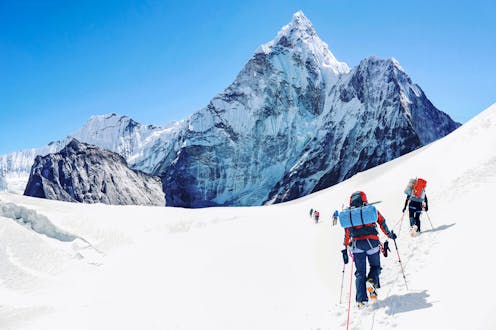
The recent death of Australian man Jason Kennison after reaching the summit of Mount Everest highlights how dangerous mountain climbing can be.
Details of what went wrong as Kennison descended from the summit have yet to be confirmed by officials.
However, his death – one of several this year on Mount Everest – is a reminder of the challenges mountain climbers face.
Read more: From Kilimanjaro to Everest: how fit do you have to be to climb a mountain?
What is it about Mount Everest?
Mount Everest – also known as Chomolungma (its Tibetan name) or Sagarmatha (its Nepali name) – is the highest mountain on Earth with a peak at 8,849 metres above sea-level.
May 29 this year marks 70 years since the first successful summit of Mount Everest by Tenzing Norgay and Sir Edmund Hillary.
This year’s climbing season is shaping to be one of the busiest ever after the Nepali government issued a record 478 climbing permits. This year has also seen Kami Rita Sherpa complete a record 28th summit of Mount Everest.
However, 2023 will end as one of the deadliest on record, with 11 deaths recorded for the season to May 23, and a further two climbers still missing.
Read more: Triumph, tragedy and climate change: telling the stories of the Sherpas of Everest
Preparing to climb
To prepare for the physical, psychological and technical challenges of a Mount Everest summit attempt, climbers typically undertake extensive preparation that can last months, and even years.
They acclimatise by sleeping in altitude tents (which can simulate high-altitudes at home) and/or training in chambers that simulate low-oxygen environments. They also climb other peaks higher than 6,000m.
Climbers typically stagger their ascent to base camp. Then, they complete further treks to higher altitudes (above 7,000m) around base camp, or on the Mount Everest summit route itself.
However, this extensive preparation does not eliminate the risks, and climbers continue to perish each climbing season.
Read more: How does altitude affect the body and why does it affect people differently?
What makes Mount Everest so deadly?
According to the Himalayan Database, more than 310 people have lost their lives on Mount Everest since 1922, through to the end of the 2022 climbing season. In that time, more than 16,000 non-Sherpa climbers have attempted to summit Mount Everest and 5,633 have been successful.
These successful attempts were supported by 5,825 summits by Sherpas. However, many more Sherpas have climbed the upper reaches of Mount Everest to support expedition members, without attempting to summit. Some have reached the summit more than once.
From 2006 to 2019, the death rate for first-time, non-Sherpa climbers was 0.5% for women and 1.1% for men.
The dangers faced by climbers pushing for the summit of Mount Everest are vast. These include the risk of avalanche, falling rocks/ice, danger when crossing the Khumbu Icefall, hypothermia from exposure to extreme cold, falls, severe fatigue and exhaustion, and illness associated with extremely low oxygen.
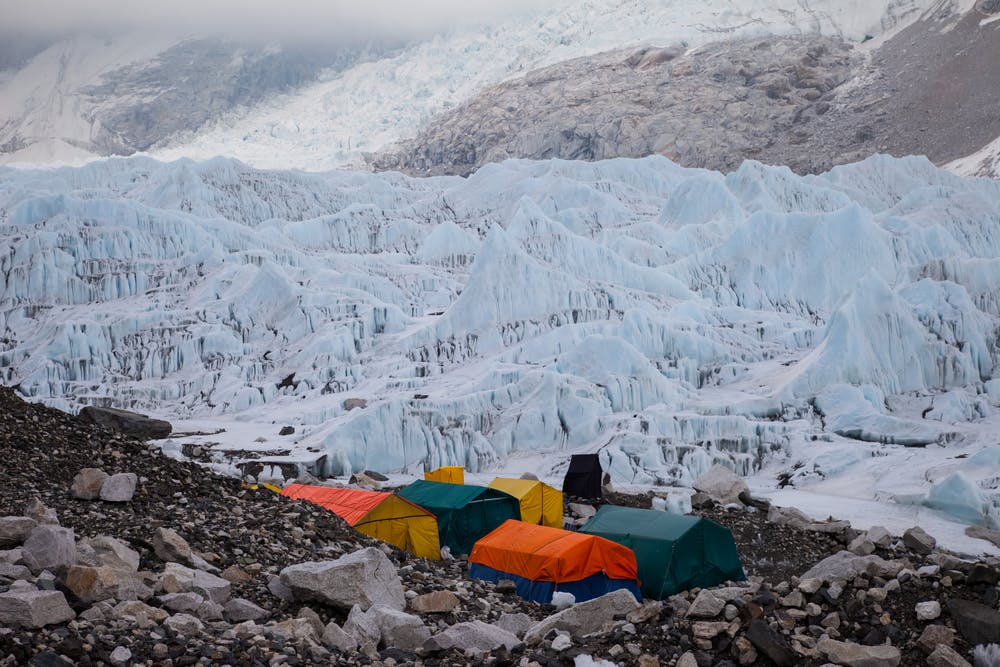
Of all deaths from 1950 to 2019 in non-Sherpa climbers during a summit bid on Mount Everest, about 35% were caused by falls, with other leading causes being exhaustion (22%), altitude illness (18%) and exposure (13%).
In Sherpa deaths over the same time period, 44% were attributable to avalanches. One 2014 avalanche took the lives of 16 Sherpas.
Almost 84% of deaths in non-Sherpa climbers occurred on their descent – after either successfully reaching the top of Mount Everest, or after turning back before reaching the summit.
While some deaths on descent are related to falls, most are linked to extreme fatigue and exhaustion, or sustained exposure to extremely low levels of oxygen.
In Sherpas, most deaths occur on the lower sections of the climb where they spend lots of time preparing the expedition route and are exposed to greater risk of trauma-related death.
Read more: What Alone Australia tells us about fear, and why we need it
Low oxygen at extreme altitude
At Mount Everest base camp (5,364m), oxygen availability is about 50% of that at sea-level. At the summit, oxygen availability decreases to less than 30%.
In these high-altitude, low-oxygen environments, climbers are at significant risk of:
acute mountain sickness
high-altitude pulmonary oedema, and
high-altitude cerebral oedema.
Acute mountain sickness is the less severe of the three conditions and is associated with symptoms such as headache, nausea, loss of appetite, and in some cases vomiting and fatigue. Generally, it can resolve following further acclimatisation and rest, or descent to lower altitudes. It rarely evolves into a life-threatening condition.
However, with continued exposure to high altitude, more severe conditions can develop.
High-altitude pulmonary oedema is caused by accumulation of fluid in the lungs. This leads to excessive breathlessness and a dry cough that can evolve to one that produces a foamy, pink sputum.
High-altitude cerebral oedema is caused by excess fluid in the brain and leads to severe headache, confusion, dizziness, loss of balance, and ultimately coma or death, if untreated.
Almost all non-Sherpa climbers on Mount Everest summit attempts climb with supplemental oxygen tanks to assist their physical performance and mitigate the risk of developing these conditions.
Ultimately however, for some climbers this is not enough and even if they successfully reach the summit, they succumb to the environment or high-altitude related illness on their descent back to base camp.
Authors: Brad Clark, Senior research fellow, University of Canberra
Read more https://theconversation.com/why-is-climbing-mount-everest-so-dangerous-206099


 Daily Bulletin


