

Kandinsky at the Art Gallery of New South Wales: a precious gem of a show celebrating the transformative power of art
- Written by: Sasha Grishin, Adjunct Professor of Art History, Australian National University
Vasily Kandinsky (1866-1944) was a pioneer of abstract art. His work and theories on art profoundly influenced the School of Paris, the American Abstract Expressionists, as well as the expressionist painters working in Australia.
Drawing on the extensive holdings of the the Solomon R. Guggenheim Museum in New York, this new exhibition at the Art Gallery of New South Wales is the largest Kandinsky exhibition to be held in Australia.
In about 50 works, it covers the full range of the artist’s vision: the early “folky” works carrying the impact of the Jugendstil (German art nouveau) and Impressionism; the groundbreaking abstracts with their impressions, improvisations and compositions; and finally the wonderful, refined late geometric and biomorphic paintings.

This is a precious gem of a show that celebrates the transformative power of art – its ability to transcend the material realm and to nourish us spiritually.
Russian imagery, spiritual realm and colour auras
Kandinsky was Russian, born in Moscow in 1866. He never lost links with Russian art and culture. He expressed a profound belief in Russian Orthodoxy as the sole true faith.
Circumstances of history meant he divided his life between living and travelling in Russia and working in Germany and finally living in France, where he died.
Nevertheless, even when living in the heart of industrial Munich, he still painted Russian horse-drawn troikas, churches with their cupolas and the great saints of Russia.
 Vasily Kandinsky, Landscape with factory chimney, 1910. Oil on canvas, 66 x 81.9 cm, Solomon R. Guggenheim Museum, New York, Solomon R. Guggenheim Founding Collection, by gift, photo courtesy Solomon R. Guggenheim Foundation.
Building on the heritage of spiritualism inherent in Russian Orthodox icons and the inventive whimsical narratives in Russian folk art, Kandinsky also explored the spiritual realm and colour auras integral to theosophy.
He was one of the most influential teachers at the German Bauhaus, before the Nazis closed it. He wrote the single most influential essay in 20th-century art, On the spiritual in art, in 1911.
What strikes me about this exhibition is Kandinsky has lost none of his timeless magic.
Frequently when visiting an exhibition of an early modern – for example, Picasso’s cubism – you may be impressed by the work and its avant-garde properties that were so amazing in their day, but they appear of their time and somewhat dated.
Kandinsky’s paintings have not aged and appear contemporary and relevant to us now.
Speaking directly to the soul
In Kandinsky’s early paintings, for example, Blue Mountain (1908-09) and Landscape with factory chimney (1910), the figurative element is still strong. Kandinsky invites the viewer to take a walk in the painting and explore an enchanted landscape.
 Vasily Kandinsky, Blue mountain, 1908–09. Oil on canvas, 107.3 x 97.6 cm, Solomon R. Guggenheim Museum, New York, Solomon R. Guggenheim Founding Collection, by gift, photo courtesy Solomon R. Guggenheim Foundation.
Together with the theosophists, Kandinsky had a mistrust of science. At one stage he remarked:
The disintegration of the atom was to me like the disintegration of the whole world […] I should not have been surprised if a stone had melted in the air and become invisible before my eyes.
A mistrust of science was linked to a mistrust of the physical world observed through the senses and the desire to explore a spiritual reality that bypasses empirical observation and speaks directly to the soul.
Some of the great Kandinsky paintings, including Improvisation 28, second version (1912), Landscape with rain (1913) and the wonderful Painting with white border (May 1913), break free of the figurative realm and create their own reality.
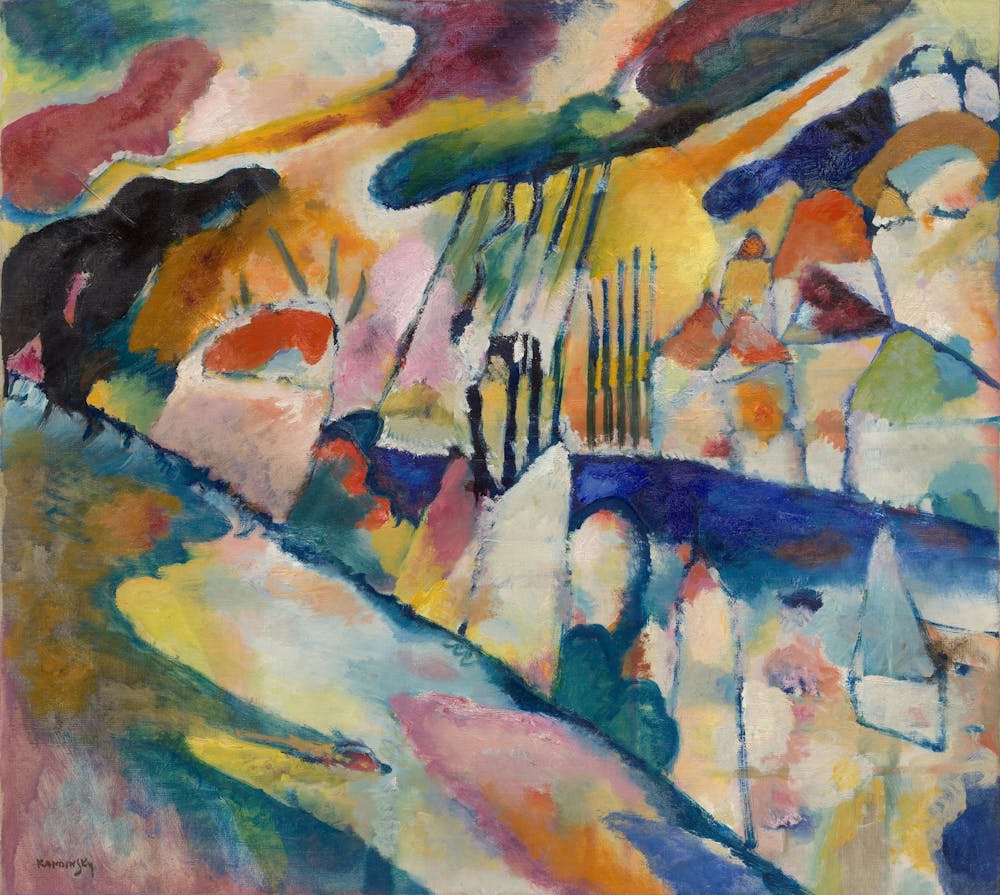 Vasily Kandinsky, Landscape with rain, January 1913. Oil on canvas, 70.5 x 78.4 cm. Solomon R. Guggenheim Museum, New York, Solomon R. Guggenheim Founding Collection, photo courtesy Solomon R. Guggenheim Foundation.
Increasingly Kandinsky questioned the importance of the object as a necessary element in a painting and demonstrated a preparedness to embrace the power, fantasy and enchantment of the palette.
Colour for Kandinsky was a symbolic spiritual experience, with colours linked with spiritual states.
In Kandinsky’s work the physiological effect of colour is sensory and short-lived; warm colours like vermilion attract the eye; the bright yellow of a lemon is painful.
A psychological resonance is produced when the sensory impression causes an emotional vibration directly or through association: red is flame and blood, black a painful silence, the appeal of orange is like the sound of a church bell.
 Vasily Kandinsky, Blue segment, 1921. Oil on canvas, 120.7 x 140 cm, Solomon R. Guggenheim Museum, New York, Solomon R. Guggenheim Founding Collection, photo courtesy Solomon R. Guggenheim Foundation.
Writing about the Painting with white border, Kandinsky observed:
At that time, I tried, by lines and by distributing of patches of colour, to express the musical spirit of Russia.
One may see in the painting in the top-left-hand corner three black lines that relate to the horses of the Russian troika. In the centre is the lance of the Russian St George slaying the dragon that threatened his homeland with the impending war. Each element in the painting was the subject of a separate study and these studies inform us about the individual elements in the painting.
In a famous passage in On the spiritual in art, Kandinsky observed:
Colour is the keyboard. The eye is the hammer, while the soul is a piano of many strings […] [harmony rests] on the principle of innermost necessity.
Many of Kandinsky’s paintings in the 1920s and 1930s, including Blue segment (1921), Blue painting (January 1924) and Dominant curve (April 1936), refine some of the earlier more organic forms through geometric discipline to create great explorations of intuitive spiritual forms ambiguously suspended in space.
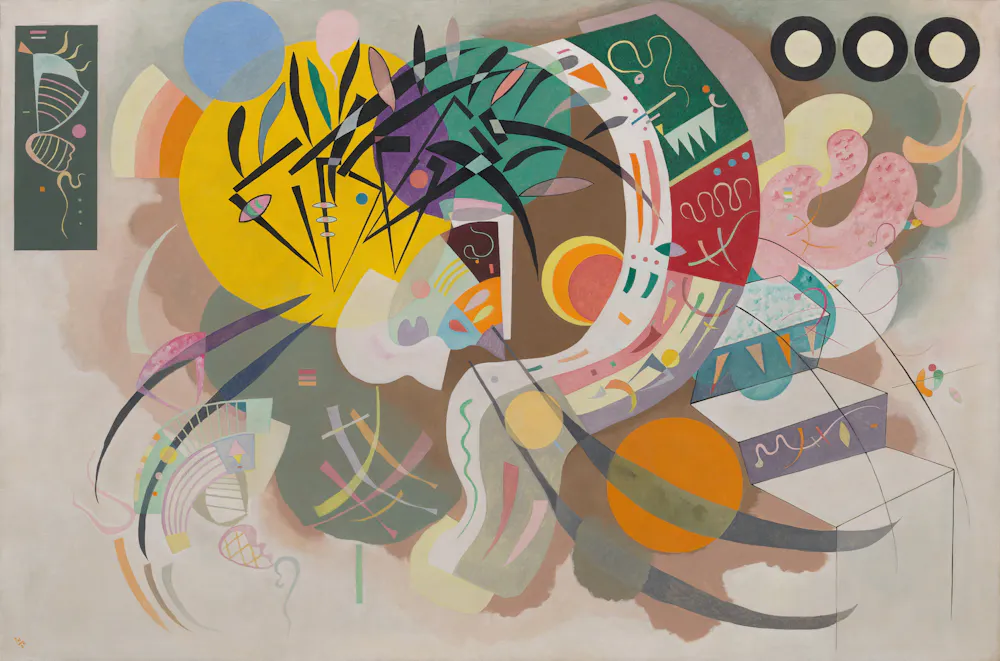 Vasily Kandinsky, Dominant curve, April 1936. Oil on canvas, 129.2 x 194.3 cm. Solomon R. Guggenheim Museum, New York, Solomon R. Guggenheim Founding Collection, photo courtesy Solomon R. Guggenheim Foundation.
Kandinsky was a great innovator, a profound thinker and a superb painter and graphic artist. His vision changed the way we think about art. This outstanding landmark exhibition, for the first time, redefines his place in art for an Australian audience.
Kandinsky is at the Art Gallery of New South Wales until March 10 2024.
Read more: Three questions not to ask about art – and four to ask instead
Authors: Sasha Grishin, Adjunct Professor of Art History, Australian National University


 Daily Bulletin


