

Kids’ sport always cancelled due to rain-soaked grounds? Green infrastructure can help
- Written by: Jua Cilliers, Head of School of Built Environment, Professor of Urban Planning, University of Technology Sydney
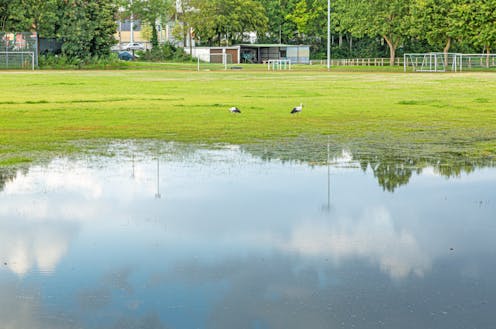
It’s been a rainy winter in many parts of Australia, wreaking havoc on kids’ sporting competitions. As mums, it has been frustrating to see so many of our kids’ sport matches (and training sessions) cancelled because of waterlogged grounds.
When footy, rugby, league tag, soccer or netball get cancelled because of ground closures, our kids miss out on valuable exercise and growth opportunities. It means less time to develop sport skills, practise teamwork, boost resilience and mental health, engage with positive role models and play with friends. It often means more time on the couch, and parents lamenting the money they spent on registration fees and sports uniforms.
With climate change predicted to bring more intense rainfall events, this situation isn’t going away. The good news is a growing body of research offers insights into how we can address this problem through smarter urban design and green infrastructure.

What’s green infrastructure?
The term “green infrastructure” can mean many things but in this context it refers to nature-based infrastructure we can build to better filter and absorb rainwater.
The fundamental principle is that concrete doesn’t absorb water. Rain that falls on it just gets channelled to stormwater drains (which can quickly overflow), or to the nearest bit of green space. Often, that’s the local sporting field.
The solution? Create more soil-based or nature-based spaces that allow for rainwater to be absorbed into the earth well before it gets to the local sports grounds.
This can include:
green roofs and rooftop farms, which use roof space to grow plants and food
green walls, where the walls of buildings are repurposed as places to support plants
urban parks
planting and preserving more street trees, which help absorb rainwater through their roots
using less concrete in our urban spaces
rain gardens, which are specially designed gardens that can rapidly absorb rainfall during wet weather
special vegetated channels called swales, which absorb rainwater.
Green infrastructure doesn’t just reduce flooding. It can also make our urban spaces more sustainable, cut urban heat, lower noise pollution and even reduce people’s stress.
Some cities and suburbs have made great strides in installing and tending to green infrastructure.
But why aren’t these principles of urban design more widely implemented?
 Seen a lot of this lately?
tomocz/Shutterstock
Seen a lot of this lately?
tomocz/Shutterstock
Yes, it costs money – but it’s worth it
Too often, governments do not advocate for investment in green infrastructure. According to the World Economic Forum, less than 0.3% of current urban infrastructure spending goes to nature-based solutions.
Yes, green infrastructure requires investment but our current concrete-based approach to cities is also enormously expensive. One study found:
Nature-based infrastructure costs around 50% less than equivalent built infrastructure while delivering the same — or better — outcomes. As well as the lower initial costs, nature-based infrastructure tends to be cheaper to maintain and more resilient to climate change.
Research has also found green infrastructure can deliver broader health benefits to the community that may represent savings to the public health bill.
New South Wales already has a planning framework, released last year, that aims to:
provide a standardised, robust and comprehensive approach to identify, quantify and monetise common costs and benefits associated with green infrastructure and public spaces.
That’s a strong start. But more could be done to embed green infrastructure principles into development application processes. This could encourage the development of green infrastructure that can absorb rain. That, in turn, could mean fewer closures of waterlogged sports grounds.
It is also possible to improve drainage on existing sports grounds. Managers of the Maryland SoccerPlex in the United States, for example, used a green infrastructure technique known as “sand slit drainage” – which involves installing special pipes and adding sand to the field – to vastly upgrade drainage. This allows people to play sports throughout the rain season.
 Poor drainage means lots of sports cancellations on the weekend.
Thomas Holt/Shutterstock
Poor drainage means lots of sports cancellations on the weekend.
Thomas Holt/Shutterstock
Can’t we just make sports grounds out of artificial grass?
Sure, fake grass sports grounds would allow fields to accommodate some games when real grass fields wash out – but it would be a huge loss for biodiversity, quality of life, our health and the broader sustainability of our neighbourhoods.
Residents in some parts of NSW have already voiced concerns artificial grass can radiate heat on very warm days. It also produces plastic pollution.
Instead, we need to rethink the design of sport fields. We should view them as valuable green spaces. They are part of the green infrastructure network and help regulate urban temperatures and enhance ecological systems in and around our cities.
They should be seen as sponges to absorb rainwater – but they cannot be the only ones. Without more green infrastructure in our cities, our sports ground sponges will quickly become overloaded and waterlogged.
Authors: Jua Cilliers, Head of School of Built Environment, Professor of Urban Planning, University of Technology Sydney


 Daily Bulletin


