

Ride a bus, take a package with you – how crowdshipping reduces the impacts of millions of deliveries
- Written by: Lynette Cheah, Professor and Chair of Sustainable Transport, University of the Sunshine Coast
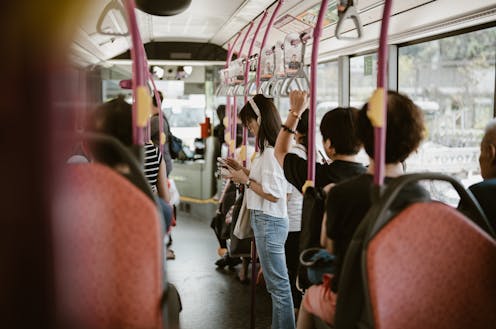
With the rise in e-commerce, 161 billion parcels were delivered worldwide in 2022, doubling in just four years. In Australia, more households are shopping online than ever before. In 2023, 5.6 million households made a monthly online purchase. This implies millions of parcels are being shipped each month.
High-emitting diesel vans or trucks undertake almost all last-mile or doorstop parcel deliveries. In cities, these vehicles add to traffic congestion, parking pressures, carbon emissions and air pollution. So how can we reduce the environmental impact of all these deliveries?
Using low-emission vehicles, such as electric delivery vans powered by renewable energy sources, can certainly help. However, electric delivery vans and trucks are still uncommon. Their global sales share in 2023 was just under 5%. Increasing the numbers of vehicle chargers powered by renewable energy will also take time.
To complement the transition to cleaner vehicles, shorter-term solutions can include optimising the organisation of deliveries, as well as more novel ideas. One of these ideas is crowdshipping.
The concept applies crowdsourcing to delivery services. Members of the public elect to deliver parcels in the course of their journeys. In this way, crowdshipping integrates passenger and freight transport to streamline movement in cities.
Crowdshipping is a form of crowdsourcing applied to delivery services.How does crowdshipping work?
Crowdshipping taps into “the crowd” to fulfil parcel deliveries. Instead of having dedicated couriers, we can match people with parcels bound for destinations close to where they are already headed, with minimal detours.
The concept leverages existing transport capacity. “Crowdshippers” are already travelling privately in their own vehicles or by public transport, or even cycling or walking. Through a service-matching platform, such as Roadie or DoorDash, crowdshippers can be paid for taking a parcel along their way.
In cities with good public transport and high levels of use, passengers can hand-carry small parcels across the network. Automated parcel lockers installed at stations can serve as mini distribution centres, where passengers pick up and drop off parcels.
What are the benefits?
We modelled crowdshipping in Singapore. The city has an excellent public transport system used by nearly 60% of commuters.
Algorithms were developed to match a selection of parcels to available passengers, considering their origins and destinations. The simulation used real-world datasets on daily parcel deliveries from the Singapore road network and public transport journeys.
The simulation showed crowdshipping can have multiple benefits. By outsourcing only 11% of parcel deliveries to crowdshippers riding public buses, an e-commerce carrier will require fewer delivery vehicles. Delivery vehicle distances fall by 20%, with matching cuts in emissions.
And even after paying crowdshippers, the carrier will enjoy cost savings.
What practical obstacles must be overcome?
There are several practical considerations.
For a start, would passengers be willing to deliver parcels? A survey of potential crowdshippers had a positive response.
Motivated by being able to earn some income while travelling, most passengers polled said they were willing to serve as crowdshippers. They were especially keen if paid one to two times their transport fare.
Next, might transporting parcels on public transport cause extra congestion or delay during peak-hour commutes? We should avoid adding more loads on crowded buses or trains.
We explored limiting crowdshipping to off-peak hours and found good availability of potential crowdshippers to deliver parcels. Many public transport systems tend to have excess capacity at these times, so making use of this to move parcels is feasible.
Finally, there’s a need to assure parcel shippers, carriers and receivers that the service is reliable. The service platform should be designed to develop and maintain accountability and trust among users. The system would have to be able to verify identity and track parcel status.
Crowdshipping using public transport would be ideal for cities with good public transport networks and high passenger numbers. Similar to outsourcing to a logistics provider, carriers can explore using people movements to complement their regular deliveries.
Cities need new solutions to make urban mobility sustainable. Integrating passenger and freight transport could make city logistics operations more efficient. By carrying out data-driven transport modelling and simulation, we can explore ideas such as crowdshipping, develop trials to test them and bring them closer to realisation.
This article draws on research conducted with Dr Meijing Zhang from Singapore University of Technology and Design.
Authors: Lynette Cheah, Professor and Chair of Sustainable Transport, University of the Sunshine Coast


 Daily Bulletin


