

Scientists could be accidentally damaging fossils with a method we thought was safe
- Written by: Mathieu Duval, Adjunct Senior Researcher at Griffith University and La Trobe University, and Ramón y Cajal (Senior) Research Fellow, Centro Nacional de Investigación sobre la Evolución Humana (CENIEH)
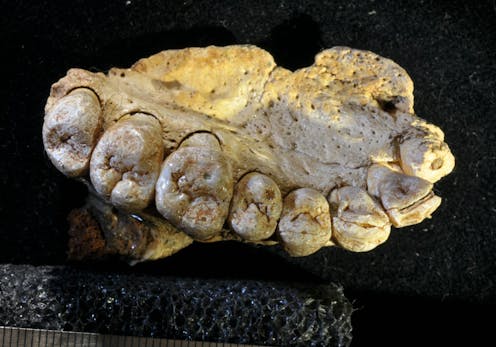
Fossils are invaluable archives of the past. They preserve details about living things from a few thousand to hundreds of millions of years ago.
Studying fossils can help us understand the evolution of species over time, and glimpse snapshots of past environments and climates. Fossils can also reveal the diets or migration patterns of long-gone species – including our own ancestors.
But when living things turn to rock, discerning those details is no easy feat. One common technique for studying fossils is micro-computerised tomography or micro-CT. It’s been used to find the earliest evidence of bone cancer in humans, to study brain imprints and inner ears in early hominins, and to study the teeth of the oldest human modern remains outside Africa, among many other examples.
However, our new study, published today in Radiocarbon, shows that despite being widely regarded as non-destructive, micro-CT may actually affect fossil preservation and erase some crucial information held inside.
Preserving precious specimens
Fossils are rare and fragile by nature. Scientists are constantly evaluating how to balance their impact on fossils with the need to study them.
When palaeontologists and palaeoanthropologists (who work on human fossils) analyse fossils, they want to minimise any potential damage. We want to preserve fossils for future generations as much as possible – and technology can be a huge help here.
Micro-CT works like the medical CT scans doctors use to peek inside the human body. However, it does so at a much smaller scale and at a greater resolution.
This is perfect for studying small objects such as fossils. With micro-CT, scientists can take high-resolution 3D images and access the inner structure of fossils without the need to cut them open.
These scans also allow for virtual copies of the fossils, which other scientists can then access from anywhere in the world. This significantly reduces the risk of damage, since the scanned fossils can safely remain in a museum collection, for example.
Micro-CT is popular and routinely used. The scientific community widely regards it as “non-destructive” because it doesn’t cause any visual damage – but it could still affect the fossil.

How does micro-CT imaging work?
Micro-CT scanning uses X-rays and computer software to produce high-resolution images and reconstruct the fossil specimens in detail. Typically, palaeontologists use commercial scanners for this, but more advanced investigations may use powerful X-ray beams generated at a synchrotron.
The X-rays go through the specimen and are captured by a detector on the other end. This allows for a very fine-grained understanding of the matter they’ve passed through – especially density, which then provides clues about the shape of the internal structures, the composition of the tissues, or any contamination.
The scan produces a succession of 2D images from all angles. Computer software is then used to “clean up” these high-resolution images and assemble them into a 3D shape – a virtual copy of the fossil and its inner structures.
Example of micro-CT results on a hominin fossil known as Little Foot, from southern Africa.But X-rays are not harmless
X-rays are a type of ionising radiation. This means they have a high level of energy and can break electrons away from atoms (this is called ionisation).
In living tissue, ionising radiation can damage cells and DNA, although the level of damage will depend on the duration and intensity of exposure. X-rays and CT scans used in medicine generally have a very low risk since the exposure of the human body is reduced as much as possible.
However, despite what we know about the impact of X-rays on living cells, the potential impact of X-rays on fossils through micro-CT imaging has never been deeply investigated.
What did our study find?
Using standard settings on a typical micro-CT scanner, we scanned several modern and fossil bones and teeth from animals. We also measured their collagen content before and after scanning.
Collagen is useful for many analytical purposes, such as finding out the age of the fossils using radiocarbon dating, or for stable isotope analysis – a method used to infer the diet of the extinct species, for example. The collagen content in fossils is usually much lower than in modern specimens because it slowly breaks down over time.
After comparing our measurements with unscanned samples taken from the same specimens, we found two things.
First, the radiocarbon age remained unchanged. In other words, micro-CT scanning doesn’t affect radiocarbon dating. That’s the good news.
The bad news is that we did observe a significant decrease in the amount of collagen present. In other words, the micro-CT scanned samples had about 35% less collagen than the samples before scanning.
This shows micro-CT imaging has a non-negligible impact on fossils that contain collagen traces. While this was to be expected, the impact hasn’t been experimentally confirmed before.
It’s possible some fossil samples won’t have enough collagen left after micro-CT scanning. This would make them unsuitable for a range of analytical techniques, including radiocarbon dating.
What now?
In a previous study, we showed micro-CT can artificially “age” fossils later dated with a method called electron spin resonance. It’s commonly used to date fossils older than 50,000 years – beyond what the radiocarbon method can discern.
This previous study and our new work show that micro-CT scanning may significantly and irreversibly change the fossil and the information it holds.
Despite causing no visible damage to the fossil, we argue that in this context the technique should no longer be regarded as non-destructive.
Micro-CT imaging is highly valuable in palaeontology and palaeoanthropology, no doubt about that. But our results suggest it should be used sparingly to minimise how much fossils are exposed to X-rays. There are guidelines scientists can use to minimise damage. Freely sharing data to avoid repeated scans of the same specimen will be helpful, too.
Authors: Mathieu Duval, Adjunct Senior Researcher at Griffith University and La Trobe University, and Ramón y Cajal (Senior) Research Fellow, Centro Nacional de Investigación sobre la Evolución Humana (CENIEH)


 Daily Bulletin


