

The secret stories of trees are written in the knots and swirls of your floorboards. An expert explains how to read them
- Written by: Gregory Moore, Senior Research Associate, School of Agriculture, Food and Ecosystem Sciences, The University of Melbourne
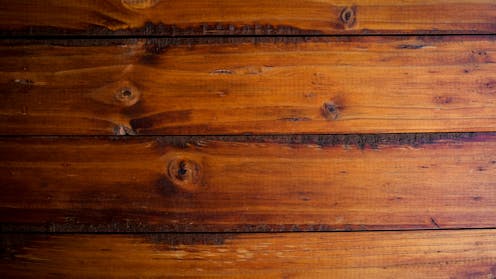
Have you ever examined timber floorboards and pondered why they look the way they do? Perhaps you admired the super-fine grain, a stunning red hue or a swirling knot, and wondered how it came to be?
Or perhaps you don’t know what tree species your floorboards are made from, and how to best look after them?
Finely polished floorboards reveal detail about the timber that can be much harder to detect in unpolished boards or other sawn timbers.
“Reading” the knots, stubs and other characteristics of floorboards can reveal what type of tree produced it and how it grew. It can also reveal fascinating details about the lives of the trees they once were.
Telling soft from hard
A variety of tree species are used to make timber floors. Hardwood species include the pale cream of Tasmanian oak, the honeyed hues of spotted gum and the deep red of jarrah.
Other times, softwood such as pine or spruce is used. Such species are often fast-growing, and prized for their availability and affordability.
Hardwoods are, by definition, flowering trees, while softwoods are from cone-bearing trees. Paradoxically, not all softwoods are soft or hardwoods hard. The balsa tree, for example, is a fast-growing hardwood tree renowned for its soft wood.
It’s not always easy to tell if a floor is hardwood or softwood, but there are discernible differences in their appearance.
Tales in the grain
The real differences between softwood and hardwood lie in the anatomy and structure of the “xylem tissues” that make up the wood. These tissues transported water and nutrients from the roots to the rest of the plant when the tree was alive.
The arrangement of xylem tissue in the tree largely determines the “grain” in your floorboards. The grain is the appearance of wood fibres in the timber. The grain can be straight, wavy or spiralled.
In floorboards with straight grains, a tree’s growth history may be clear. As a tree trunk grows in diameter, it typically produces a layer of bark on the outside and a lighter layer of xylem tissue on the inside. When a tree is cut horizontally, the growth appears as rings. In a tree cut lengthwise (which happens when floorboards are milled) the growth appears as long lines in the timber.
If the lines in floorboards are very close together, this indicates the tree grew slowly. Wider lines suggest the tree grew rapidly.
Vessels in a tree’s xylem transport water from the roots to the rest of the plant. Hardwood tree species tend to have large vessels. This gives hardwood floorboards a coarser-grained and less uniform appearance. In contrast, softwood species such as conifers have smaller, dispersed vessels and produce more fine-grained, smoother timber.
Knotty histories
Knots in floorboards occur when a branch dies or is cut, then tissue grows over the stub. The bigger the missing branch, the more substantial the knot.
Knots in floorboards can reveal much about the source tree. Pine, for example, often features multiple small knots originating from a common point. This reflects the growth pattern of young plantation pines, where several branches grow out from the trunk at the same height from the ground.
Often, the distance between knots tells us how quickly the tree grew. The greater the distance between the knots, the faster the tree grew in height.
Clever chemical defence
The presence of a tree’s “defence chemicals”, known as polyphenols, can be seen clearly in some floorboards.
Polyphenols protect plants against stressors such as pathogens, drought and UV radiation.
The chemicals contribute to the red hue in some floorboards. Because polyphenols have a preservative effect, they can also make timber more durable.
Dark reddish or brown timbers containing a high concentration of polyphenols include mahogany, merbau, red gum, ironbark and conifers such as cedar and cypress.
In cases where a tree is burnt by fire, or attacked by insects or fungus, it produces a lot of polyphenols at the site of the damage.
In these cases, the presence of polyphenols in floorboards can be very obvious – sometimes appearing as a section that is dark brown verging on black.
Keeping your floorboards for longer
It’s widely known that living trees store carbon, and that this helps limit climate change. It’s less well known that timber floorboards also store carbon. And as long as that timber is preserved – and not destroyed by fire, decay or wood rot – that carbon will stay there.
If floorboards have to be removed, try to make sure the timber is reused or repurposed into other products.
And if you are installing a new polished timber floor, or already have one, there are steps you can take to make it last for a long time.
Softwood boards will benefit from a hard surface coating, especially in high-use areas.
Reducing the floor’s exposure to bright sunlight can preserve the colour of the floorboards and prolong the life of the coating and the timber itself.
Large knots in floorboards can twist and start to protrude from the surface. To ensure the floor remains even and safe, and to prevent the board from splitting, secure the knot to a floor joist with a nail or glue.
And take the time to understand the lessons embedded in your floorboards. They have much to teach us about biology and history, if we take the time to read them.
Authors: Gregory Moore, Senior Research Associate, School of Agriculture, Food and Ecosystem Sciences, The University of Melbourne


 Daily Bulletin


