

Why Your Kindle Won't Read to You — and What Australians Are Doing About It
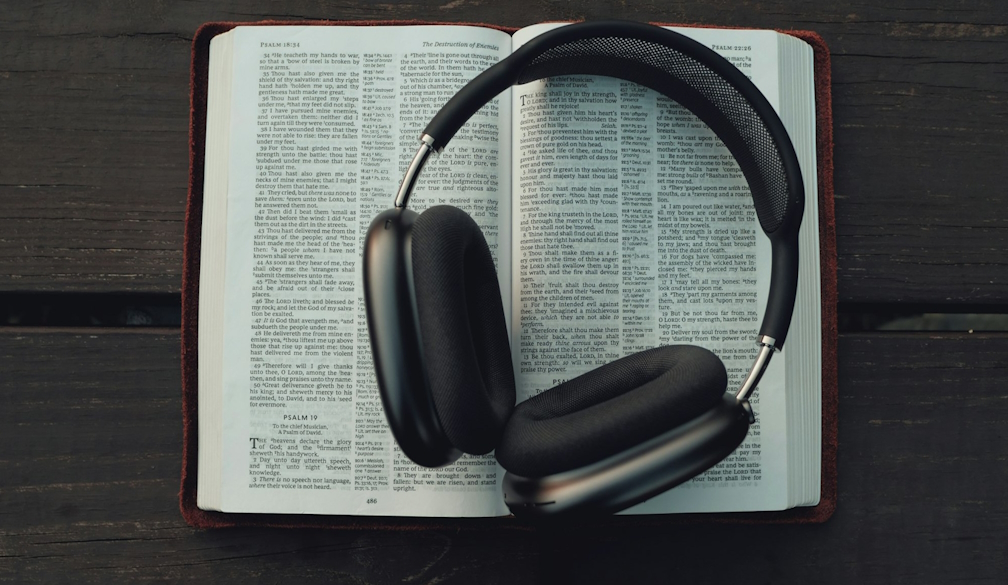
The gap between a full ebook shelf and a spare pair of headphones is smaller than most Kindle owners think. Photo: Aaron Burden / Unsplash (Unsplash License — free for commercial use).
Ask a long-time Kindle owner in Sydney or Brisbane about their library and you tend to hear the same confession: hundreds of titles bought, a fraction of them finished. The books are paid for. The commute is long. The obvious fix — listening instead of reading — turns out to be surprisingly hard to arrange.
The device itself doesn't do it
Most people assume a Kindle can simply read aloud, and it is easy to see why. The Kindle Keyboard, sold last decade, had speakers and a genuine text-to-speech button. Every current e-ink model — Paperwhite, Colorsoft, Scribe, the entry-level Kindle — has neither a speaker nor a headphone socket.
What survives is VoiceView, an accessibility screen reader that pairs over Bluetooth. It works, and for readers with low vision it is genuinely important. But it narrates menus and interface elements alongside the prose, and it was never designed for a two-hour stretch on the M1.
The official alternative asks you to pay twice
Amazon's answer is Whispersync for Voice, which links a Kindle book to its Audible edition and keeps your place in both. It is a well-built feature. It also requires you to buy the audiobook — a second purchase of a book you already own, usually discounted, often on top of a monthly membership.
For households auditing every subscription line, that is a hard sell. It is also why a growing number of readers have gone looking for a third route: keep the book, add the voice separately.
What actually works on an existing shelf
The practical options fall into three groups, and most Kindle libraries contain a mix of all three.
On phones and tablets, the Kindle app can be driven by the built-in screen readers — VoiceOver on iOS, TalkBack on Android. Free, a little clunky, but it reads.
For DRM-free files, the situation is much better. Public-domain classics, the majority of self-published titles, and the PDFs and Word documents people email to their own Kindle can be opened directly by a dedicated reading app and spoken end to end. This is where a surprisingly large share of a typical shelf actually sits, and few owners realise it.
For anything read in a browser, including Kindle Cloud Reader, a browser extension can narrate the page as it is rendered on screen.
CastReader is built around those last two patterns: extensions for Chrome, Edge and Firefox, alongside iPhone, iPad and Android apps that import DRM-free EPUB, PDF, DOCX and scanned pages via OCR. Its voice catalogue runs to several hundred options across nine languages, with English and Mandarin the most developed. It does not break DRM or bypass paywalls — the honest limit on every tool in this category. Protected Amazon purchases stay protected, and no legitimate app will tell you otherwise.
The multilingual case
There is a second reason this matters in Australia. More than one in five people speak a language other than English at home, according to the 2021 Census. In those households the obstacle is often not the length of the book but the language it is written in.
That has created demand for something narrower than translation. Read-and-explain tools leave the original text on screen and explain a selected passage in the reader's own language, rather than replacing the English with a translated version. It is a comprehension aid for students and second-language readers, not certified translation, and it is a different job from simply pressing play.
A realistic expectation
Synthetic narration has improved sharply in the past two years, but it is not an Audible production. There is no cast, no direction, no performance — and for a novel you have been saving up for, that difference is worth the money.
Where it earns its place is the backlog: the industry reports, the long-form articles saved and forgotten, the dozen titles bought in a sale and never opened. For a country that spends as much time in cars as this one does, that may be the more useful problem to solve.
CastReader is an independent product and is not affiliated with Amazon. Amazon, Kindle and Audible are trademarks of Amazon.com, Inc. or its affiliates.


 Daily Bulletin


