

Health Check: do cold showers cool you down?
- Written by: Yossi Rathner, Lecturer in Human Physiology, Swinburne University of Technology
It’s normal to feel hot, sweaty and uncomfortable in warm weather, but what’s the best way to cool down? To answer this question, we first need to look at how the body maintains stable internal (core) temperature.
We feel uncomfortable at hot environmental (ambient) temperatures because our bodies are striving to maintain a constant core temperature. When the ambient temperature is too high, we engage in reflexive (things our nervous system does without us realising) and behavioural (things we do) adaptations to try to cool ourselves. The discomfort we feel is the motivation for the behavioural adjustments. Many of us just want to jump in a cold shower. So will this help to cool us down?
From the physiological perspective, core temperature is what our body is regulating. Small changes in core temperature can quickly lead to illness (such as heat exhaustion, fever and heat stroke). We are not consciously aware of our core body temperature. Although the body has sensors that monitor core body temperature, our perception of temperature comes exclusively from skin temperature sensors (temperature receptors). These allow us to sense if we are cold, comfortable or hot.
Human biology is remarkable; we maintain a relatively stable core body temperature over a wide range of ambient temperatures. For instance, core body temperature only differs by 0.5⁰C over a wide ambient temperature range (as wide as 12-48⁰C). The body’s ability to restrict core temperature to such a tight range means reflexes to control core temperature need to occur before there is an actual change in core temperature.
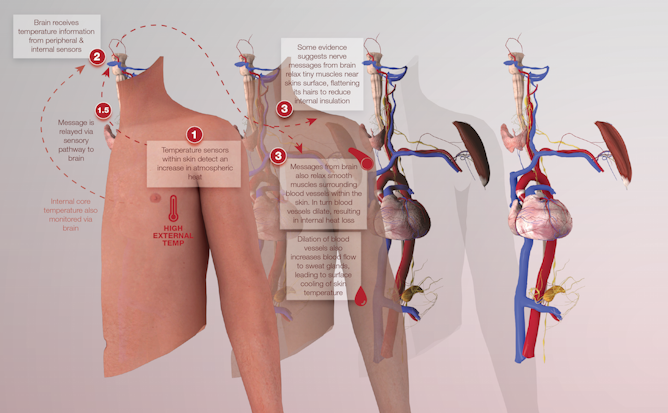 Controlling blood flow to the skin, along with sweating, is an important way of controlling internal body temperature.
Author provided
Controlling blood flow to the skin, along with sweating, is an important way of controlling internal body temperature.
Author provided
Controlling blood flow to the skin is an important way of controlling internal body temperature. The circulatory system moves blood around the body; it also transports heat around the body, so changing where the blood flows allows the body to determine where the heat goes. With reduced blood flow to the skin, heat is conserved in the body, and with increased blood flow to skin, heat is lost to the environment.
In cold environments, there is almost no blood flow to the skin to keep all the heat in (which is why we get frostbite). This is why, when we’re very cold, our skin is pallid and pale. At hot ambient temperatures, skin blood flow can increase to as much as seven litres per minute to try to expel all the heat through the skin. This is a 23-fold increase to normal, and about 35% of the total volume of blood volume pumped from the heart. This is why, when we’re hot, we can appear flushed.
 In cold environments restricting blood flow to the skin is crucial for maintaining core body temperature.
Author provided
In cold environments restricting blood flow to the skin is crucial for maintaining core body temperature.
Author provided
The exquisite control of blood flow to the skin means there is an optimum ambient temperature (known as thermoneutral), where the body does not engage in any regulatory activity to maintain core temperature. This occurs when the skin blood flow is about 300mL a minute.
Other mechanisms for temperature control are quite different. In cold environments, the body increases heat generation to maintain core temperature. One method is to move the muscles to heat them up (shivering thermogenesis); another is to speed up metabolism to produce more heat (non-shivering thermogenesis).
In hot environments, when air temperature is higher than skin temperature (above roughly 33⁰C), heat loss only takes place with sweating. When sweat evaporates off our skin, it has a cooling effect. Sweating, or wet skin, can increase the amount of heat lost from the body by as much as ten times.
Given free range, animals will spend most of their time in a thermoneutral environment, where they are most comfortable (the comfort zone). Humans are most comfortable (thermoneutral) at an ambient temperature of about 28⁰C (and a skin temperature of 29-33⁰C). The further we are away from that temperature (either cold or warm), the more uncomfortable we feel.
Our bodies respond more to changes in skin temperature than core temperature. So, if we cool part of the body (for instance with a cold sponge, or cold shower), skin blood flow decreases and skin temperature falls.
Here we “feel” cooler because cold water causes cold temperature receptor activation in the skin. We may also feel more comfortable, as our skin temperature enters the comfort zone. But because there is less blood flowing to the skin, we’ll actually keep more heat inside, thus leading to an unintended overall increase in core temperature.
A cold shower to “cool off” might seem a good immediate choice. We feel cooler because of the combination of the cold water and the decreased blood flow to the skin, but in fact our core will get warmer because of reduced heat loss from the body without skin blood flow. Some minutes later, we feel hot again. But a warm sensation on the skin will lead to increased blood flow to the skin, increasing heat loss from the body.
So, keeping cool in summer will be more effective with a warm shower (water temperature about 33⁰C) rather than a cold shower (water temperature 20-25⁰C). It will seem warm initially but after a few minutes will provide better comfort in the long term.
Authors: Yossi Rathner, Lecturer in Human Physiology, Swinburne University of Technology
Read more http://theconversation.com/health-check-do-cold-showers-cool-you-down-71004


 Daily Bulletin


