

Baby galaxies light up the universe
- Written by: Alan Duffy, Associate Professor and Research Fellow, Swinburne University of Technology
Looking up at a dark night sky it might not seem it but our Universe is full of light. In fact, we probably take for granted that we can see across space to those distant stars and even more distant galaxies. There was however a time when we wouldn’t have seen those stars, there was a time when a fog lay across it. That time was the Cosmic Dark Ages. Now we may know how it ended thanks to new observations using the Hubble Space Telescope.
The Cosmic Dark Ages began 330,000 years after the Big Bang when the Universe cooled enough to allow atoms to form, revealing the Cosmic Microwave Background. The atoms of hydrogen stretched across the near featureless early Universe for millions of years. These atoms acted like a fog, blocking the light from the newly formed baby galaxies and stars. A billion years later, the Universe had dramatically changed with the fog now vanished in a process known as the Epoch of Reionisation, definitively ending the Dark Ages.
Peering deep into the Universe we see objects as there were when the light first left them. Images such as the Hubble Ultra Deep Field show that huge numbers of galaxies of all sizes had grown surprisingly quickly in the early Universe. Yet even the Hubble Space Telescope can only see the brighter of these galaxies at such enormous distances. Adding together everything we can see simply doesn’t provide enough light, similar to the type of ultraviolet light that burns your skin on the beach, to ionise away the fog. Instead astronomers have tried to locate other sources of ultraviolet light.
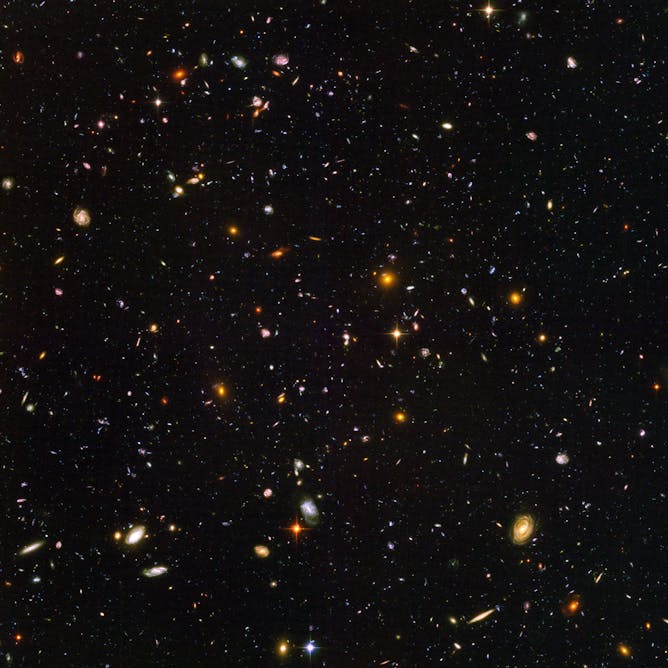 The Hubble Telescope finds 10,000 galaxies stretching away into the distant Universe, showing them as they were when the light them. The smaller, redder objects are from a time when the Universe was just 1 billion years old.
NASA, ESA, and S. Beckwith (STScI) and the HUDF Team
The Hubble Telescope finds 10,000 galaxies stretching away into the distant Universe, showing them as they were when the light them. The smaller, redder objects are from a time when the Universe was just 1 billion years old.
NASA, ESA, and S. Beckwith (STScI) and the HUDF Team
Feeding blackholes are an obvious choice, creating huge amounts of ionising radiation from material swirling around the gravitational ‘plughole’ at nearly the speed of light. Alternatively, the first stars (known as Pop III stars) could be giants exploding in spectacular fashion, hundreds of times more energetically than anything we see today. However, there may well not be enough of either to provide the huge amount of ionising ultraviolet to light up the early universe.
Instead we can turn to a less exotic source of light. Vast numbers of baby galaxies, beyond the limits of even Hubble’s ability to see. In model universes, created as part of the DRAGONS simulation series led by Prof Stuart Wyithe, we showed that ever greater numbers of ever smaller baby galaxies could light up an entire Universe with their combined light.
A ‘baby’ galaxy formed within the first billion years of a simulated universe. Redder colours indicate denser regions of gas that can form new stars. Enough of these tiny galaxies can light up the universe.The issue with testing this idea was not even the Hubble Space Telescope can see these baby galaxies as far away as in the distant Epoch of Reionisation. Instead, Dr Rachel Livermore and colleagues used the gravity of giant clusters of galaxies to magnify background objects. This effectively meant that Hubble became ten times more powerful, but first they had to remove the blinding effects of the bright nearby galaxies in the cluster itself. After applying this technique, the astronomers uncovered 167 magnified baby galaxies. Finding so many baby galaxies tentatively suggests there may well be enough even smaller objects to light up the universe as simulations had predicated.
However confirming how the Cosmic Dark Ages ended will take even bigger telescopes than Hubble, including its successor mission the James Webb Space Telescope or on Earth the Giant Magellan Telescope and event the continent-spanning Square Kilometre Array.
For now at least, ingenious use of a naturally occurring cosmic magnifying glass suggests baby galaxies are a leading culprit for bringing light to our Universe’s darkest moment.
Authors: Alan Duffy, Associate Professor and Research Fellow, Swinburne University of Technology
Read more http://theconversation.com/baby-galaxies-light-up-the-universe-72860


 Daily Bulletin


