

How far they'll go: Moana shows the power of Polynesian celestial navigation
- Written by: Duane W. Hamacher, Senior ARC Discovery Early Career Research Fellow, Monash University
This article contains minor spoilers.
One of the greatest feats of human migration in history was the colonisation of the vast Pacific Ocean by Polynesian peoples. They achieved it thanks to their sophisticated knowledge of positional astronomy and celestial navigation.
The Disney film Moana has drawn attention to these accomplishments and helped inform a new generation about the complexity of Indigenous astronomy.
Polynesia forms a triangle across the Pacific, with Hawaii to the north, Rapa Nui (Easter Island) to the southeast, and Aotearoa (New Zealand) to the southwest, with Tahiti in the centre. But Polynesian voyaging extends beyond this triangle; there is strong evidence they reached the coast of South America and sub-Antarctic islands.
 The Polynesian triangle with the areas of Melanesia and Micronesia.
Opinion Global
The Polynesian triangle with the areas of Melanesia and Micronesia.
Opinion Global
Moana touches on Polynesian voyaging, showing the eponymous main character using traditional celestial techniques to navigate across the sea.
During production, Disney created the Oceanic Story Trust – a board of experts, including Polynesian locals and elders – to advise on cultural accuracy. The film accomplished this reasonably well, especially in respect to celestial navigation, despite the producers facing criticism for cultural appropriation and commodification.
Navigating by hand
To navigate the wide expanse of the Pacific, voyagers need to map the stars to determine their position from our perspective here on Earth. Navigator and Polynesian Voyaging Society president Nainoa Thompson explains:
If you can identify the stars as they rise and set, and if you have memorised where they rise and set, you can find your direction.
Since 1976, the famous Hokule'a voyages have demonstrated how Polynesians used traditional sea-craft and navigational techniques to cross the expanse of the Pacific, from Japan to Canada.
 In 1976, the Hokelea sailed from Hawai'i to Tahiti using traditional navigational methods.
Waʻa Kaulua – Our Canoes
In 1976, the Hokelea sailed from Hawai'i to Tahiti using traditional navigational methods.
Waʻa Kaulua – Our Canoes
So what are some of these navigational techniques?
 The Southern Cross is visible throughout the southern hemisphere.
Wikimedia, CC BY-SA
The Southern Cross is visible throughout the southern hemisphere.
Wikimedia, CC BY-SA
To calculate their position on Earth, voyagers memorised star maps and used the angle of stars above the horizon to determine latitude. For example, the top and bottom stars of the Southern Cross are separated by six degrees. When the distance between those stars is equal to the bottom star’s altitude above the horizon, your northerly latitude is 21º: that of Honolulu.
When the bright stars Sirius and Pollux set at exactly the same time, your latitude is 18º South: the latitude of Tahiti.
Voyagers measure the angles between stars and the horizon using their hands. The width of your pinkie finger at arm’s length is roughly one degree, or double the angular diameter of the Sun or Moon.
Hold your hand with the palm facing outward and thumb fully extended, touching the horizon. Each part of your hand is used to measure a particular altitude.
 The hand method used by Nainoa Thompson to find the altitude of the Polaris.
Journal of the Polynesian Society
The hand method used by Nainoa Thompson to find the altitude of the Polaris.
Journal of the Polynesian Society
In Hawai'i, the “North Star”, Polaris, is Hokupa'a, meaning “fixed star”. It lies close to the north celestial pole. The altitude of Hokupa'a indicates your northerly latitude.
In the film, we see Moana Waialiki using this technique to measure the altitude of a group of stars. Look closely and you can see that she’s measuring the stars in Orion’s Belt. The position of Moana’s hand indicates the star above her index finger has an altitude of 21º. Given that the movie takes place about 2,000 years ago near Samoa, the position of Orion indicates they are travelling exactly due East.
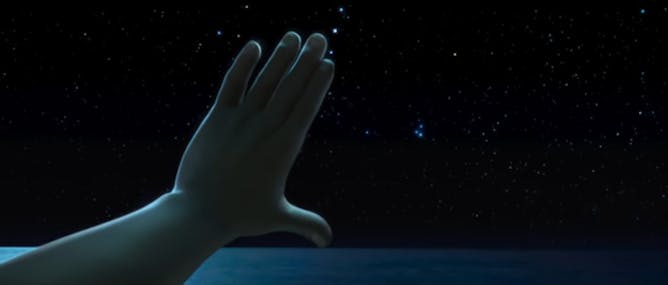 Moana measures altitude of Orion’s belt stars.
Walt Disney Studios Motion Pictures
Moana measures altitude of Orion’s belt stars.
Walt Disney Studios Motion Pictures
Later in the film, we see Moana navigating by following Maui’s fish hook. In the various Polynesian traditions, the hook was used to pull islands from the sea. It is represented by the constellation Scorpius, which rises at dusk in mid-May. This indicates southeasterly travel.
 Looking at Scorpius - Maui’s Hook - in the same orientation as shown in the film.
Stellarium
Looking at Scorpius - Maui’s Hook - in the same orientation as shown in the film.
Stellarium
However, the positions of the stars are not fixed in time. Over the 3,500 years that Polynesians have been exploring the Pacific, the stars have gradually shifted due to precession of the equinoxes.
From the latitude of Samoa, the Southern Cross has lowered from 60º altitude in 1500 BCE to 41º today. Those navigating by the stars must gradually adjust their measurements as the positions of stars slowly shift over time.
In his book Hawaiki Rising, Sam Low tells how navigators would develop new techniques.
Aboriginal knowledge
In Australia, colonists knew little about Aboriginal celestial navigation, with some researchers claiming Aboriginal people did not use it at all. However, collaborations with elders shows that Aboriginal people use celestial navigation and developed star maps to link the sky with the land.
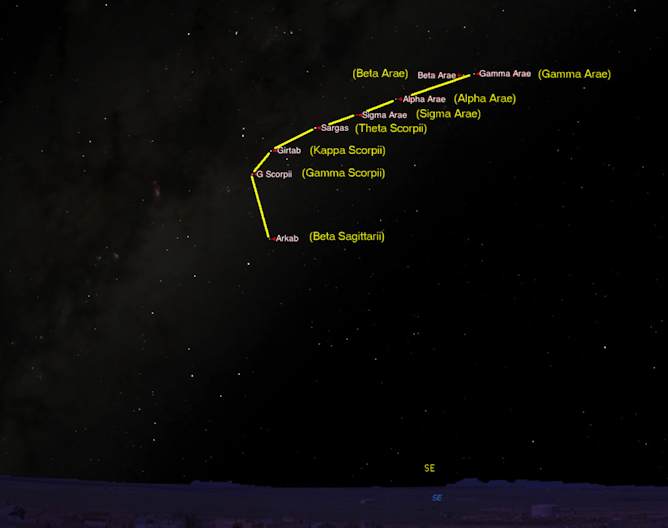 Euahlayi Aboriginal star map route from northern New South Wales to the Bunya Mountains in Queensland.
Starry Night Education
Euahlayi Aboriginal star map route from northern New South Wales to the Bunya Mountains in Queensland.
Starry Night Education
Celestial navigation is an important component of Indigenous astronomy around the world. Try going out tonight and measuring the positions of the stars with your own hands. It’s actually quite fun!
Authors: Duane W. Hamacher, Senior ARC Discovery Early Career Research Fellow, Monash University


 Daily Bulletin


