

When mammals took to water they needed a few tricks to eat their underwater prey
- Written by: David Hocking, Research associate, Monash University
Have you ever watched a dog retrieve a ball thrown into water? On land, dogs are swift and agile, but in water they become slow and ungainly.
Kicking relentlessly at the water, they snap at the ball with their jaws, only to find that they are pushing it further away. Having eventually caught the ball, they inevitably go into a fit of coughing and sneezing, as they try to shake off water from their nose and face.
Most other mammals have a similarly hard time in water. Yet a select few have come to dominate the world’s rivers and seas, from the poles to the Equator and from the water’s surface to the depths of the abyss.
To achieve this, mammals had to learn to swim, to keep warm, and to find, capture and handle their prey in water.
How aquatic mammals have adapted to feed underwater is the subject of a new research article published this week in Proceedings of the Royal Society B.
In this study, we originally set out to review the feeding behaviours of all carnivorous aquatic mammals – creatures as varied as sleek otters, agile seals and dolphins, and filter-feeding whales. To our surprise, we discovered that all of these animals are linked by a simple evolutionary pattern.
The need to feed in water
Despite their obvious differences, when feeding in water all mammals appear to follow just six well-defined, interrelated and increasingly specialised strategies.
 Sequence of increasingly aquatic feeding strategies used by mammals when eating underwater.
Illustrations by Carl Buell
Sequence of increasingly aquatic feeding strategies used by mammals when eating underwater.
Illustrations by Carl Buell
The ancestors of aquatic mammals started out as terrestrial feeders, using their teeth and claws to catch and process their food entirely on land.
Over time, some parts of the feeding process began to happen underwater, while others still occurred at the surface, giving rise to semi-aquatic feeding.
For example, modern otters hunt fish underwater using their jaws and paws, but they then bring their catch to the surface to process it with their teeth.
As mammals became more aquatic, they began feeding entirely underwater. Seals and dolphins are capable of catching, handling and swallowing food beneath the waves. Like their terrestrial and semi-aquatic cousins, these raptorial feeders still primarily rely on their teeth to pierce and hold their prey.
To make sure that captured prey does not float away before swallowing, they then suck their food deeper into the mouth by pulling back their tongue.
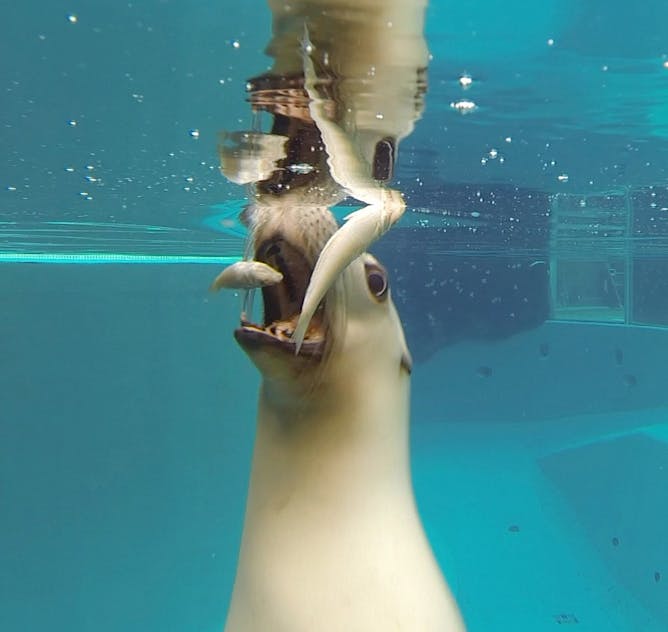 Australian sea lion capturing a fish in its teeth during underwater feeding.
David Hocking
Australian sea lion capturing a fish in its teeth during underwater feeding.
David Hocking
The suckers
Building on this need to generate suction, some species took advantage of the ability to manipulate water flow, and became specialist suction feeders.
Animals that use this strategy – including certain seals, sperm whales and beaked whales – largely do away with teeth. Instead they “hoover” prey directly into their mouth, often from a considerable distance, or even from the sea floor.
Because suction feeding does not rely on teeth to pierce individual prey items, it allows the capture of relatively small prey. But as prey gets smaller, it also becomes more difficult to retain inside the mouth.
The filterers
Suction filter feeders solve this problem by using a specialised filter, such as the elaborate teeth of crabeater and leopard seals, or the comb-like baleen plates of grey whales. They then strain small prey like krill from water sucked into the mouth.
Leopard seal using suction feeding to capture a small fish and semi-aquatic feeding to process a large fur seal.Ram-based filter feeders, including rorquals like the blue and humpback whales, retain a specialised filter but do away with suction. They filter small prey directly from large mouthfuls of seawater.
All of these strategies are flexible in that a single animal may switch between them when feeding on different kinds of prey. For example, a leopard seal may use semi-aquatic or raptorial feeding when hunting penguins, but suction filter feeding when preying on krill.
Nevertheless, any single feeding event will only follow one feeding strategy at a time: after all, a leopard seal cannot filter a penguin.
Behaviour informs evolution
The six strategies defined here naturally grade into each other, and together form a sequence that recalls the evolutionary transition of mammals back to the sea.
Some species can cross the boundaries between strategies, but only when one strategy is derived from the next, like semi-aquatic from terrestrial, or suction from raptorial feeding. Thus, for example, fur seals can switch between the semi-aquatic, raptorial and suction strategies when targeting prey of different sizes.
Australian fur seals vary their feeding strategy when targeting different sized prey.Being able to read evolutionary history from the feeding behaviour of living mammals allows us to explain and make predictions about how the fossil ancestors of these modern species may have behaved.
For example, we might predict that modern baleen whales must have evolved from raptorial ancestors via a suction-feeding intermediate. Recent discoveries, such as that of a suction feeding, toothed fossil “baleen” whale, seem to bear this out.
So imagine again a dog, struggling with the ball in the water. If we wanted to engineer it to perform better next time, these are the stages we’d have to go through: teach Rex to capture the ball underwater; next, teach him to handle the excess seawater; finally, teach him to suck the ball towards his snout, rather than accidentally pushing it away.
The same process happened for real at least three times in the evolutionary history of mammals. Who knows where it might go next – suction-feeding otters, anyone?
Authors: David Hocking, Research associate, Monash University


 Daily Bulletin


