

Painkillers like ibuprofen can increase the risk of heart disease and should be restricted
- Written by: Michael Stokes, Cardiologist and PhD Candidate, University of Adelaide
Medications such as ibuprofen and aspirin, known as non-steroidal anti-inflammatory drugs or NSAIDs, are widely available over the counter from pharmacies and supermarkets. But health providers have known for some time they can be unsafe for people with chronic health problems such as kidney disease, high blood pressure or heart failure.
NSAIDs can also have dangerous interactions with other commonly taken medications, notably many types of blood pressure and blood-thinning pills such as warfarin and aspirin.
Two recently published studies have brought back into the spotlight the possible heart-related side effects of NSAIDs. One found an increased risk of heart failure in users of NSAIDs, while another an increased risk of cardiac arrest.
Heart failure is a disease that presents with symptoms such as shortness of breath, fluid retention, leg swelling, and fatigue. This is a result of the heart not being able to pump blood around the body effectively. There are many causes of heart failure, including heart attacks, high blood pressure and excessive alcohol consumption.
A cardiac arrest occurs when the heart stops functioning abruptly and results in complete loss of effective blood flow through the body. The most common cause of a cardiac arrest is a heart attack, where heart muscle is damaged from loss of blood supply due to a blockage in a heart blood vessel. There are many other causes of a cardiac arrest that include structural heart abnormalities and inherited heart diseases of muscle and electrical function.
 Heart failure is when the heart isn’t able to pump blood around the body effectively.
from shutterstock.com
Heart failure is when the heart isn’t able to pump blood around the body effectively.
from shutterstock.com
The recent studies are an important reminder that over-the-counter medicines are not without risk. This class of anti-inflammatory pain killers should no longer be available for sale in grocery stores, but instead restricted to prescription-only or behind-the-counter status in pharmacies.
How they work
Non-steroidal anti-inflammatory drugs are commonly used to relieve pain. They can be either prescribed by a doctor or purchased by the patient over the counter from a supermarket or pharmacy.
NSAIDs are used in a broad range of health conditions associated with pain and inflammation, including types of arthritis, headaches, musculoskeletal injuries and menstrual cramps. Their easy availability, effectiveness and presumption of safety contribute to their widespread use.
They work by inhibiting enzymes called cyclooxygenase 1 (COX-1) and 2 (COX-2). These are involved in a number of internal pathways that result in production of hormone-like substances called prostaglandins, which promote inflammation and increase pain perception.
Prostaglandins also protect the stomach lining from acid, by decreasing acid production and increasing mucus secretion and its neutralising properties. So inhibiting prostaglandins also reduces their protective functions. This is why frequent users of anti-inflammatories may suffer from gastric ulcers.
NSAIDs can either inhibit both COX-1 and COX-2 (non selective) or inhibit COX-2 only (selective). Drugs like ibuprofen and aspirin are non selective and inhibit both the COX enzymes.
COX-1 mediates gastrointestinal, kidney, and clotting function, while COX-2 is induced primarily in states of inflammation and tissue repair. That’s why blocking the COX-2 pathway reduces the effects of inflammation such as fever, swelling, redness and pain.
Importantly, COX-2 inhibition accounts for the anti-inflammatory drug effects of NSAIDs, while COX-1 inhibition can lead to side effects including gastrointestinal ulcers, prolonged bleeding and impaired kidney function. However, it’s not entirely safe for the drugs to inhibit COX-2 only.
 Nurofen (ibuprofen) works by inhibiting both COX enzymes.
from shutterstock.com
Nurofen (ibuprofen) works by inhibiting both COX enzymes.
from shutterstock.com
Animal studies have shown blocking COX-2 and the subsequent pathway of prostaglandin production may have the unwanted effects of increasing the tendency of blood to clot inside arteries, and a reduced ability of the heart to heal after a heart attack.
In the early 2000s, a number of large studies found a significant association of negative heart events, such as heart attack and stroke, with the use of selective COX-2 inhibitors. This resulted in two of these drugs, Valdecoxib and Rofecoxib or Vioxx, being withdrawn from the market.
In Australia there are only a small number of COX-2 inhibitors available, including Celecoxib and Meloxicam. These are prescription-only medicines and the maximum prescribed dose is at a level at which the heart risks are minimal.
COX-2 inhibitors are used in people who require a non-steroidal anti-inflammatory but have a history of stomach upset or ulcers, or who were thought to be at risk of developing stomach ulcers.
Risk of heart failure
Non-steroidal anti-inflammatory drugs are associated with elevating blood pressure as well as sodium and fluid retention. Both of these effects may unmask previously undiagnosed heart failure, or worsen the symptoms in people known to already have heart failure.
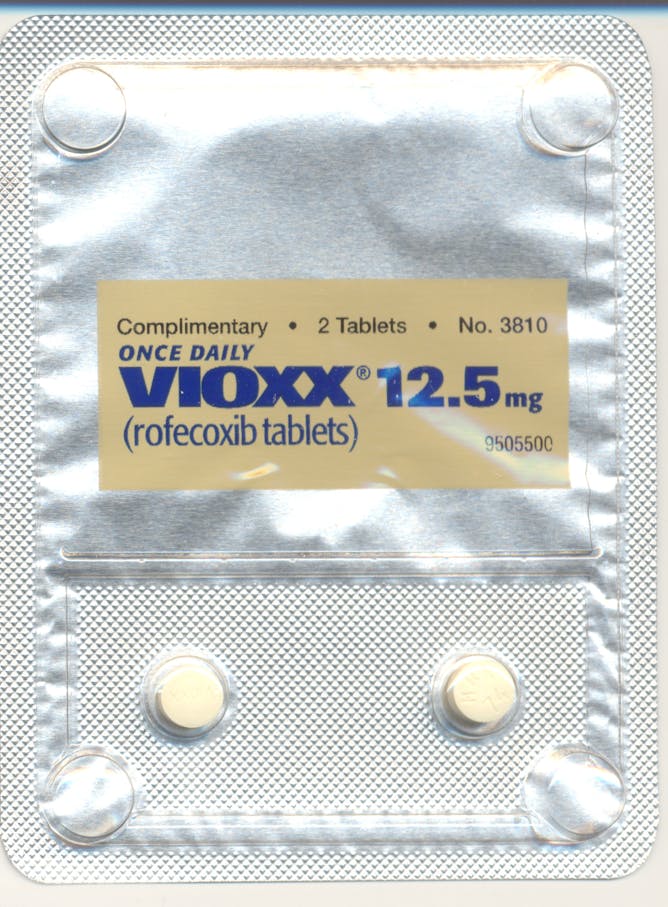 Vioxx was a selective inhibitor and take off the market for its adverse effects on the heart.
Wikimedia Commons
Vioxx was a selective inhibitor and take off the market for its adverse effects on the heart.
Wikimedia Commons
Research published in the British Medical Journal in September 2016 studied 92,163 people admitted to hospital with heart failure, and found NSAID use in the two weeks prior to admission was associated with a 19% increased risk of hospital admission for heart failure. This was compared with people who had not used NSAIDs prior to admission.
The association of NSAIDs with an exacerbation of heart failure was also seen in many older studies. For example, an Australian study in 2000, suggested almost 20% of all heart failure related admissions to hospital may be attributed to recent NSAID use.
Risk of cardiac arrest
Further heart safety concerns with NSAIDs were raised in a recent study from the University of Copenhagen, published in the European Heart Journal.
Data was collected from nearly 30,000 patients who had suffered cardiac arrest between 2001 and 2010. Of these, around 3,500 were found to have been treated with an NSAID within 30 days of having a cardiac arrest.
Use of any NSAID was associated with a 31% increased risk of cardiac arrest. The commonly used non-selective NSAIDs, diclonenac (Voltaren) and ibuprofen were associated with a 50% and 31% increased risk respectively.
A large proportion of cardiac arrest is a result of clot formation in the arteries of the heart and underlying plaque formation which can rupture. NSAIDs may increase the risk of cardiac arrest by raising blood pressure, forming blood clots and blocking the heart’s own blood vessels.
It is important to emphasise that in people with no known heart disease and who don’t have any heart risk factors, short term use of these anti-inflammatories carries a minimal increase in heart-related risk.
These recent studies should not create community panic about the safety of NSAIDs when used for short periods of time and at low dosage.
But the high burden of heart disease and heart disease risk factors, such as high blood pressure, obesity and diabetes (which are often unrecognised), warrant a personalised approach to NSAIDs, which weighs the benefits and risks of their use.
This was recommended in the Therapeutic Goods Administration review of the heart related effects of NSAIDs in 2014. These anti-inflammatories should be available for purchase through prescription by a medical practitioner or behind the counter at the pharmacy.
Authors: Michael Stokes, Cardiologist and PhD Candidate, University of Adelaide


 Daily Bulletin


