

Sidelining planners makes for poorer urban policy, and future generations will pay the price
- Written by: Jenny McArthur, Postdoctoral Research Associate, City Leadership Laboratory: Department of Science, Technology, Engineering and Public Policy, UCL
Modern urban planning first came about to improve industrial cities that had become unsafe, unhealthy and essentially unliveable. However, new policies in Australia and New Zealand view planning as a cause of urban problems, not a solution. Both treat urban planning as a hindrance, which supposedly slows down economic growth and is the main reason for unaffordable housing.
But what might this approach mean for future development of Antipodean cities? While urban planning may have fallen short of its goals over recent decades, policy that marginalises urban planning exposes us to long-term social and environmental risks.
Cities in Australia and New Zealand do face particular challenges: both countries are highly urbanised, 89% and 86% respectively. A closer look at land use patterns and infrastructures show they are mostly suburban – closer to Houston than Hong Kong. Therefore, urban policy faces the challenge of governing suburbia.
Why did urban planning fall out of favour?
Several underlying factors explain this aversion to planning.
First, many urban areas developed under the current planning system haven’t produced a very liveable environment. It is difficult to make a case for the value of planning with few good examples. In some cases this isn’t bad planning; rather, traffic engineering has taken precedence.
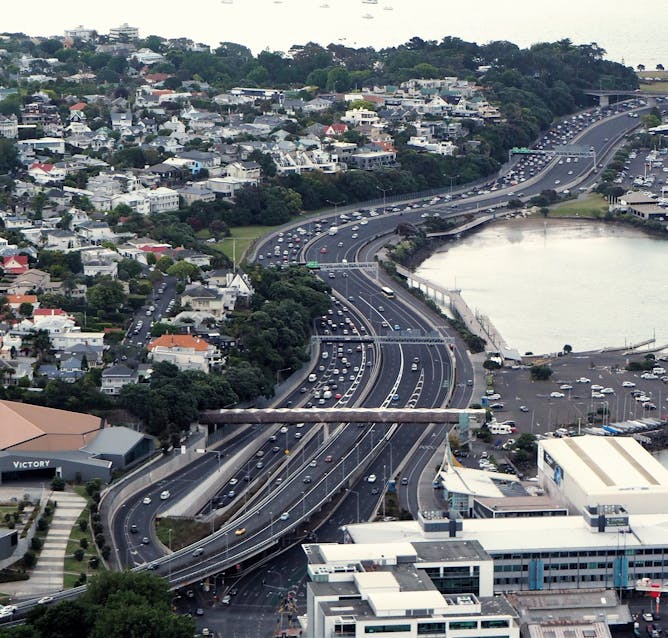 Giving priority to traffic engineering has compromised planning principles in Auckland and many other cities.
Henry Burrows/flickr, CC BY-SA
Giving priority to traffic engineering has compromised planning principles in Auckland and many other cities.
Henry Burrows/flickr, CC BY-SA
Many areas of Auckland, for instance, are designed in such a way that residents have little choice but to drive everywhere. They are unsafe for children or seniors to navigate. And vast amounts of space are allocated to parking for private vehicles.
This is the cumulative result of decades of infrastructure decision-making that prioritises private vehicle movement over safer and more efficient public transport. Residents are living with the consequences of this, and current policy risks more of the same for future residents.
New shared spaces, cycle lanes and frequent transit services are a dramatic improvement. However, greater change is needed to make an impact on everyday life for those who live and work outside the city centre.
Second, delays in planning approvals are notorious for adding significant cost and uncertainty to property development. But inefficient delivery of planning services should not be confused with overly stringent planning rules.
Planning rules are intended to mitigate environmental damage and improve the quality of development. Rather than getting rid of planning, delays can be reduced through better resourcing, training and management of planning departments.
Also, approvals are only one step in delivering new housing. Fast-tracked consenting in Auckland’s special housing areas resulted in 30,000 consented dwellings, but only 1,300 new homes were built over almost three years.
This shows that other factors slow down the pace of development. These include capacity in the construction sector, local construction labour and delays due to land banking.
Putting affordability claims to the test
Poor urban planning is claimed to be the primary cause of unaffordable housing. It is said to be linked to higher house prices and lower economic performance.
Evidence to support these claims shows a correlation – but not a causal link – between the restrictiveness of planning regulations and housing affordability.
The simple correlation ignores other factors driving house prices: speculative investment behaviour, incentives for land banking, record-low mortgage rates and strong cultural biases toward home ownership.
Looking to land supply as the primary policy lever to fix this may do little to moderate house prices. It also overlooks more important causes.
Urban expansion also has implications for transport: it is expensive and inefficient to leave transport authorities playing catch-up to serve new growth areas.
The politics of growth further complicate expansion of land supply and tend to distribute new growth haphazardly. Most residents agree that cities need to allow for future growth, but deciding where this should go is contentious. Recent growth in New Zealand and Australian cities has been accommodated mostly in the city centre and at the urban fringe.
 Development on the urban fringe follows the line of least resistance politically but isn’t best planning practice for accommodating growth.
David Crosling/AAP
Development on the urban fringe follows the line of least resistance politically but isn’t best planning practice for accommodating growth.
David Crosling/AAP
Only a small share of growth is in existing suburbs. Suburban residents (or at least a vocal contingent) often oppose new growth. This is unsurprising since intensification counters the very reason for living in the suburbs – more space and fewer people.
Regardless, urban policy needs to acknowledge the political tensions in accommodating growth.
Good planning involves citizens
National urban policy is important to manage land use and infrastructure differently in cities. Policies don’t have to be prescriptive. They can also enable local authorities to govern better with greater devolution of power and fundraising capabilities.
Scaling back urban planning is an understandable but disappointingly short-term response. In many cases planning hasn’t delivered what it promised. Measures to reduce delays and improve the quality of the built environment are needed. However, policy that simply reduces the role of planning may result in significant long-term costs.
Such an approach risks environmental damage, as well as uncoordinated land and transport development. The next generation living in our cities will pay for it.
Informed citizens are essential to support good planning and infrastructure decisions. For the general public, however, local regulations on urban planning, infrastructure and environmental quality are painfully dull. But they are also fundamental in shaping your everyday life: where you can afford to live, your daily commute, and the chance of air pollution shortening your lifespan.
For those without time to go through lengthy consultation documents and plans, local advocacy groups are leading the way to translate these concisely to the public. Auckland’s Generation Zero is a good example. This organisation is advocating for inter-generational equity and environmental sustainability in local planning and transport, with targeted campaigns on important projects and planning decisions.
Negotiating the trade-offs and politics of urban growth is always a challenge for policy, but quality public engagement is crucial to build cities that are liveable, affordable and environmentally sustainable over the long term.
Authors: Jenny McArthur, Postdoctoral Research Associate, City Leadership Laboratory: Department of Science, Technology, Engineering and Public Policy, UCL


 Daily Bulletin


