

Hazelwood power station: from modernist icon to greenhouse pariah
- Written by: Erik Eklund, Professor of History, Federation University Australia
The roar of the furnaces, the rattle of the conveyors, and the occasional whoop of a siren marked out both day and night at Hazelwood. The pungent smell of brown coal permeates the air, and the fine particles would work their way into your clothes, hair and shoes.
On quiet evenings you could hear it all the way over in the nearby town of Churchill, seven kilometres away. That distant hum has been a comforting one as the station produced power in all weathers, day and night, for more than five decades. For many in Churchill and the other coal towns of Victoria’s Latrobe Valley, the noise also represented continuity of employment for more than 450 workers.
Those old certainties are now disappeared. The eight units that make up the 1,600 megawatt power station were progressively decommissioned this week, all now shut off ahead of Hazelwood’s official closure on March 31. While some 250 workers will remain, the distant hum has settled to a whisper.
 Noisy no longer: the turbine hall.
Erik Eklund, Author provided
Noisy no longer: the turbine hall.
Erik Eklund, Author provided
When the brand new Hazelwood power station was officially opened on March 12, 1971, it represented a new and confident future for the Latrobe Valley region and the state of Victoria. Plans for this major infrastructure project were first made in 1956 and the first contracts signed in 1959. Victorian Premier Sir Henry Bolte spoke of the Latrobe Valley as the “Ruhr of Australia”.
The first six generating units were constructed between 1964 and 1967, and the plant was eventually expanded to include another two. All eight were operational by the time of the official opening in 1971. The station was fed by the Morwell open cut brown coal mine, and was built right next door to the mine’s open-cast pit. The Morwell mine eventually grew to such mammoth proportions that the nearby Morwell River had to be diverted three times. Each day, the mine fed more than 55,000 tonnes of brown coal into Hazelwood’s eight furnaces.
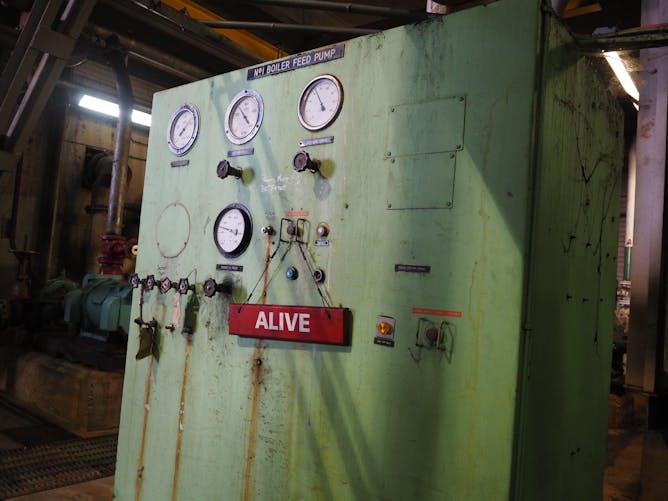 Alive no longer.
Erik Eklund, Author provided
Alive no longer.
Erik Eklund, Author provided
The Hazelwood station was planned, built and operated by the State Electricity Commission of Victoria (SECV). This government-owned body was formed in 1921 and had overseen the development of the power generation network in the Latrobe Valley. The first power station at Yallourn (now decommissioned) began providing Victoria with power in 1924, and was followed by further expansion at Yallourn with newer units that still operate today. The Morwell power station and briquette factory were completed in 1959 (and shut down in 2014), and the nearby Hazelwood completed the picture by 1971.
These power stations, along with the Morwell and Yallourn coal mines, defined the industrial heart of the Latrobe Valley as part of a postwar push to create entire communities in the region, centred on the coal industry. The SECV and then the state government had a meticulously planned vision, deciding on the location of new developments and entire new towns. By 1981 electricity generation and mining employed more than 10,000 workers in an overwhelmingly male-dominated workforce.
It had not all been plain sailing. Completion of the Morwell power station was delayed by financial constraints and then technical problems. Coal from the Morwell mine proved to be unsuitable for briquette manufacture and so the SECV reverted to using Yallourn coal in the briquette furnaces. The SECV also met with considerable local criticism over its decision to close the planned township of Yallourn so as to dig out the coal underneath it. Polluted though it was, many Yallourn residents had no desire to leave their tree-lined community.
The new town of Churchill, built to house the industrial workforce and their families, would accompany the Hazelwood development. Churchill was a model town located to avoid the prevailing winds from existing power stations, perched on a hill with views across the Latrobe valley, the distant Baw Baw ranges, and newly created lakes of Hazelwood Pondage. Churchill joined other new public housing developments in nearby Moe and Morwell to house the expanding workforce.
Yet life in the coal heartland came with its own problems. Issues with air quality began to become evident as early as the 1970s, while the privatisation of Hazelwood and the other power stations from 1996 led to 8,000 job losses. A 2004 WWF report named Hazelwood as the dirtiest power station in Australia, producing the most greenhouse emissions per megawatt of energy.
Hazelwood became a powerful political symbol and rallying cry for those concerned about the impact of carbon dioxide emissions on global warming. It has been credited with producing 5% of the nation’s power and 3% of its carbon dioxide emissions.
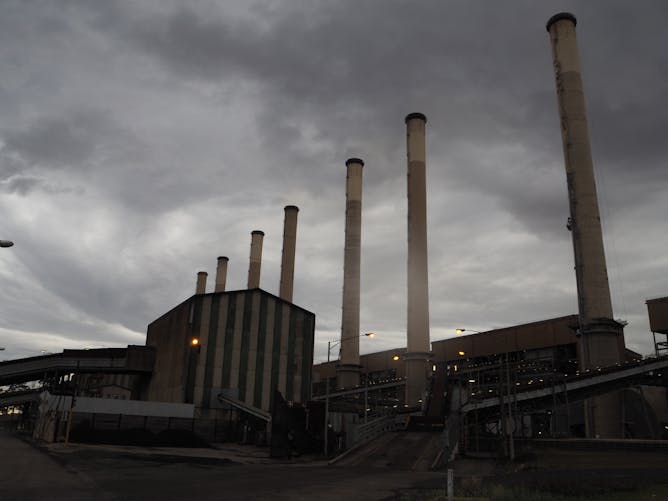 The symbolic face of brown coal power.
Erik Eklund, Author provided
The symbolic face of brown coal power.
Erik Eklund, Author provided
The media image of Hazelwood today, its eight stacks standing as a visual image of greenhouse emissions and industrial pollution, was forged in the decade since the WWF report. Worse was to come when it became the site of a coalmine fire that blazed for 45 days in February-March 2014, showering Morwell with smoke and ash and creating a major public health disaster.
The confident, modernist image of 1970s Hazelwood went up in smoke, but this image has not been forgotten by many in the Latrobe Valley who lived through it.
Federation University, through the Centre for Gippsland Studies, is planning to take part in a project to record the memories and experiences of Hazelwood workers. The author thanks Engie, who approved a site visit to research this article, and Mark Richards, a Hazelwood worker and CFMEU delegate who acted as a tour guide.
Authors: Erik Eklund, Professor of History, Federation University Australia
Read more http://theconversation.com/hazelwood-power-station-from-modernist-icon-to-greenhouse-pariah-75217


 Daily Bulletin


