

ASKAP telescope speeds up the hunt for new Fast Radio Bursts
- Written by: Keith Bannister, Astronomer, CSIRO
They’re mysterious bursts of radio waves from space that are over in a fraction of a second. Fast Radio Bursts (FRBs) are thought to occur many thousands of times a day, but since their first detection by the Parkes radio telescope a decade ago only 30 have been observed.
But once the Australian Square Kilometre Array Pathfinder (ASKAP) joined the hunt we had our first new FRB after just three and half days of observing. This was soon followed by a further two FRBs. And the telescope is not even fully operational yet.
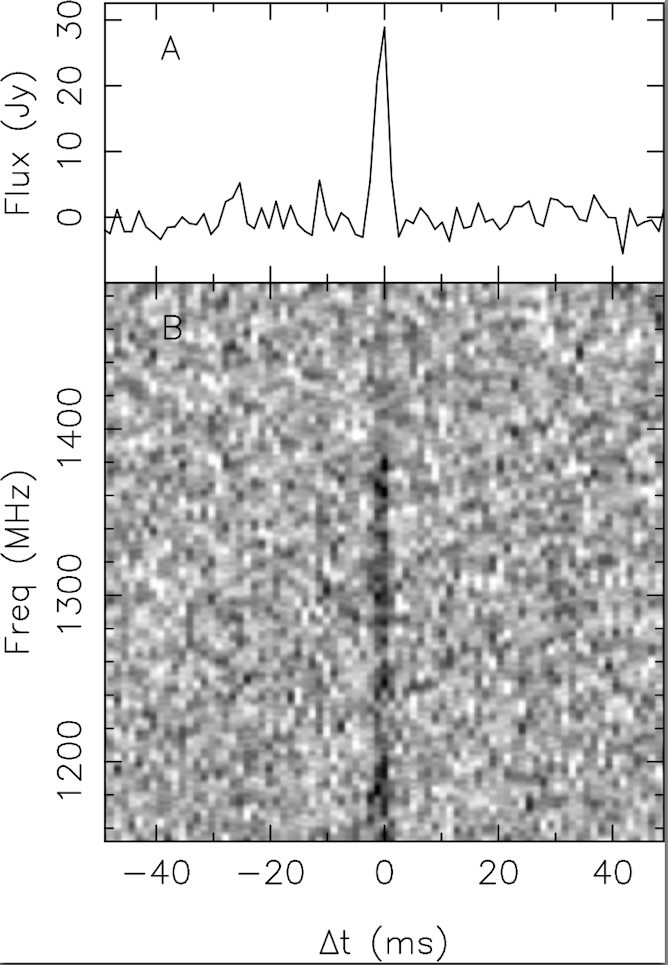 The first FRB that ASKAP found. Bottom panel shows a grey scale image of what the FRB looks like. It’s less than 1 millisecond long and we detect it over a range of frequencies from 1,100 MHz to 1,400 MHz. The top panel shows what the FRB looks like when you add up all the frequency channels.
Ryan Shannon (CSIRO/Curtin University), Author provided
The first FRB that ASKAP found. Bottom panel shows a grey scale image of what the FRB looks like. It’s less than 1 millisecond long and we detect it over a range of frequencies from 1,100 MHz to 1,400 MHz. The top panel shows what the FRB looks like when you add up all the frequency channels.
Ryan Shannon (CSIRO/Curtin University), Author provided
The fact that ASKAP detects FRBs so readily means it is now poised to tackle the big questions.
One of these is what causes an FRB in the first place. They are variously attributed by hard-nosed and self-respecting physicists to everything from microwave ovens, to the accidental transmissions of extraterrestrials making their first baby steps in interstellar exploration.
The astounding properties of these FRBs have so enthralled astronomers that, in the decade since their discovery, there are more theories than observed bursts.
A distant flash
FRBs are remarkable because they are outrageously bright in the radio spectrum yet appear extremely distant. As far as astronomers can tell, they come from a long way away - halfway across the observable universe or more. Because of that, whatever makes FRBs must be pretty special, unlike anything astronomers have ever seen.
What has astronomers really excited is the fossil record imprinted on each burst by the matter it encounters during its multibillion-year crossing of the universe.
Matter in space exerts a tiny amount drag on the radio waves as they hurtle across the universe, like the air drags on a fast-moving plane. But here’s the handy bit: the longer the radio waves, the more the drag.
By the time the radio waves arrive at our telescopes, the shorter waves arrive just before the longer ones. By measuring the time delay between the short waves and the longer ones, astronomers can work out how much matter a given burst has travelled through on its journey from whatever made it, to our telescope.
If we can find enough bursts, we can work out how much ordinary matter - the stuff you and I and all visible matter is made of - exists in the universe, and tally up its mass.
The best guess so far is that we are missing roughly half of all the normal matter, with the rest lying in the vast voids between the galaxies — the very regions so readily probed by FRBs.
Are FRBs the weigh stations of the cosmos?
Difficult to find and harder to pinpoint
There are a few reasons why we still have so many questions about FRBs. First, they are tricky to find. It takes the Parkes telescope around two weeks of constant watching to find a burst.
Worse, even when you’ve found one, many radio telescopes like Parkes can only pinpoint its location in the sky to a region about the size of the full Moon. If you want to work out which galaxy an FRB came from, you have hundreds to choose from within that area.
The ideal FRB detector needs both a large field of view and the ability to pinpoint events to a region one thousandth the area of the Moon. Until recently, no such radio telescope existed.
A jewel in the desert
Now it does in ASKAP, a radio telescope being built by the CSIRO in Murchison Shire, 370km northeast of Geraldton in Western Australia. It’s actually a network of 36 antennas, each 12 metres in diameter.
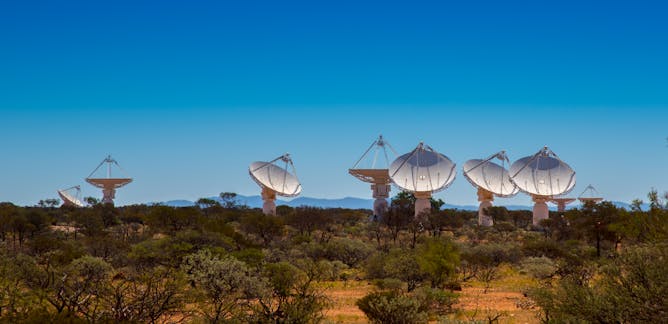 ASKAP antennas during fly’s-eye observing. All the antennas point in different directions.
Kim Steele (Curtin University), Author provided
ASKAP antennas during fly’s-eye observing. All the antennas point in different directions.
Kim Steele (Curtin University), Author provided
ASKAP is a very special machine, because each antenna is equipped with an innovative CSIRO-designed receiver called a phased-array feed. While most radio telescopes see just one patch of sky at time, ASKAP’s phased-array feeds see 36 different patches of sky simultaneously. This is great for finding FRBs because the more sky you can see, the better chance you have of finding them.
To find lots of FRBs we need to cast an even wider net. Normally, ASKAP dishes all point in the same direction. This is great if you’re making images or want to find faint FRBs.
Thanks to recent evidence from Parkes, we realised there might be some super-bright FRBs too.
So we took a hint from nature. In the same way that the segments of a fly’s eye allow it to see all around it, we pointed all our antennas in lots of different directions. This fly’s-eye observing mode enabled us to see a total patch of sky about the size of 1,000 full Moons.
That’s how we discovered this new FRB within days of starting, and using just eight of ASKAP’s total of 36 antennas.
 Radio image of the sky where ASKAP found its first FRB. The blue circles are the 36 patches of the sky that ASKAP antenna number 5 (named Gagurla in the local Wadjarri language) was watching at the time the FRB was detected. The red smudge marks where the FRB came from. The black dots are galaxies, far, far, away. The full Moon is shown to scale, in the bottom corner.
Ian Heywood (CSIRO), Author provided
Radio image of the sky where ASKAP found its first FRB. The blue circles are the 36 patches of the sky that ASKAP antenna number 5 (named Gagurla in the local Wadjarri language) was watching at the time the FRB was detected. The red smudge marks where the FRB came from. The black dots are galaxies, far, far, away. The full Moon is shown to scale, in the bottom corner.
Ian Heywood (CSIRO), Author provided
When fully operational
So far, in fly’s-eye mode we have made no attempt to combine the signals from all the antennas. ASKAP’s real party piece will be to point all the telescopes in the same direction and combine the signals from all the antennas.
This will give us a precise position for every single burst, enabling us to identify the host galaxy of each FRB and measure its exact distance.
Armed with this information, we will be able to activate our network of cosmic weigh stations. At this point we will be able to investigate a fundamental question that has been plaguing astronomers for more than 20 years: where is the missing matter in the universe?
Authors: Keith Bannister, Astronomer, CSIRO
Read more http://theconversation.com/askap-telescope-speeds-up-the-hunt-for-new-fast-radio-bursts-77481


 Daily Bulletin


