

A new discovery of gravitational waves has black holes in a spin
- Written by: Matthew Bailes, ARC Laureate Fellow, Swinburne University of Technology., Swinburne University of Technology
Within just a couple of months of turning back on for its second major science run, the Laser Interferometer Gravitational-wave Observatory (LIGO) made a third detection of gravitational waves, ripples in space and time, demonstrating that a new window in astronomy has been firmly opened.
As was the case with the first two detections, the waves were generated when two massive black holes merged to form a larger one.
In the latest merger, detailed today in the journal Physical Review Letters, the resulting black hole was about 50 times the mass of our Sun.
The detection is called GW170104 - so named because it was made on January 4 this year. The merging black holes are probably the most distant yet seen, about three billion light-years from Earth.
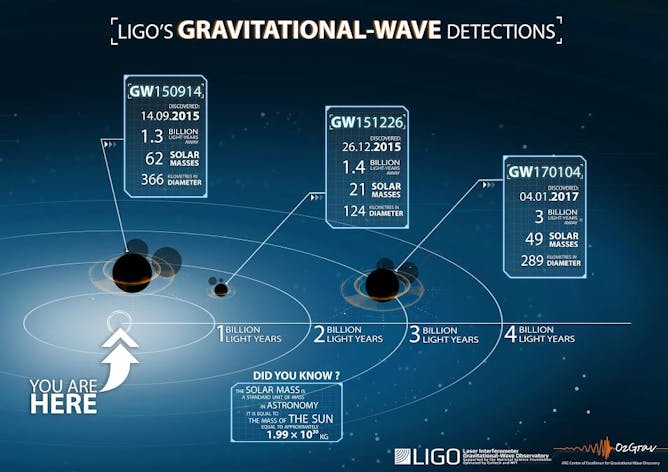 OzGrav infographic showing the approximate masses and distances to the first three gravitational wave sources discovered by LIGO.
ARC Centre of Excellence for Gravitational Wave Discovery (OzGrav)
OzGrav infographic showing the approximate masses and distances to the first three gravitational wave sources discovered by LIGO.
ARC Centre of Excellence for Gravitational Wave Discovery (OzGrav)
The three known LIGO events are remarkable for the amount of energy liberated in the final few seconds before the merger. In that time their energy loss rate (luminosity) is greater than all the stars in the observable universe put together.
When you think that there are more than 100 billion stars in our galaxy, and a similar number of galaxies in the universe, you realise the stupendous amount of energy that is released during these mergers.
Despite the energetics of these events, the ripples cause the LIGO mirrors to be displaced by a rather paltry 0.000000000000000001 of a metre. That’s about one-thousandth the size of the nucleus of an atom!
Remarkably, LIGO is capable of measuring such tiny displacements. This technology has been developed over decades.
An OzGrav animation depicting the binary black hole merger event GW170104, detected by LIGO. The animation simulates the final moments of the merger and is placed near the Earth as an indication of scale.All in the spin
The gravitational waves are detected by fitting one of a large number of theoretical “templates” to the data. These templates model how the detectors will react to the passing waves from different mass black holes.
There are two leading models for how these massive black holes are brought together.
In the simplest model, they are born as a stellar pair. Like planets, black holes spin about their axis. Black holes born in a stellar pair are thought to spin in the same direction.
In the other model, massive black holes court each other in huge swarms of stars known as globular clusters. They exchange partners until they dance too close and spiral together in a burst of gravitational waves.
In this model, the two black holes are unlikely to spin in the same direction.
There is some evidence that this latest black hole collision comes from the second class.
Prof Bangalore Sathyaprakash, of Penn State University, is one of authors of the journal paper. He says:
This is the first time that we have evidence that the black holes may not be aligned, giving us just a tiny hint that pairs of black holes may form in dense stellar clusters.
LIGO will continue to be upgraded over the coming years, and the rate of detections is expected to increase as LIGO is further refined with new technologies. With more detections LIGO will be able to further test the stellar cluster hypothesis.
Australia’s gravitational wave experts
Members of the Australian Research Council Centre of Excellence for Gravitational Wave Discovery (OzGrav) anxiously await these new data. We asked some of OzGrav’s postdocs, students and chief investigators what they were most excited about in this nascent field of astrophysics.
Susan Scott, Professor of Physics at Australian National University and a chief investigator at OzGrav
Letizia Sammut, Postdoctoral Researcher at Monash University One of the most exciting possibilities of gravitational wave astronomy is the detection of gravitational waves from the very early universe almost immediately after the Big Bang! Observation of such a signal would have far-reaching applications across many fields of physics and over a wide range of (energy and length) scales. Lilli Sun, PhD candidate at the University of Melbourne Neutron stars tell their stories continuously by emitting gravitational waves. Once we hear them humming, we will learn how physics works under extreme conditions which can never be reproduced on Earth, like how matter behaves in the densest stars, how a fluid composed almost entirely of neutrons moves, how incredibly strong magnetic fields twist and tangle and annihilate, and so on. We cannot “see” these things with our own eyes, but now we may have the chance to “hear” them! David Ottaway, Associate Professor at the University of Adelaide The most exciting thing about the future of gravitational waves is using detectors limited only by quantum mechanics to measure the composition of neutron stars, which are an exotic form of matter that cannot be studied any other way. Bram Slagmolen, ARC Future Fellow at the Australian National University The future of gravitational waves using next-generation detectors will be super exciting. We will not only be able to observe deeper into the universe, at the same time, we will also be able to study fundamental physics in extreme environments more precisely. Qi Chu, Phd student at the University of Western Australia I am part of a team led by Professor Linqing Wen at UWA that is racing to create faster ways to crunch the LIGO data to minimise the time between the gravitational waves hitting earth and an alert being sent for follow-up observations with other telescopes. That will help us localise the event to a host galaxy to learn even more about these extreme events in the universe.In the coming years I am eagerly anticipating the detection of continuous gravitational waves radiated by rotating neutron stars with small deformities or minute “mountains”.
With a combination of relativistic velocities, huge magnetic fields and densities beyond that of an atomic nucleus, neutron stars are expected to emit gravitational waves of sufficient amplitude to be detectable by Advanced LIGO. Their detection is a very exciting prospect as it would reveal much about the physics of matter at extreme densities.
Authors: Matthew Bailes, ARC Laureate Fellow, Swinburne University of Technology., Swinburne University of Technology
Read more http://theconversation.com/a-new-discovery-of-gravitational-waves-has-black-holes-in-a-spin-78262


 Daily Bulletin


