

I have always wondered: when do baby birds begin to breathe?
- Written by: Maggie J. Watson, Postdoctoral Researcher in Ecology, Conservation and Parasitology, Charles Sturt University
This is an article from I Have Always Wondered, a new series where readers send in questions they’d like an expert to answer. Send your question to alwayswondered@theconversation.edu.au
This question dates back to when I was a kid and no one has ever been able to answer it in a convincing way. I have always wondered: when do birds (and other egg-born creatures) take their first breath? And how do they take in oxygen before their lungs are working? Obviously since eggs squeak before they hatch, lungs are functional prior to the hatching… but when is that magical inflation-of-the-lungs moment? And how does it happen? – Gabrielle Deakin, Barcelona.
As placental mammals, our first breath of air comes after birth. But egg-born creatures like birds and reptiles don’t have an umbilical cord to feed them oxygen, so how do they breathe? And how can a chick inflate its lungs inside the egg?
First, let’s talk about the eggs themselves.
Eggs laid by birds have shells that are bumpy (at least under the microscope), made almost entirely of calcium carbonate, and have as many as 17,000 tiny pores. Because of these pores, oxygen can travel from the outside world to the embryo inside and carbon dioxide and water move out of the egg in the same way.
Lying between the eggshell and the albumen, or egg white, are two transparent membranes that prevent bacterial invasion, and also develop into a network of blood vessels. These membranes are the chorion and the allantois.
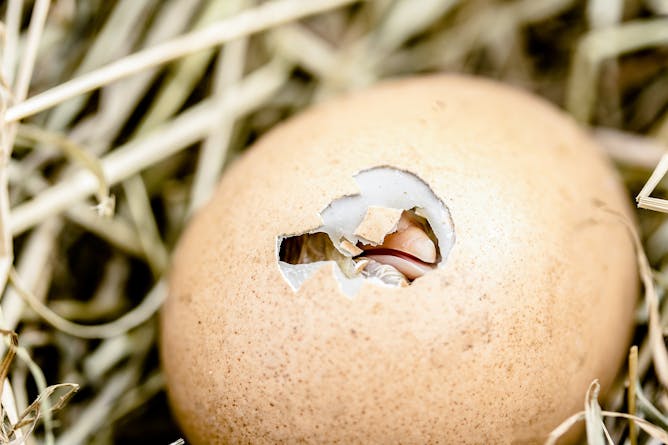 Membranes inside the egg move oxygen inside for the embryo, and pass carbon dioxide out.
Pixabay, CC BY
Membranes inside the egg move oxygen inside for the embryo, and pass carbon dioxide out.
Pixabay, CC BY
Reptile eggs can either be hard and almost identical to bird’s eggs, as thin shelled as parchment, or soft and leathery. Most reptile eggs are porous to air and water, and tend to absorb more water from the outside world than bird eggs. Finally, the membranes of reptiles’ eggs are very similar to birds’, but don’t always entirely surround the embryo.
Regardless of these differences, the chorion and allantois have a network of blood vessels which act as a respiratory organ and is the first stage of “breathing” for bird or reptile embryos.
Birds actually go through three stages of breathing in the egg. Reptiles have a similar path, but they skip straight from step one to three.
Stage 1: embryonic
Before chicks or reptiles develop lungs, they still need to get oxygen and get rid of carbon dioxide. In placental mammals like humans (and some marsupials), all of this is accomplished by the mother through the umbilical cord and the placenta.
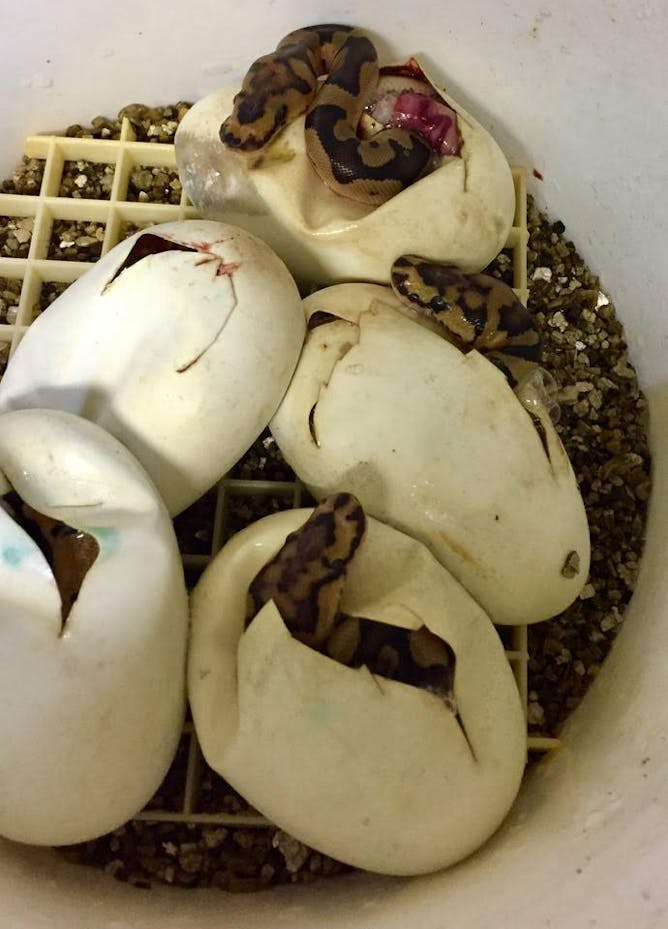 Some reptiles have leathery shells.
Brad Chambers, Author provided
Some reptiles have leathery shells.
Brad Chambers, Author provided
In birds, this gas exchange is done by diffusion (the movement of air from the outside to the inside of the egg) through the eggshell and a complex fusion of the chorion and the allantois called the chorioallantoic membrane. Reptiles also have a chorioallantoic area which functions as a respiratory organ.
In birds, the chorioallantoic membrane develops about three days after incubation begins and takes about two weeks to develop fully. It is highly vascularised (has lots of blood vessels), which allows for the free exchange of oxygen and carbon dioxide.
This membrane also plays a central role in the development of the embryo’s bones, because it transports calcium from the eggshell to the developing chick or embryonic reptile (excluding some reptiles which get some of their calcium from the egg yolk).
Stage 2: pre-hatching
 A bird hatching from the egg.
Maggie J Watson, Author provided
A bird hatching from the egg.
Maggie J Watson, Author provided
The embryo doesn’t actually breathe via lungs for almost all of its time in the egg. When the embryo is getting close to hatching, a few differences between reptiles and birds emerge. In birds, a few days before hatching, the chick, which is now curled up tightly with its head stuck under one wing and its beak pointed towards the top of the egg, penetrates an air pocket or air cell at the top of the egg.
This air pocket began to form when the egg was laid. A freshly laid egg is the temperature of its mother’s body, but it soon begins to cool. As it cools, the inner shell membranes begin to shrink and separate from the outer shell membrane to form a pocket, which slowly fills with air and gets larger as the egg is incubated.
As soon as the chick breaks into this air pocket, it takes its first breath and the lungs begin to function. The air cell continues to be refilled with air through diffusion. Diffusion through the chorio-allantoic membrane is also still used, but is slowly replaced by lung activity as hatching nears. At the very end of this period, if you put your ear to the egg, you might hear some peeping sounds.
A chick peeps in the egg. Also visible is a distinctive ‘pipping’ pattern, as the chick hammers the inside of the egg.In birds, this sound is made through a structure called a syrinx as birds don’t have vocal chords. But most reptile species don’t have an egg air pocket, so they go straight to stage three.
Stage 3: post-hatching
Many egg-born creatures develop a small, sharp protuberance called an “egg tooth” (technically called a caruncle) on their beak or snout. It can be made of hard skin (like in crocodiles and birds) or be an actual extra tooth (like in some lizards and snakes), but regardless, it’s used to break through the egg and falls off or is reabsorbed soon after hatching.
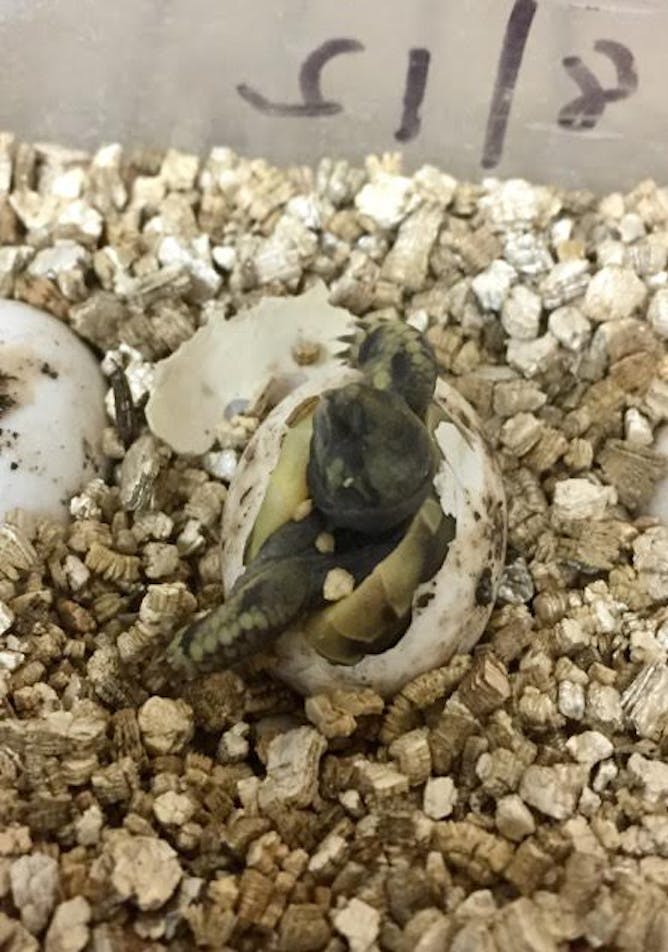 A baby turtle cracks through its egg.
Brad Chambers, Author provided
A baby turtle cracks through its egg.
Brad Chambers, Author provided
The chick, guided by its wing placement, uses its egg tooth to hammer the inside of the egg. First the egg “stars” (when the beak begins to crack the shell), and then it “pips” (when the beak breaks through the shell). The chick uses its feet to move around in a circle and pierce the egg. The chorioallantoic membrane begins to lose function as it dries out, and the chick then relies solely on its lungs. The chick continues to peep, which tells the parent that hatching is imminent and ensures its clutch mates hatch synchronously.
Reptiles slice through their weakened eggshells (weak now because they’ve extracted most of the calcium) with an egg-tooth on their snouts and start to breath. Some reptiles (crocodiles) also produce sounds, but unlike birds they use a larynx and vocal cords, very similar to humans.
When you get right down to it, birds and reptiles do pretty much the same thing in the egg. It’s not that surprising, as birds and some reptiles are quite closely related. They’ve all evolved specific eggs to both protect growing embryos and provide them with what they need – including air.
* Email your question to alwayswondered@theconversation.edu.au * Tell us on Twitter by tagging @ConversationEDU with the hashtag #alwayswondered, or * Tell us on Facebook
Authors: Maggie J. Watson, Postdoctoral Researcher in Ecology, Conservation and Parasitology, Charles Sturt University
Read more http://theconversation.com/i-have-always-wondered-when-do-baby-birds-begin-to-breathe-81754


 Daily Bulletin


